The virus that changed the way life was spent is still doing well for itself in Goa. Scores of people are being detected every day. At the time of going to press, the number was at 463 and expected to rise further. The poorer sections of society have had to face the rough end of the stick, many of them unable to pay the rent for the month were being pressured by the landlord to either pay or to get out. For many of them the lockdown meant an inability to work or to find work which meant no money. Stories of hungry migrants were now appearing in the local media and reports of migrants planning to walk thousands of km to reach home were also reported. The government seemed to be stuttering in their efforts and it all looked very grim. But like everything in this country and generally in life, the good and the bad are sometimes existing side by side or could even be two sides of the same coin. Community organisations and individuals rose up to be counted. They decided this was not the time to stand and watch the suffering of fellow humans.
Dhruv Goswami who is otherwise a business strategy consultant and helping companies find their way in a rather complex market place decided to stand up and be counted. He said “We are a group of citizen volunteers which includes architects, writers and professionals of various hues. All of us are friends. When the lockdown was imposed, we could manage with daily life with some restrictions but for migrants, their lives just collapsed. We learnt many of them were without jobs and food. We decided to reach out. Rations would have to be provided. Our families and friends started contributing money and some supplies. We decided we would have to source rice, dal, atta, masks, soaps and vegetables. We started packing it and started delivering them. We would drive around in our cars and identify clusters and distribute food. Over a period of time, people heard of us and started sending us SMS’s”. They started distributing packets in areas as diverse as Betim, Pilerne industrial estate, Santacruz and Dona Paulo.
The geographical spread began to increase as the days passed. They started receiving calls from different places which then forced them to hire tempos and small trucks. They had also commenced the process of data verification. This meant if a person received a packet on Monday, he or she would receive the next packet after three days. Over a period of time, they were providing food packets to over 5000 people. When they reached 3500 people, the government reached out and requested they share their data list. Since it was verified, it made the job of the government easier. However, according to Dhruv, the experience of the people with the government’s attempt to help them proved to be frustrating. Many would receive their food packets and then nothing would be forthcoming for the next ten days. He said they had to then go back and help the people with food packets in addition to the new places they had commenced their operations.
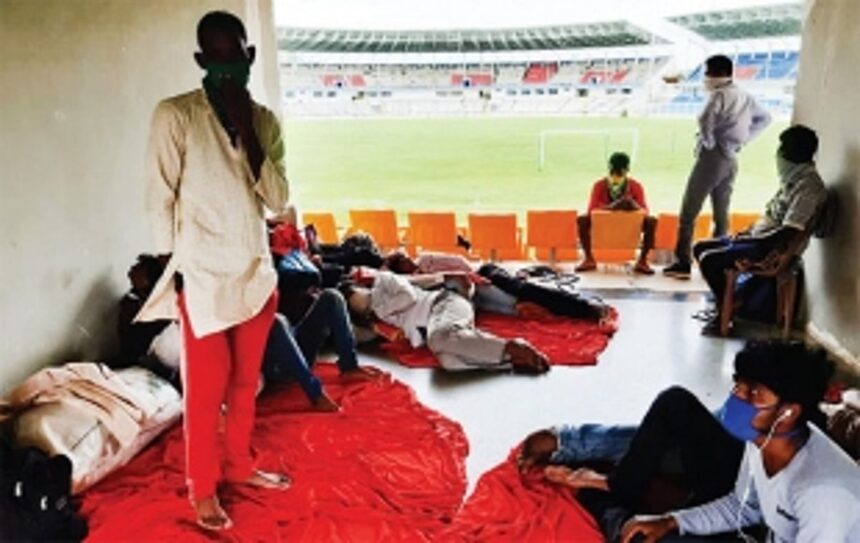
Apart from providing food packets they also brought on board counsellors because many of the migrants were feeling suicidal. Some had attempted to get on to trucks and move out. Others had attempted to walk home and were stopped by cops and sent back. These counsellors spoke to them and helped many of the migrants. They also created a directory with a name of all the migrants along with their skillsets which was then made available to companies online. This helped many migrants get jobs with these companies. The group also helped the government schedule the movement of migrants moving out in trains. He said “Many of them are illiterate are unable to fill forms. We gave our data to collectors and it has been of some help. Right now, we are providing food to people living in the Bambolim stadium and also to people who sent texts” The group has around 25 to 30 people who are part of the core team and when distribution was happening all over they had around 100 volunteers.
Another volunteer Aditya Naik has been helping migrants fill out their forms which will help them get registered. He said “Many of the panchayat offices are shut for the weekend and the new notification requesting them to register was announced on June 10. The advertisement in English appeared the next day. Many of them had registered earlier and had not received an SMS. It was and still is quite confusing for them. On average I do around 30 to 40 forms a day. I instruct the migrants to Whatsapp me their pan card details and I do the rest”.
Vijaya Pais, another pillar of the citizen’s movement said since the lockdown commenced people were in distress. She said, “We have a wide network of volunteers and we are providing food packets now in stadiums where the migrants are and in stations because we know there is a problem there”. They have also created a database to help migrants find jobs.
Ishita Godinho another volunteer had started helping out three months ago with ration distribution in North Goa in places like Panjim, Arpora and Porvorim. She said it was sad to see so many people in such hardship and they used to work long hours to help the migrants. She also assisted in the registry which was created with all the data of the migrants which could help them get a job.
Events planner and marketeer Nupura Hautamaki has been involved in helping provide food and other services to migrants from the very start of the lockdown. She was blunt when she said “Now migrants cannot register because the panch offices are shut and many of them when they are open have specific times for the registry of migrants. We are taking photographs, collating information and helping the government because the panch is not functional”.
She bemoaned the fact that several of the volunteers could not reach many places and many migrants could not be contacted because they had no money to recharge their phones. In the village she said, migrants had no idea that they would have to as per the new notification register again with the deadline being June 14th. They were planning to request the government to extend the date by at least a day.
People may have not died in Goa, but that should not be a source of any consolation but the fact that human beings had to experience this does not make us look very good. Perhaps its time to ponder as to what we as humans have become. And thank those ordinary humans like these volunteers who did extraordinary work.