If
the upward graph of English writing in Goa is anything to go by, then the term
‘explosion of writing’ is right in keeping with the current trend on the Goan
literary circuit. Early this April,
Valmiki Faleiro’s ‘Soaring Spirit’, Menino Peres ’Mass Communication in Goa’,
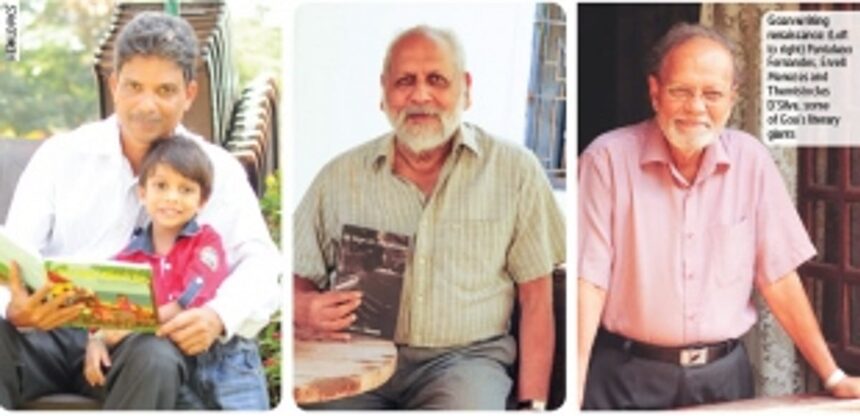
Themis D’Silva’s ‘Unravelling History’
and a tribute to Professor Lucio Rodrigues’ ‘Abolim’ were released, almost
simultaneously. Another interesting and
emerging trend is the focus on Goa-centric themes. “This is a healthy and
positive sign,” observes publisher Fredrick Noronha, who started his publishing
house Goa, 1556 in 1997. “There are so many authors being born each year.
People have stories to tell; they need the confidence to be able to tell them,
and the infrastructure to take their work to the reader. For decades, this has been lacking,” he adds
of the market that sees an average of eight to twelve authors every year and
around 100 books being published in English, Konkani Marathi. “In our
experience, local stories build their own interest and if we do not write about
them, then who will?” he queries.
The
growth, he points out is attributable to a surge in modern technology, grants
from various organisations, the support of major bookshops, growing interest to
understand Goa, book clubs, more connectivity and a shift to English which has
grown in the past five years, among other aspects. Several publishers like Broadway, Cinnanmon
Teal, Rajhauns and others including Goa, 1556 have been equally active on this
front, making publishing much easier and more economically viable.
From
another perspective, Sahitya Puraskar awardee, Damodar Mauzo, an author for
over five decades, explains that Goa has always contributed richly to the
literary scene. Censorship on creativity
during the Portuguese era saw a restraint on writing, but flourished after the
sixties. “The number of authors has increased exponentially now. It’s a good
thing that many people are writing, but to sustain the momentum, the writing
must be of merit,” he maintains.
On
the literary scene since the ‘70s, Valmiki Faleiro, who has authored two books,
also believes that writing today is a breeze.
“There has been an explosion in the number of Goa-centric books. In the
60s-70s Goa-centric books were very rare in comparison. The reason for the paradigm shift is
technology/computers and an increase in the number of publishing houses,” he
states.
To
sustain the momentum, the challenge, Fredrick maintains, is how to build and
maintain quality. “Writers need to build on their writing skills and more needs
to be done in the field of children’s literature and writing by/for women,” he
adds.
Although
online publishing is making a mark elsewhere, Goa is yet to catch on. “My dream
was to be an ebook publisher. Then I realised that it was easier to get printed
work noticed and it can often become viable too,” Fredrick surmises.
Whatever
the hiccups may be, the explosion has begun and as the seasoned authors aver,
it is up to the writers to sustain the momentum and place Goa on the world
literary scene.