Konkani joins the big league
The Jnanpith Award is India’s highest literary award. It is presented not by the government of India, but by the Bharatiya Jnanpith, a trust founded by the Sahu Jain family. Its name comes from the Sanskrit – ‘jnâna-pîtha’ means pulpit of knowledge – and the award includes an amount of Rs7 lakh, a citation plaque and a bronze replica of Vagdevi Saraswati, the Hindu goddess of knowledge, music, and the arts. Only Indian writers in the country’s official languages, as recognised by the Eighth Schedule of the Constitution of India, are eligible for the award.
Since it was instituted in 1961, it has been awarded 46 times. Seven awards each have been won by writers in Kannada and Hindi, followed by five writers in Bengali, four writers in Malayalam, three writers each in Gujarati, Oriya, Marathi and Urdu, two each in Telugu, Oriya, Tamil, Assamese and Punjabi, and one each in Kashmiri, Sanskrit and, now, Konkani. Till 1992, the awards were given for a single work by a writer. But since then, the award is given for the writer’s lifetime contribution to Indian literature.
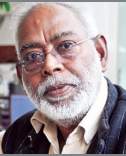
When he was presented the prestigious Jnanpith Award on Saturday at the Kala Academy by Lok Sabha Speaker Meira Kumar, octogenarian Konkani litterateur Ravindra Kelekar was not being honoured merely as an individual. For, the award is as much of an achievement for Konkani. Goa’s language now ranks with the best in the annals of Indian writing, and a Konkani writer has been recognised as having made an outstanding contribution to the enrichment of Indian literature.
It is a triumphant ascent to the very summit of literary endeavour for a language that, just 35 years ago, was not even recognised as one. It has been a long and hard climb. For it to recognise Konkani as an independent and literary language, the then Sahitya Akademi had to contend with a written threat from the then Goa government not to do so, and that if it did, rivers of blood could flow on the streets of Goa. Notwithstanding that, the Akademi recognised Konkani on 26 February 1975. Needless to say, no blood was spilled.
Since then, it has been a steady uphill struggle, overcoming one insurmountable obstacle after another. After a year-long agitation that paralysed the state, turned violent and cost six precious lives, on 4 February 1987, the Goa Legislative Assembly passed the Official Language Bill making Konkani Goa’s official language.
Konkani was finally included in the Eight Schedule of the Constitution, became one of the country’s official languages and found itself on Indian currency notes, following the 71st Constitutional Amendment on 31 August 1992. This also made writers in the language eligible to be awarded the Jnanpith, which Ravindrabab finally made possible when his award was announced on 22 November 2008. His award is for 2006, along with Satya Vrat Shastri, the first Sanskrit poet to win the Jnanpith since its inception.
At the function were Jnanpith Selection Board Chairman and Oriya writer Sitakant Mahapatra, who himself won the award in 1993 – the first to be award for lifetime contribution to literature – and Hindi writer Namwar Singh. So were Chief Minister Digambar Kamat and Speaker Pratapsingh Rane.
The greater importance that this award carries for his language than for himself has not escaped Ravindrabab. Replying to all the felicitations heaped on him at the function, the 85-year-old doyen among Konkani writers first expressed satisfaction that he represented Konkani. He added, tongue-in-cheek, that it was a language which some, including those who spoke the language, till recently did not even consider as one. That is the humility that marks one who – apart from being among its foremost exponents – has been a soldier at the forefront of every struggle waged for the cause of Konkani and Goa.
2 August 2010