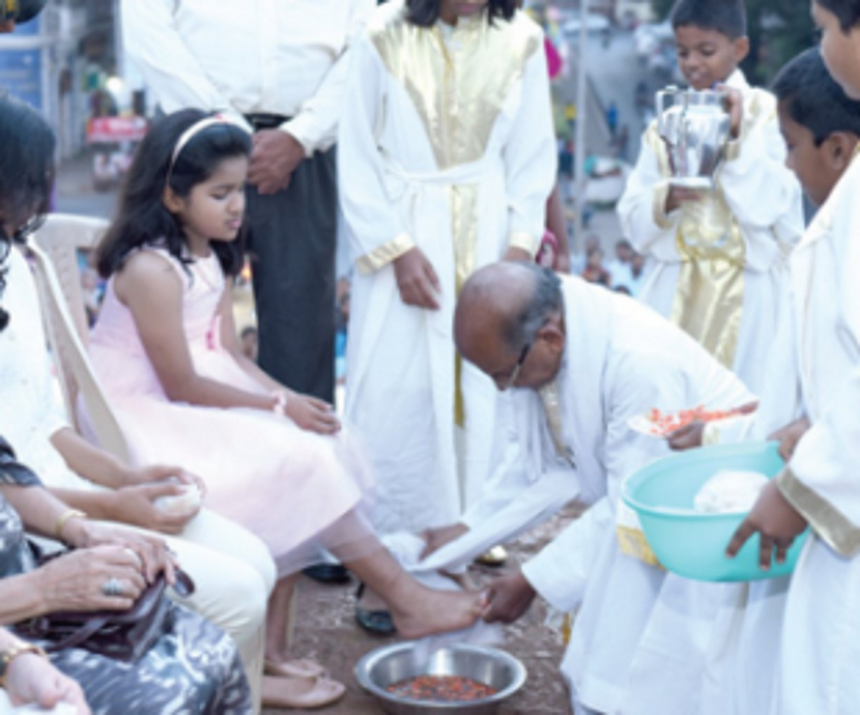
Catholics enter the Easter Triduum this Thursday with the celebration of the Last Supper. In normal times the faithful would have gone to Church on this Maundy Thursday, witnessed the enactment of the washing of the feet by the main celebrant who washes the feet of 12 selected members of the congregation.
This is done in commemoration of Christ washing the feet of his disciples, later in the night they would, until midnight, silently pray before the Blessed Sacrament in their parish churches. On Good Friday they would participate in the Way of the Cross and then attend the afternoon service that would included the re-enactment of the crucifixion and then the penintential procession of Christ’s body and his mother following behind, culminating with the sermon of soledade. On Saturday after visits to the Church, there would be the Easter Vigil, where the Easter candle would be lit, the water blessed and then the morning masses.

Most of these masses and services, with the exception of the processions, will still take place, but as churches are closed to the people, there will be no congregations participating. Across the world Catholic churches are holding masses and all Holy Week rites behind closed doors and in front of television cameras. Even in the Vatican, Pope Francis has been doing the same. These are being televised live and uploaded on social media sites for the faithful to join in prayer. Palm Sunday, the first day of the Holy Week was an example of how people have been particpating in the rites despite the lockdown.
This perhaps is the first time that something of such a nature is occuring in the Catholic Church. The laity has been following masses and blessings by the Pope on television for years, but joining in masses from their parishes on television, is definitely a first. While technology makes this possible, is sitting in front of a television and following the mass the manner in which Catholics can observe the Easter Triduum of the Holy Week? Dispensations on attending services in Church have been given, but there is a discussion on this that cuts through all arguments on both sides, leaving little hypothesis for both to continue the debate.
That question aside, one has to wonder at how a microscopic virus has been able to create such devastation in the world that it brings all activity – economic, political, social and religious – to a halt. The entire world is in agreement that in the current times it cannot be business as usual. It also horrifyingly proves just how fickle the world is and how all that is taken for granted in normal times can be brought to a sudden halt, with a future that is also currently uncertain. The reality of the world is what makes these three days that prepare Catholics to the Easter celebration of the Risen Lord so special this year.
At the beginning of Lent, the laity went to Church and received the ash on their foreheads as a sign of penance. At that time, nobody would have imagined that the Holy Week would be anything but normal. Catholics are these days unable to go to Church, but under the guidelines of the Vatican and also the local Archbishop, there are various other meaningful ways in which to observe these days of penance. When you look at it closely, Holy Week this year has become so much more meaningful than it otherwise was. If for many Maundy Thursday and Good Friday was a ritualistic attendance of services in the Church, the inability to go to Church provides the time and the opportunity to reflect on the meaningfulness of these days against the background of what is occuring in the world.