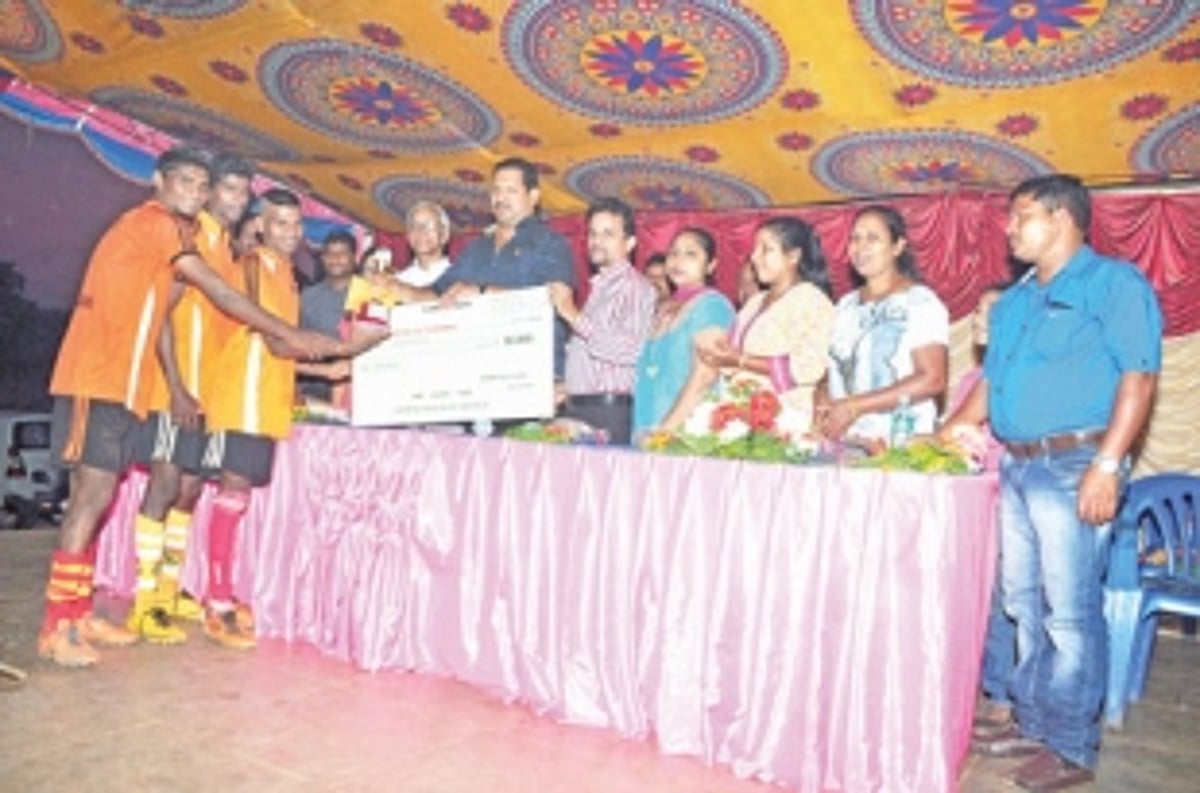
Chief Minister Laxmikant Parsekar’s outstretched arms before the union Finance Minister Arun Jaitley asking for a cash injection of Rs 1000 crores to keep Goa barely running, is a riveting image of a state which has messed up, with the new Chief Minister realising that while the drawing room was dressed up for his coronation by his predecessor Mr Parrikar, the economics of the kitchen were woefully out of shape.
The economic condition of Goa- to put it in a manner devoid of jargon- is that of a traditionally well to do family which has fallen on hard times but is struggling to put up a front of being a provider with largesse available in plenty. Therefore with the steady flow of mining royalty and other taxes which added up to Rs 1500 crores gone, the state has been further hit. Added to this is the depletion in the central share of taxes, as a fall out of the slow economic growth, lower rates of production and manufacturing.
The Centre has also been fairly tepid in its response to funding for the Mandovi and the Zuari bridges. At the same time the government through the GSIDC has gone on a project signing spree reminiscent of a home which has not planned for today and has no concept of tomorrow. The sheer spend on infrastructure has added to the earlier burden of infrastructure loans and interest.
Therefore these Rs 1000 crores asked for by the Chief Minister may cushion the current account deficit but this cannot be an additional annual cash injection. Given its own precarious balance of payments situation, this will continue to be a miniscule drop unless the following are done
a) Relook at populist social spending schemes like Laadli Lakshmi, the Griha Aadhar and the Dayanand Social Security scheme
b) Rationalise the number of infrastructure projects including roads and bridges. Draw up a list on priority and focus on the ones needing urgent maintenance and repair and cut down those for which funding is not arranged for
c) Use the Public Private Partnership mode for all expensive infrastructure and recover amounts through tolls by road users
But beyond all rational thinking has to be the biggest one of them all. Goa has to look at life beyond mining. And the figures tell you why.
Of every ton of dry ore sold, the exporter pays 15% royalty, 15% to the district development fund and 10% to the Goa development fund which adds to 40% of the amount received per ton.
Therefore if the rate per ton of ore received by the exporter is 60 dollars per tonne, 20 dollars per ton goes as freight charges. Of the remaining 40 dollars, 40% is deducted on account of the three heads mentioned above which effectively translates to 16 dollars. Thus the exporter is left with 24$ per ton (40 less 16 dollars). This amounts to around Rs 1500. Then there are is a cost of moving the ore from mine to port which comes to Rs 500 per ton, leaving the exporter with Rs 1000 per ton. From this amount, the extraction cost of Rs 600 per ton is lessened leaving the exporter a net amount of Rs 400 per ton. On this the exporter pays a 35% income tax leaving him with about Rs 250 per ton. Incidentally these calculations are for a grade of 58 when the majority of ore from Goa is in the range of 52 or 54, which brings down the earnings further.
Added to this is weakening market for Goan (Indian) ore. New mining points in South East Asia are producing 300 million tons of 62 grade with the physical distance from the China market far less than India. So what are we saying? In clear terms, mining isn’t a viable business proposition.
If that is the case, Goa cannot ask for annual cash injections from the centre to close the gap in resources due to non mining. The stark reality of balancing the budget without mining is harsh. These figures only tell us that this is non-negotiable. Goa is staring at an unprecedented economic crisis and hasn’t woken up to the fact that the centre will not come to its rescue.
CM can’t beg, borrow or steal to balance Goa’s finances