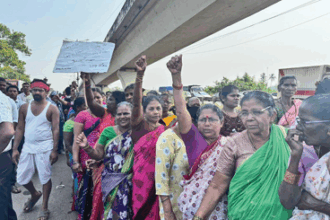
The matter of double tracking of railway lines on Vasco to Londa route has been a heated topic of discussion for the past several years. Double tracking has faced strong objection from locals and Opposition leaders alike. There are two main reasons why double tracking is being opposed. If the project was to take off then the houses and shops close to the tracks will have to be demolished. Secondly, locals are worried that the respective project is pushed only to smoothen the coal transportation through the State and not for the benefit of the passengers.
Residents of Vasco have already been suffering thanks to the coal handling in the State’s port hub and if the handling capacity is increased then it’s the locals who will have to pay a hefty price. The pollution will have a tremendous negative impact on the daily life of the locals. Hence, they have opposed the doubling of the tracks since the beginning. The government on the other hand, however has claimed that double tracking is being undertaken only to ease the hardships of the passengers and to make their travel more hassle-free. Since the public have grown a deep sense of distrust towards the government due to past incidents, they have defied the authority’s claims. In the latest development, people’s instincts may have proven to be stronger than what the government has said so far.
During the meeting of Zonal Railway Users Consultative Committee of South Western Railway held at Hubballi, it has come to light that no new passenger trains will be flagged off on the Vasco-Londa route. Infact, the train services on the route which were discontinued during the Covid19 pandemic will not resume in the near future either. Hence the double tracking hints at likely increase in coal transportation. The General Manager of South Western Railway (SWR) clearly stated that no new passenger train services can be operated on the respective route due to the tricky Tinaighat area. PWD Minister Nilesh Cabral and one more official was present for the meeting to represent Goa.
Gomantak Express connecting Vasco and Miraj and Vasco-Chennai Express were weekly trains which used to be operated on the route before being discontinued. It was demanded in the meeting for these trains to be put back in the service with an additional ‘vista dome’ coach. The demand for resumption of bi-weekly Vasco-Bijapur-Solapur train was also put forth in this meeting. An appeal was made earlier in this regard as well but after the meeting, the chances for these trains to get back on track looks bleak. The trains from Vasco to Londa are pulled by diesel locomotives as this route is yet to be electrified.
It should be taken into account that 71% of SWR’s railway network is electrified except Vasco-Londa stretch and possibility of that happening anytime soon is low. No clear decision has been taken regarding demands favouring Goa which were presented in this meeting.
A need for flyover in Curchorem constituency was the only demand which received approval at the meeting. A reason that’s always cited whenever restarting the train services is brought forward is, the difficulty in operating trains in the Tinaighat stretch. However, a resolution must be found, as the railways cannot raise their hands. At least the trains which were in service earlier should be resumed. In view of potential rise in railway travel in the future, the government is doubling the rail lines for better rail connectivity between the State and other parts of the country. If the Railways are not keen on resuming the discontinued services, much less launching new ones, how will the ridership increase? This will intensify people’s suspicions.
The social workers have alleged that double tracking is imposed only for the sole purpose of expanding coal handling in the State and the recent meeting of SWR signals just that. The government has to take people into confidence and convince them that the doubling of the railway line is for their benefit. Resuming the discontinued train services could be a good start and adding more passenger trains would be ideal. The government also needs to compensate fairly to the ones who will lose their houses, land and establishments in the process.