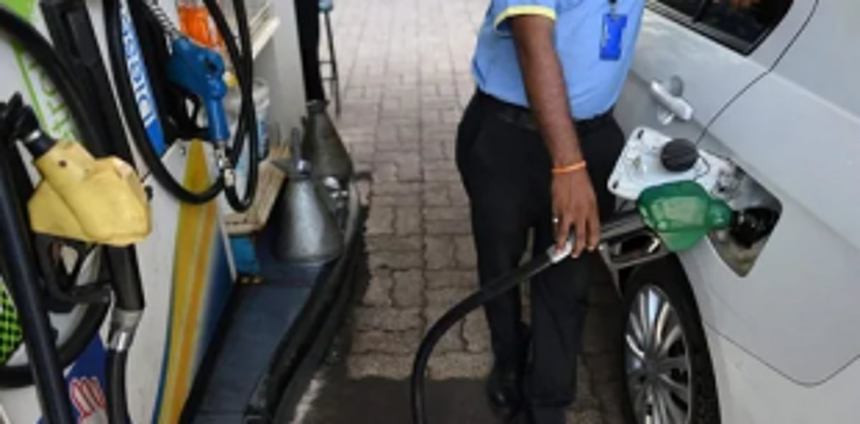
The prices that had been revised on an almost daily basis earlier had remained steady for a period of four months, despite the rise in international crude prices. The revision soon after the elections in five States has very clearly not gone down well with the consumers who see the four month period before the polls when there was no change in prices as a ploy to lure voters. The opposition in particular has hit out against the upward revision and the parties have demanded that the price of fuel be brought down.
It is pertinent to note that India depends almost entirely on imports to meet the fuel demand, as up to 85 per cent of the oil comes from outside the country. So, any change in crude oil would reflect on the price in the country, but there is a catch here as the retail price is largely made up of taxes. Though fuel comes from companies that are nationalised, the retail price is not the same across the country and varies from State to State. This is primarily because after the base price there are the Central excise duties and the State taxes. According to data available, in Goa, for Rs 100 worth of petrol, Goans pay Rs 45.50 in various taxes. This is less than some other States and Union Territories, but still higher than some others. In Maharashtra for instance, consumers pay tax of Rs 52.5 per Rs 100 worth of petrol, while in Lakshadweep it is Rs 34.6 in tax for petrol worth Rs 100.
The pertinent question at this point of time is whether the fuel prices can be lowered by cutting the rate of tax. It is entirely possible and it has been done in the past, so why not now? Goans will remember how on assuming office in 2012 after the election victory, the then BJP government in the State had reduced Value Added Tax on petrol to 0.1 per cent to bring the price of fuel down by Rs 11. For that matter, bringing down the price of petrol had been an election promise and the government had delivered immediately after the victory. Interestingly, VAT and elections have a sort of relation in Goa with the tax either dropping or going up around election time.
If in 2012 the government had brought VAT on petrol down to 0.1 per cent immediately after the elections, by 2016, VAT had been re-imposed at 15 per cent and just prior to the 2017 polls the same tax was slashed by 6 per cent. After the elections it saw an steady escalation, hiked from 15 per cent to 20 per cent in June 2019, and further to 21 per cent in November, and then to 25 per cent in April 2020 and to 27 per cent in February 2021. Currently, Goa’s VAT on petrol stands at 27 per cent of the rate.
With the increased Value Added Tax on petrol, fuel prices in the State are almost on par with that of other States, unlike a decade ago when it was so much cheaper after the cut in VAT that consumers from just across the border would fill up their vehicle tanks in the State. Today, the same political party has been voted to power again and will be forming a government in the next week. Can a similar cut in the Value Added Tax be expected so that the price of petrol is brought down and the pinch on people’s wallets reduced? For that, Goa will just have to wait and see how the new government reacts.