If not you better act quickly. There is a Goa Wetland Authority appointed by the State Government and a very meticulous process followed to aid the process of identification of your neighbourhood freshwater lake, justification by documentation and verification of the same and then due acceptance for notification as a state protected wetland.
In Goa we are very lucky to have many such freshwater lakes, some natural, others man made. Today I will share with you the story of our engagement with the neighbourhood Bondvoll Lake, which has already been notified as a wetland. Bondvoll Lake is a man made reservoir, possibly built more than a century ago. It would fill up during the monsoons and then dry up in the summer. The villagers would use it for sustaining their fields in the lowlands of the village. Such systems are seen all across Goa. Salcete is rich with such man made reservoirs that sustain the agrarian belt of the South. Curtorim lake, Raidol, Maintollem and Kumtollem in Curtorim, the Macazana lake are excellent sustainable wetlands and our climate resilient infrastructure. Closer to home, the Chimbel lake also known as Toyaar lake is an architectural marvel that sustained the needs of the city during the Portuguese colonisation.
Not much was known about Bondvoll Lake and not many knew about its existence. The first time I visited Bondvoll was in 2005! Thanks to Harvey D’Souza and Clinton Vaz, Goa’s well known birders and nature guardians. The memories of that visit are still vivid – the walk uphill through the wilderness, then the sudden sight of the vast reservoir, the walk down from the laterite dam wall, the small structure at the base of the dam that worked like a valve and finally the birds of the pristine hot spot – pied kingfishers, forest wag tails, including the majestic white bellied sea eagles, nesting residents of the lake!
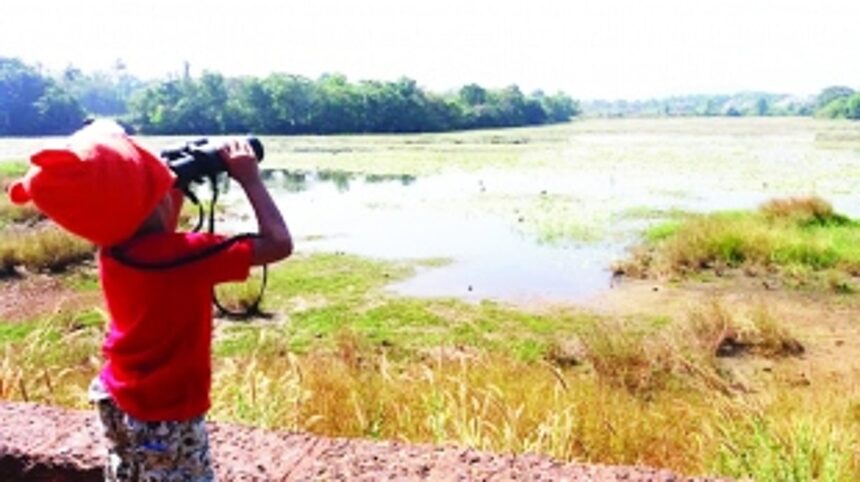
Many years later, going to the Bondvoll Lake had become routine with the children from my colony and friends interested in bird watching. A couple of visits in the year 2013 and 2014 are important to share here. The path to the lake was strewn with thorny shrubs that made it near impossible to approach the reservoir. The lake was dry but there were wet patches teeming with wading birds in the basin of the lake. Before we could reach the high dam wall with a linear path we were lucky to sight more than 30 peacocks, peahens and juveniles. The next visit a few months later had the same thorny barriers along the path. When we approached the lake, we were accosted with burly looking thugs. They asked us very rudely what we were doing and that we would not be allowed. I simply asserted that we had been visiting the lake with children in the past and were studying birds and nature. Without getting frightened, we continued to walk across the periphery and explored the lake. We documented what we had sighted. We noticed that the ‘thugs’ as well as the others who were there were busy planting some scraggly looking plants along a part of the lake. What was their purpose to do this suddenly? Was this area going to become an orchard or be ‘developed’? What would happen to the nesting birds? Was the lake doomed to become extinct?
We only learnt later that it was slated to be filled up. Can you imagine that? A pristine reservoir with its unique ecology and function as a working community asset was under threat to be built upon and disappear! Imagine ‘Lake view’ apartments and gated communities on this hillock.
Fortunately the villagers were vigilant. They acted in time and saved the soul of St Cruz village from being sold. Thanks to the relentless efforts of one passionate earth guardian, Arturo D’Souza from St Cruz along with other sons and daughters of the soil, Bondvoll Lake still exists today as a community and key ecological asset of not only the village but Goa as well.
During the pandemic, Bondvoll Lake among other such gems in the backyard, became our respite to walk, explore, swim and dive. All the children of our Community Classroom initiative, cite this as their favourite nurturing and outdoor learning spot. When we first visited it during the pandemic and lockdown, we were accosted by a middle aged gentleman who claimed that he was the tenant. He asked very arrogantly what we were doing here and that we should leave. We asserted that as educators along with our community classroom students we meant no harm or vested intent. Our purpose was simply to connect our students to nature and learn from observation and experience. We also asserted that the lake was already notified as a wetland and community asset. He took my picture on the phone camera for record, I too did the same. Then he retreated along with his group.
The second time too he came to us and warned us saying, ‘I had told you not to come here, right? Now you’ll seem to be coming here every day!’ So I asserted again that we had come to do no harm but to observe and learn about nature. I also asked him to take any necessary step to stop us, if we were violating any law. He retreated to his small group as they were plucking wild mangoes and jackfruits. After this they left never to accost or threaten us till date as we happily walk, swim and dive in our mother’s lap!
(Tallulah D’Silva is an
architect and features in the Top 20 Golden Door Awards 2020 shortlist of
international writers.)