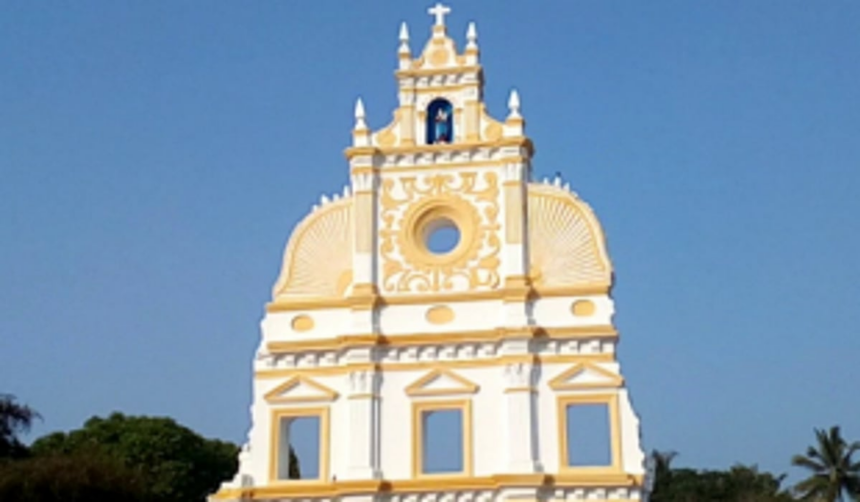
Goans who claim politics and religion do not mix, understand neither. This is because the controversy stoked by fringe elements in this tiny State who claim the 416-year-old Sancoale church to actually be a Laxmi Narasimha temple, may be an alleged template to assert some of the ruins of 500-year-old churches in Goa were built after razing temples. Hence, these temples should be rebuilt.
From 1606, Sancoale’s Our Lady of Health church has continuously possessed the property within which the old façade gives the church its name. Now, a local litigant has put up an allegedly spurious claim of tenancy over seven church properties surrounding the old church because his forefather was allowed to pluck coconuts for six years without any ownership rights, according to sources.

This litigant had allegedly lost his earlier battles but after appealing to the high court at Goa had his case remanded back to the Mamlatdar court during the Manohar Parrikar regime. He may be instrumental in spreading the rumour there was a pre-existing temple. On December 30, 2020, some Hindutva persons conducted a puja. On January 2, 2022, one of them gave an inflammatory speech to stop the feast on January 16 which passed off peacefully.
They got the publicity they sought to further their Hindutva agenda because the police did not arrest anyone on tacit orders from above. These elements may try to grab the land which stands in the name of the Fabrica de Igreja de Nossa Senhora de Saude. Form I and XIV is evidence of this.
But first, a bit of history.
In the late 1500s, the Jesuits got a decree from the then Portuguese viceroy Dom Francisco de Mascarenhas which allowed them to use a part of the revenues from the villages in Salcete for the catechumens, (converts being taught the faith) some of whom were bhatkars. These bhatkars got their mundkars to embrace Catholicism and replace innumerable shrines dedicated to different family deities with a single church consecrated by the Jesuits.
The white man (the Portuguese) was charged with “saving the souls” of the povo da India (local people) as per the 1493 bull or decree of Pope Alexander VI to Portugal and Spain which allowed them to colonize and convert these lands. This obsolete thinking has changed forever.
Afonso de Albuquerque conquered the town of Old Goa in 1510 from Yusuf Adil Shah of the Sultanate of Bijapur, but allowed these sects and cults to practice their ancient faith because a syncretized Hinduism as we know it today was a product of the 19th century. The Portuguese did tear down temples dedicated to numerous deities chosen as per the occupation, location and caste of different families.
The Jesuits first built a chapel at Sancoale in 1566 which they named Nossa Senhora de Saude or Our Lady of Good Health because during the time of the Viceroy Louis de Ataide, the entire region was hit by countless plagues forcing the villagers to migrate to Benaulim, Loutolim, Varca and Velim, according to old records. Miraculously, some people reported healings.
These gaonkar-brahmin converts had to cross the Zuari river to attend the old Cortalim church. So, they decided to build their own church at Sancoale which was completed in 1606 on their own community land which is proved by the tombstones of prominent gaonkar families like Cunha, Menezes and Cardoso which can still be discerned within the church precincts.
Jesuit historians such as Sebastiao Gonsalves would have recorded the existence of a panchadevata or five temples built around a major temple in Sancoale during the early 1500s or between 1560 and 1600 if such existed. But both Paolo de Trinidade and Gonsalves never mention any pre-existing temple.
Gonsalves, recorded there were side altars inside the church dedicated to Jesus and St. Braz. There was also an altar dedicated to Our Lady of Conception which was declared privileged by a decree of April 19, 1788. Today, only the edifice of the church remains as it was hit by lightning. Plans for a new church at Sancoale were made during the Archbishopric of Dom Jose Maria da Silva Torres.
In 1834, the old church was ravaged by fire and so in 1839 a chapel having a similar invocation in the same village, at Anaulim, was elevated to the rank of parish and continues today to be the Church of Sancoale. The old Sancoale church, reduced to ruins, is a tourist attraction.
The ‘Fabrica of Church of Sancoale’ continues to own this property for over 400 years as evidenced by Form 1 and XIV which is why the archives and archaeology department of the Goa government has declared the church a ‘Protected Monument’ in a frontispiece which was put up. But the archaeology department is charged only with preserving the monument and does not own the land as is falsely being propagated.
The authenticity of the church ownership is proved by the fact that St. Joseph Vaz wrote his “Deed of Bondage” on August 5, 1677 dedicating his life to Mother Mary. This is why the road leading to the old church ruins was named as “Rua do Escravo de Maria” (Road of Bondage of Mary) prior to the old church being destroyed in a huge fire in 1834. On 19th March 1937, the erstwhile Portuguese Government declared this church façade as a national monument.
There is no doubt the Sancoale church owns its own land on which its old façade stands. The ownership dates back to 1606 or perhaps to 1560.
That is why Hindus who believe in Hinduism reject coercion in favour of compassion.
(Dr Olav Albuquerque is a senior journalist-cum-advocate scholar.)