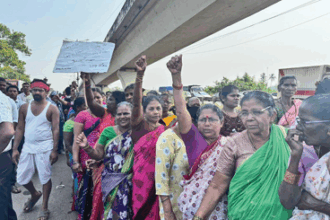
With the proposed Mhadei river diversion back in the news and local political discourse, the blame games and political posturing return as Goa takes on what is at best a political googly ahead of the Karnataka polls and at worst a grave threat to Goa’s very existence and sustenance.
However, a question we haven’t asked, or perhaps not enough, is why this decades-old issue doesn’t make news beyond Goan shores?
An existential question for Goa, India’s smallest yet richest state, generating the country’s highest per capita income – it is also a non-partisan issue, with all the state’s stakeholders unequivocally opposing the project. After all, the Mhadei river is considered to be the state’s lifeline, providing drinking water to over 40% of Goa’s residents. Our state makes it to national prime time for crimes, defections, illegal mining and the like – but what of River Mhadei?
Whether we like it or not, the country’s discourse is set in Delhi and our MPs (sent on considerable tax money) become an important vehicle for setting the agenda both inside and outside Parliament. A simple Google search and analysis of news media, however, will show you the latter has hardly been done. But what about inside the Parliament of the ‘world’s largest democracy’?
Auditing MPs performance
A large part of my work as a legislative researcher, has involved closely following proceedings of the Indian Parliament over the past year and a half. Coming from a small state that hardly ever features in policy or political discussions in New Delhi, initially I’d eagerly look out to see when Goan MPs would speak, curious to see what issues they’d raise and how. Soon enough, however, I learnt that our representation in Parliament is fairly inadequate. Most speculation on how the Centre will sway on the Mhadei issue boils down to what’s at stake politically – Karnataka’s 40 MPs versus Goa’s 3 MPs. But doesn’t that make the individual and collective role of these three representatives all the more crucial?
While MPs from most other states, use their platform in the legislature to raise even the most hyperlocal issues, one hardly hears even a mention of Goa. Tune into the telecast of a Question hour or Zero hour (the first two hours of an average day in Parliament) and you will hear MPs raise a range of local issues ranging from roads to railways, schools and hospitals, even as specific to districts in their parliamentary constituencies. One can argue that this stems from strong expectations from constituents to raise their issues in Parliament, and perhaps a converse sense of accountability that these representatives feel to their voters – seemingly missing in the case of Goa. This marked inactivity hasn’t gone unnoticed, in fact it provided ammunition to TMC MPs eying electoral gains in Goa last year, and as a result, we had MPs all the way from Bengal raising Goan public interest issues in Parliament.
As per Parliamentary records, since 1999 the only time an intervention related to the Mhadei water dispute was raised in either House of Parliament, was an unstarred (written) question by the former Rajya Sabha MP, late Mr. Shantaram Naik in February 2009, seeking information on the status of the dispute and steps taken for resolution. Beyond the issue of the Mhadei river dispute, this also prompts an audit of Goa’s representatives in Parliament at large – how are Goa and Goan issues being represented in New Delhi?
Goa in the Lok Sabha
Presently, Goa’s two seats in the 543-member-strong Lok Sabha (LS) are held by Mr. Shripad Naik, (MP for 5 consecutive terms and current Minister of State) and Mr. Francisco Sardinha (MP for 4 terms).
Given that MPs who go on to become Ministers represent the Government, they do not sign the attendance register or raise issues through interventions like questions, private member bills or zero hour interventions – making it difficult to assess their legislative performance. However if Mr. Naik’s past record as an Opposition MP is any indication, in the 15th Lok Sabha (2009-2015) he asked less than half the number of questions an average MP in the LS asks and filed no private member bills (which is a crucial tool for setting legislative agenda and contribute to the law making process).
Mr. Fransciso Sardinha, despite being a fourth-time MP, has an impressive legislative record as far as his attendance in Parliament goes – with a 94% attendance, above the national average of 79%. But what substantial engagement does this regular attendance have to show for? Since 2019, Mr. Sardinha has asked hardly 30% of the number of questions an average LS MP asks, and participated in less than half the number of debates an average LS MP, also introducing zero private legislation.
Goa in the Rajya Sabha
Goa has one seat in the Rajya Sabha (House of States) currently held by Mr. Vinay Tendulkar, a first time MP elected in 2017. With his term set to lapse this July, in the past 6 years Mr. Tendulkar has participated in 35 debates, barely one-third of the national average, asked 112 questions, less than half of the national average, and introduced zero private member bills.
This is in stark contrast to his predecessor, late Mr. Shantaram Naik who in his two terms raised an impressive number of interventions, more than double the national average, whether through questions or participation in debates, as well as introduced a record 31 private member bills – a reminder that Goa can produce active and effective legislators.
And so as we, Goans & all who care about Goa, gear up to oppose the Mhadei, here are some critical questions we must ask: Are our elected representatives adequately representing our interests? Do we as citizens engage with our legislators and the legislative process? Do our MPs make themselves available to public feedback? Do their legislative capabilities even remotely factor into our voting decisions? How can we better hold our representatives accountable? There is much to be desired, but greater civic engagement is an indispensable part of getting there.
(A graduate in Political Science and Economics from St. Stephen’s College, Delhi, the author is
currently work as a
legislative researcher with a Member of Parliament
in New Delhi.)