Sujay Gupta in Manila
MANILA: It’s called the world’s fair of muck racking. Journalists from 33 countries gathered in Philippine’s capital, Manila for The First Asian Investigative Journalism conference, to set up networks, collaborate on stories and share tips and data. But above all it was a melting pot of the world’s finest storytellers who constantly and tirelessly bring journalism back to the high table of media reminding us that uncovering facts to bring you the truth is the core fundamental of journalism beyond everything else.
The Global Investigative Journalism Network (GIJN) whose secretariat was established by the High acclaimed investigative journalist David Kaplan, teamed up with the Philippine Centre for Investigative Journalism (PCIJ) and Konrad-Adenauer — Stiftung foundation for the conference named “Uncovering Asia”.
The conference began with its plenary session on Sunday. David Kaplan addressing journalists at the start of the conference said, ‘When we planned to have a conference of this kind in Asia, Manila came up in our discussions all the time”. He gave a special award to the hosts, the PCIJ, the pioneering investigative journalists network in the Philippines for “25 years of extraordinary journalism”.
The conference comes at the time when the media faces the severest of all challenges. These are times when the media is not a bystander but an immediate victim of terror with the killing of two journalists by the ISIS and mounting instances of kidnappings and hostage taking, as journalists step up their investigations in conflict zones.
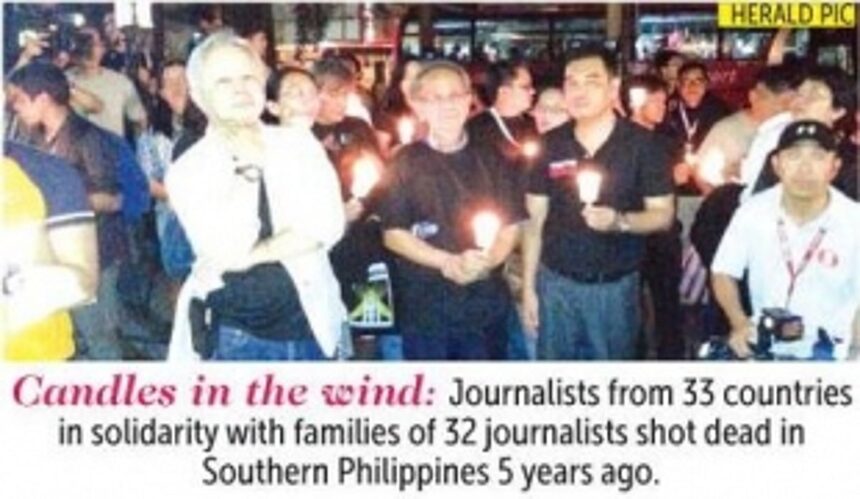
On Sunday evening, “Uncovering Asia” joined with members of a companion conference, “Journalism Asia”, for a special event marking the UN-designated International Day to End Impunity. Journalists attending the conference gathered for a candle-light assembly at the Epifanio de los Santos Avenue (EDSA), the historic site of the 1986 People Power Revolt.
Journalists raised candles to honour the hundreds of slain journalists in Asia and worldwide whose cases are still awaiting justice. Sunday was also the fifth anniversary of the brutal gunning down of 32 journalists and 26 others, after their convoy was ambushed. The journalists were shot in cold blood in groups in Ampatuan in the Southern province of Mundanao while on their way to cover the filing of election nomination papers of a local politician. Not one person has been convicted. This Sunday as journalists from 33 countries across publications, including your own Herald, lit candles at EDSA, the rest of the world joined the Philippines in expressing fresh outrage at this absolute lack of justice for the victims.
Earlier on Sunday morning, in her keynote address, “Holding power to account in the world’s largest continent”, Sheila Coronel, Dean of Academic Affairs, Columbia Journalism school said, “You are not alone. We are a thriving community of journalists in 107 groups in 50 countries. People want to know if schools are working, medicines are available, garbage is cleared. If the bad guys went international years ago, 300 journalists from 33 countries including Germany and Costa Rica, are here to tell them that we will catch up”. Ms Coronel was referring to the reach of governments and their PR machinery to mobilise media. The underlying take away was that investigative journalism is not just about scams and making governments fall but about uncovering truth and holding power to account.
Herald found a lot of resonance in her words in the context of its own footprint in Goa.
Some of the sessions included investigating the environment, using social media for investigative reports, managing investigations, corruption and cover ups, investigating in conflict zones, coping with trauma and threat and building an investigative journalism infrastructure in Asia.
But above all, this was a continuation of the initiatives of the Global Investigative Journalism network, led by David Kaplan, with every journalist in the world its member in spirit, with one message, “We tell it like it is, no matter who, no matter what.”