VITHALDAS HEGDE
As the State government prepares to roll out Artificial Intelli gence (AI)-enabled traf fic enforcement cameras from July 15, the ambi tious technology-driven project has triggered growing apprehension over whether it will genuinely improve road safety or simply become another revenue-gener ating exercise while leav ing Goa’s chronic traffic management failures un addressed. While the govern ment has projected the AI surveillance network as a major step towards curbing traffic viola tions, several transport operators, road safety activists and civil socie ty members argue that technology alone cannot compensate for poor en forcement, inadequate infrastructure and a se vere shortage of traffic personnel.

Former State Information Commissioner (SIC) Adv Juino De Souza questioned the rationale behind investing crores of ru pees in AI surveillance while fundamental issues continue to plague the State’s roads. “Installing such expensive AI cameras in a small State like Goa is nothing but a money-making stunt before the Assem bly elections. Can AI cameras detect drunken driving? What about tourists driving rent-a-cars, who are mainly responsible for causing accidents? What about overloaded trucks crushing two-wheeler riders? Instead of spending crores of rupees on AI-enabled cameras, what is needed is improved traffic infra structure and more policemen to regulate traffic and manage congestion. There is large-scale unemployment and jobless ness, and the government could very well invest this money in recruiting more traffic police.” His concerns found resonance among road safety campaign ers, who argued that AI cameras should not become a substi tute for comprehensive traffic enforcement.
Goa Road Safety Forum convenor Dilip Naik said the State undoubtedly requires stricter enforcement but questioned whether the new system would be effective against motorists who deliberately evade identification. “We have always maintained that traffic enforcement in the State needs to be strengthened. Traffic violations are rampant, with people riding two-wheelers without helmets and using mobile phones while driving. This reflects a lack of fear of the law. Many riders wear helmets only when they spot traffic policemen and remove them immediately after crossing the checkpoint. We also see several vehicles plying without regis tration number plates, making it difficult to identify the vehicle or its owner even if it is captured by AI cameras. One of the AI cameras has been installed at the Loutolim junction, where the traffic volume is relatively low. It appears to be more of a busi ness, with 70 per cent of the revenue going to the operator and the remaining 30 per cent to the government.” Others cautioned against judging the project before it is put to the test. All Goa Private Bus Owners Association general secretary Sudip Tamankar said the rollout itself had already been de layed and that its effectiveness could only be assessed after implementation. “The government had initially planned to introduce AI cam eras from July 1, 2026, but postponed the rollout to July 15. It may be deferred further. Let the government first implement the system. After it has been in operation for a few days, we will be able to understand how it works and assess its impact.” Goa Civic and Consumer Action Network (GOACAN) coordi nator Roland Martins said public awareness would be crucial if the system is to gain public acceptance. “The company officials gave a presentation to the members of the North Goa District Road Safety Committee on Tuesday. We have suggested that the government undertake greater public awareness campaigns and publish a set of frequently asked questions (FAQs) so that motorists and the public un derstand how the AI-enabled cameras function. We will have to wait and see how the system performs in practice before as sessing its shortcomings. Only after it is implemented will we be able to evaluate its advantages and disadvantages.” Even those backing the initiative stressed that technology by itself would not make Goa’s roads safer. MARG member secretary Anant Agni described AI cameras as a positive step but pointed out that the State’s weak enforce ment machinery and hazardous road conditions remain major concerns. “AI-enabled cameras are a welcome initiative and will cer tainly help improve road safety. However, people also need to be educated and develop better civic sense. Strict adherence to traffic rules should become a way of life. Goa has a major shortage of traffic police personnel compared to the number of vehicles registered in the State, with a ratio of one traffic policeman for every 2,000 vehicles. At the same time, several accident-prone black spots still exist across the State and need to be addressed.”
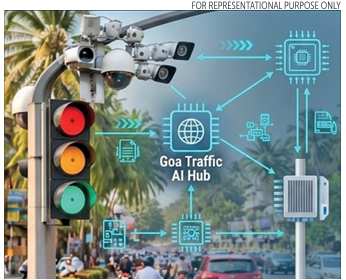
Sanjay Dessai, Principal of Shree Damodar College of Com merce and Economics, echoed the sentiment, saying the suc cess of AI-enabled enforcement would ultimately depend on governance rather than technology alone. “The introduction of AI-enabled traffic cameras is a wel come initiative, but the real question is whether the system will continue to function effectively or become defunct after a few months. What is equally important is good governance, which is currently lacking. Unless there is discipline at every level, in cluding among politicians who are expected to set an example, such initiatives will have limited impact. At our college, we do not allow students to enter the campus if they are found riding two-wheelers without helmets. If any student below the age of 18 is found riding a vehicle, we immediately inform the police.” Under the new system, AI-enabled cameras will automatical ly detect traffic violations and issue electronic challans through SMS, email, WhatsApp and other electronic modes. Motorists will have 45 days to either pay the penalty or challenge it before the Grievance Redressal Authority by submitting documentary evidence online. The government plans to activate cameras at 26 locations from July 15, expand the network to 52 locations by September and complete the installation of 92 cameras across Goa by December.
According to Additional Director of Transport Bhalchandra A Sawant, violators will have 45 days to either pay the fine or challenge the challan before the Grievance Redressal Authority by submitting documentary evidence online. If the challan is neither paid nor contested within the stipulated period, it will be deemed to have been accepted. The government has also provided an appellate mechanism and laid down timelines for disposal of objections. Persistent non-payment could lead to suspension of services related to the offender’s driving licence or vehicle registration until the dues are cleared, he said. For many observers, however, the central question remains unanswered – whether AI-powered surveillance will bring last ing discipline to Goa’s roads or merely automate the collection of fines without addressing the governance deficits, poor road engineering and weak on-ground enforcement that continue to fuel traffic violations and accidents.