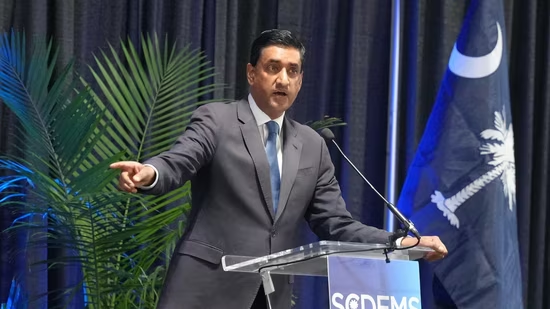
Indian-American Congressman Ro Khanna launched a sharp attack on US President Donald Trump, claiming that his policies have pushed India-US relations to their weakest point in nearly three decades. Speaking at the US-India Strategic Partnership Forum Leadership Summit in Washington, the California Democrat argued that the deterioration in ties was largely due to Trump’s foreign and trade policies.
Khanna asserted that even India’s External Affairs Minister S Jaishankar would acknowledge the strain in bilateral relations. “Ask Jaishankar if you don’t believe me,” he remarked while criticising Trump’s decision to engage in conflict with Iran, saying it had negatively affected global energy prices and increased fuel costs for India.

The Congressman also claimed that during a recent visit to China, India’s ambassador told him that “a generation of trust” had been lost because of Trump’s approach towards international relations. According to Khanna, the damage to diplomatic ties cannot be ignored if the two countries hope to rebuild their partnership.
Apart from foreign policy, Khanna criticised Trump’s trade measures, including tariffs imposed on Indian goods. The US administration had justified the duties by citing India’s continued purchases of Russian oil, a move that further complicated economic relations between the two nations.
Khanna also accused Trump of abandoning America’s moral leadership by threatening countries such as Iran and Cuba while making remarks about Greenland. He further criticised the administration’s immigration and student visa policies, arguing that they discourage global talent from coming to the United States.
Highlighting the importance of international expertise, Khanna said a significant share of leading artificial intelligence researchers come from outside the US, making immigration crucial for maintaining technological leadership.
Confident about the political future of his party, Khanna described Trump as a “lame duck” president and predicted that Democrats would secure victories in both the upcoming mid-term elections and the 2028 US presidential election.