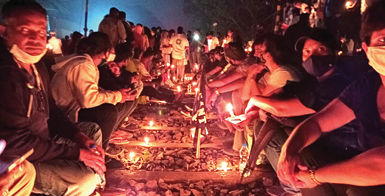
Five years after thousands of Goans gathered in Chandor to oppose the railway double-tracking pro ject, frustration over the pro longed legal battle has deep ened once again — this time following the Margao Chief Judicial Magistrate’s (CJM) decision to issue a bailable warrant against the Investi gating Officer (IO) handling the case. The warrant was issued after Police Inspector (PI) Arun Desai, who heads the Maina-Curtorim Police Sta tion, failed to appear for two consecutive hearings despite being duly informed. During the proceedings, the Assis tant Public Prosecutor (APP) Sanford Fernandes con firmed to the court that the officer had been notified but was still absent. Noting that this was not the first time the IO skipped a hearing, CJM Shubada Dalvi observed that the absence was obstructing compliance with the High Court’s directions to expe dite the trial and ordered the warrant to be executed through the Superintendent of Police (SP) South, with a copy sent to the Deputy In spector General (DIG). The court has directed PI Desai to appear at the next hearing on October 16. The warrant comes against the backdrop of multiple High Court reminders over the past two years to ensure “speedy and efficient dis posal” of all double-tracking cases. Despite these direc tions, activists point out that trials have progressed in fits and starts, often hindered by missing officers or pending procedural applications. The Chandor case stems from the 2020 protest, when thousands of Goans gath ered after midnight near the railway crossing to oppose the track-doubling works they feared would turn the State into a coal corridor. Ten activists were later charge sheeted by the Maina-Cur torim police for unlawful assembly and restraint, even though, as activists note, the then South Goa District Col lector had ordered the tem porary closure of the road for railway work that night. For the activists now fac ing trial, the police’s repeat ed absence and procedural delays amount to what they call a deliberate attempt to demoralise the movement. “This is a time-tested tactic to wear down citizens who are fighting to protect Goa,” said social activist Abhijit Prab hudesai, one of those charge sheeted in the Chandor case. “It’s not about investigating anything new — it’s about dragging the process for as long as possible. But these tactics only strengthen our resolve.” Earlier this year, the Mai na-Curtorim police filed an application seeking permis sion for further investiga tion, claiming that certain station-diary extracts and statements had been “inad vertently omitted” during the initial inquiry. The plea, filed in January, said that these extracts were “essen tial to establish the presence of the complainant and wit nesses” and sought to record the testimonies of three Sal cete Joint Mamlatdars — Ra ghuraj Faldessai, Dattaraj K Gauns Dessai (Joint Mamlat dar-III) and Gaurav S Gaon kar (Joint Mamlatdar-VI) — who were deployed for bandobast duty during the protest. The application has remained pending for nearly nine months. When asked by CJM Dalvi about the status of that ap plication, the Assistant Pub lic Prosecutor confirmed that the plea for further investiga tion remained pending since January. The court took note that this pendency, com bined with repeated non-ap pearance of the investigating officer, was compounding the delay in concluding evidence. Prabhudesai questioned the intent behind this re newed investigation. “Even assuming they wish to in vestigate further, why are officers not attending hear ings?” he asked. “The reason is simple — the government isn’t serious about ensuring early disposal of these cases.” This is not the first time the Margao court has pulled up investigating agencies in double-tracking cases. In an earlier proceeding, for mer CJM Carlo Santana Silva had issued a stern warning to the Railway Protection Force (RPF) in the Arossim case, saying hearings would proceed even in the absence of their Special Public Prose cutor after repeated non-ap pearances had stalled the trial. South Goa MP Captain Viriato Fernandes, who is also named in one of the dou ble-tracking cases, said the government’s conduct only strengthens the people’s re sistance. “If the authorities think delays will demoralise activists, they are mistaken. Every postponement only renews the people’s commit ment to save Goa,” he said. Activists have urged the judiciary to take stronger measures to ensure compli ance. “The High Court wanted these cases fast-tracked, yet what we’re seeing is a pattern of procedural indifference,” said a lawyer familiar with the matter. “It’s not just one case — it’s systemic delay.” Several related cases from Cortalim, Arossim, and Vasco also remain pending, each arising from peaceful protests against the double-tracking works. For many campaigners, the slow-moving trials have be come symbolic of the wider fight against Goa’s transfor mation into a coal corridor. The Chandor protest re mains emblematic of Goa’s broader environmental struggles, linking coastal and hinterland communities un der one banner of resistance. Campaigners say that while the government has spent years defending the project in court, not a single accused has sought to delay proceed ings — a contrast that, they argue, reveals who is tru ly responsible for the slow march of justice. Observers say CJM Dal vi’s latest order could mark a turning point. “When a magistrate issues a warrant against a police officer, it signals judicial impatience with repeated neglect,” said a senior lawyer. “It’s a message that accountability cannot wait indefinitely.” For the villagers and activ ists who stood at Chandor’s tracks five years ago, the courtroom struggle contin ues — a reminder that while the trains may run faster, jus tice in Goa still moves at its own pace
CJM Issues Bailable Warrant Against Investigating Officer in Chandor Double-Tracking Protest Case