ROHAN SHRIVASTAV
PANJIM: Commuters including tourists continue to suffer on account of Goa’s poor last mile connectivity.

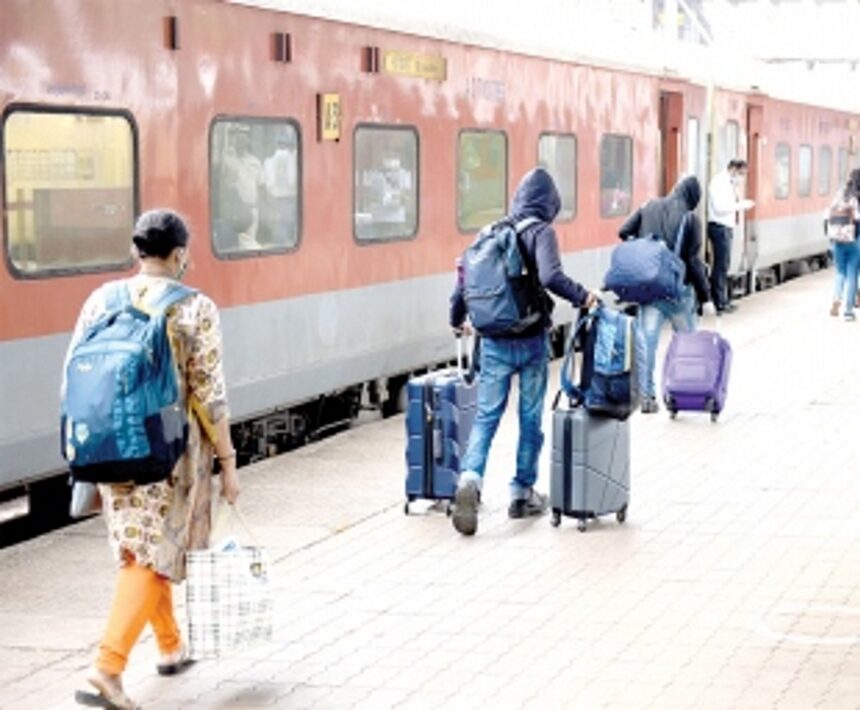
Commuters are compelled to walk quite a distance to hire a private transport due to the significant gap between the first and the last mile connectivity, particularly from railway and bus stations across the State.
Further, not every commuter can afford to hire a taxi or a rickshaw for the entire journey throughout the day.
Despite the fact that last mile connectivity is pushed by the Prime Minister’s Office (PMO) through the NITI Aayog, the State government has taken no concrete steps to address the issue.
Shockingly, the ‘state task force on mobility’ which was constituted on July 4, 2018 under the chairmanship of Chief Secretary has met only twice, i.e. on July 12, 2018 and January 7, 2019. Thereafter, no meeting of the said task force has taken place, which clearly shows that the so-called governance is merely on paper.
The public transport facilities in Goa need to be enhanced and required to be made efficient in terms of quantity, quality and coverage.
GOACAN co-ordinator Roland Martins pointed out that after the mobility strategy plan was prepared, it has not been discussed in length as there has been no subsequent meetings.
“The road safety and traffic management committees of all village panchayats and municipal councils must deliberate on the plan and make proposals to improve last mile connectivity in their respective jurisdiction,” Martins said.
“The government must take steps to put in motion the preparation of a comprehensive traffic management plan at the district level, in which last mile connectivity must be an important component,” he added.
Martins opined that the State task force on mobility must be revived and regular meetings be held to take stock of the progress made by different members to ensure improved public transport, facilities for pedestrians, use of railways and waterways and promotion of electric mobility.
Stating that there is no proper transport system in Goa, Travel and Tourism Association of Goa (TTAG) president Nilesh Shah, who is also the member of the State task force on mobility, said there is a need for an affordable bus coach and app-based taxi services connecting North and South Goa including all tourist places.
“Just having road networks and bridges won’t resolve the problem. For tourism to sustain and the economy to grow, there is a need for a proper public transport system,” Shah said.
Adv Moses Pinto, author of the book ‘Practice Traffic Yoga’, said, “The glaring indifference between Goa’s comprehensive mobility plan and the international principles of last mile connectivity manifest into traffic bottlenecks which cause impediments to passenger mobility in Goa.”
“Goa ranks among the top five States and Union Territories having the best coverage of roads in rural areas at 4,336 km of road for every 1,000 sq km and despite the resource of connectivity being available, the last mile connectivity is being overlooked by authorities,” Adv Pinto said.
Anant Agni, Secretary of Movement for Amity towards Roads in Goa (MARG) said, “In the absence of last mile connectivity people are compelled to use their private vehicles. “
“The government needs to have a focused approach to connect the urban areas with rural areas. Authorities should encourage people to consider railways,” Agni said.
Rajan Satardekar, Director of Transport said, “The government is in the process of procuring 100 EV buses to improve and boost the last-mile connectivity in the State.”
“A fleet of 100-odd EV buses will be under Kadamba Transport Corporation by March and we will ply these buses on routes that are not presently covered, it will also have nine-metre long mini buses which will be put on routes that have narrow roads,” Satardekar said.
Satardekar said “The Transport Department will seek budgetary allocation in the coming financial year, which will be utilised for improving the lastmile connectivity.”