SHASHWAT GUPTA RAY
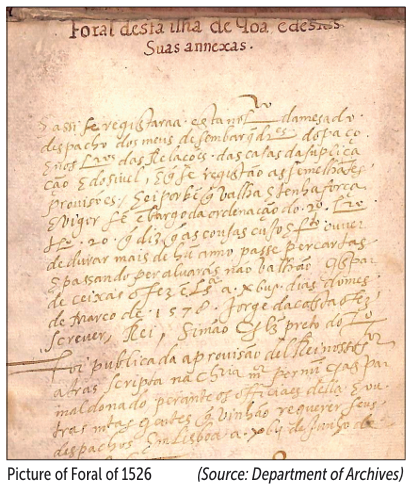
As Goa marks the 500-year milestone of the Foral of 1526 today, Rev Dr Jason Keith Fernandes — academic, author, a Gaunkar and Secretary to the Archdiocese of Goa’s Committee for the Academy of Research and Culture in Old Goa — said the decline of the Comunidades, the centuries-old indigenous system of collective land ownership and resource management, is the central catalyst for the State’s esca lating socio-environmental crises. Originally called Gaunka ris, these institutions his torically managed approxi mately 70 per cent of Goa’s land as a common ecologi cal and economic trust. Over the decades, legis lative dilution, rapid urban isation and a hyper-com mercialised real estate boom have systematically dismantled this communi ty-driven governance, re placing ecological steward ship with aggressive land exploitation, Fr Fernandes told O Heraldo. Fr Fernandes has writ ten on the contemporary politics surrounding the Foral of 1526, formal ly known as the Foral de Usos e Costumes dos Gão cares or the ‘Charter of Customs and Practices of the Gaunkars’.

Issued by the Portuguese Crown through its Comptroller of the Exchequer, Afonso Mexia, on September 16, 1526, the charter legally institutionalised the Comunidades (originally the Gaunkaria system), the ancient collective village landholding and governance system. Fr Fernandes approaches the document through legal anthropology and post-colonial frameworks. “The Foral of 1526 was a historic charter established be tween the Portuguese Crown and the local inhabitants of the Goa islands. It created a formal legal architecture that established the village as the primary unit of administra tion.
This framework laid the foundation for the Comuni dade, also known as Gaunkari, an institution where village lands were collectively held and managed by the assembly of Gaunkars — members of dominant local lineages,” he said. Under this system, village lands were managed, main tained and leased out through auctions. The proceeds were distributed among the Gaunkars as a dividend called zonn. For over four centuries, these village-level institutions op erated essentially as local municipalities, managing local infrastructure and land use, he said. However, he noted that the traditional system suffered from a significant democratic deficit, as lower-caste groups and non-dominant communities were historically excluded from decision-making and ownership rights. “Following Goa’s integration into India in 1961, land re form laws and the later implementation of the Panchayati Raj Act systematically shifted power away from the Co munidades.
Instead of reforming and democratising these historical bodies to include all residents, the modern ad ministration treated Comunidades as private landholders, stripping them of their traditional administrative roles,” Fr Fernandes added. He pointed out that this shift, alongside the State’s ex ercise of eminent domain to acquire land for modern in frastructure projects, has led to severe land alienation and local unrest across the State. According to him, this is the root cause of Goa’s unplanned urbanisation and environ mental destruction. “The people must come together and take collective steps to ensure that this degradation of Goa doesn’t happen any further,” he said.