RIVONA: When you arrive at Rivona into the lap of greenery, it doesn’t quite live up to its tag of a ‘mining village’, or a mining dependent village. There are orchards and fields, rivulets meandering through the countryside and you can see a community going back to the farms.
And yet there are abandoned mining trucks, and tales of an economic downturn heard from many homes.
Clearly, this pristine village in the Quepem taluka is tossed between the hangover of a mining dependent past, which brought in prosperity, and the prospect of letting mining back, which would not allow the natural and environmental revival of the village
At the moment, there is a bit of a déjà vu spreading through the village as mining extracts are carried in loads on trucks. One sees them lined up in hundreds, speeding through the village.
The ravages caused by mining, the activity that funds the movement of trucks and provides revenue/earnings to truck owners and drivers, are also visible.
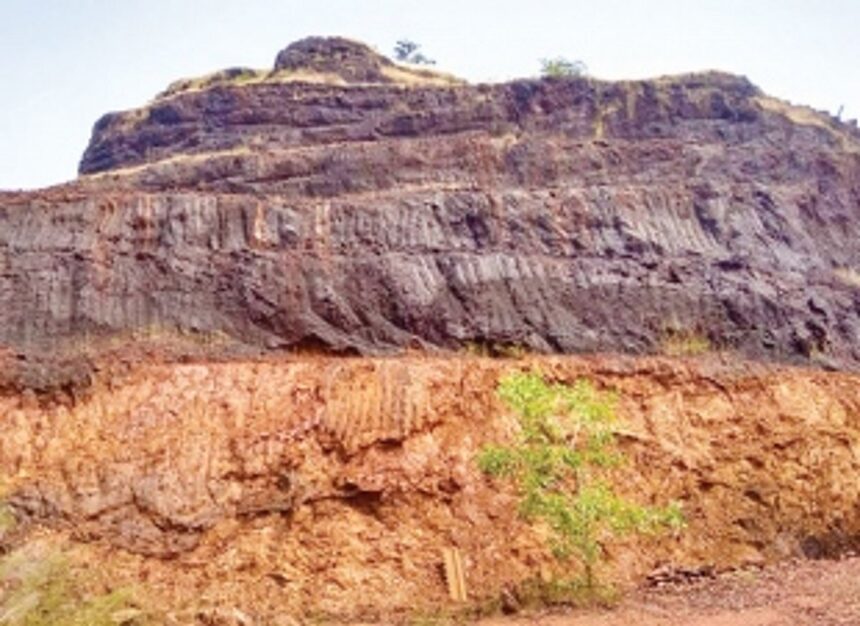
Mining has destroyed the hills completely. The mining waste has run into the fields along with the rain water, damaging the crops leading to poor harvest.
A Rivona local, Rosita Dias said, “On grounds of humanity, we have always supported the mining dependent people, because this is their livelihood. But there should be smooth mining transportation without troubling local residents. This can only be possible when the local authority and police are totally committed to their jobs to ensure that the ore is transported safely and all the ore that moves is legal.
Nazareth Lobo, another resident of Rivona said,“I feel embarrassed when looking at our forest areas that are being levelled and finished for mining purposes. Wild animals have been forced to move to the village areas as their habitat is being destroyed to carry out mining. Incidents have taken place in Rivona, wherein a labourer working in the land near a forest area was attacked by a wild boar during the day time. Such incidents sound shocking. If we save our wild places, we will ultimately save ourselves.”
Tony Cardozo, yet another Rivonkar observed, “Houses are full of dust. There is no watering of roads. Over speeding and overtaking has become the order of traffic. Many times people have stopped the trucks because of the traffic mess they cause.
There is evidence that since mining has stopped, the number of accidents is less. Villagers are still baffled as to why mining trucks are allowed on village roads and not through the bypass roads.
Carma Cardozo, a 70-year-old woman who has seen the village transform from a green jewel to a dust-laden centre of mining activity said “We cannot go for a walk when mining transportation is going on. It’s dangerous for school children too (when schools were and will be open).”
The senior citizen then wisely opined, “The only solution is a bypass for mining transportation.”
Anita Cardozo adds that when mining transportation goes on, her house is covered with layers of dust. Demands of locals to have speed-breakers have also not been met.
What has Rivona ever got from mining
Meanwhile, Rivonkars are finally asking a quintessential question. What has Rivona got from mining? Rico Faria lamented, “Mining is going on for more than 40 years in Rivona but there is no development in spite of the fact that so much revenue has been generated from this mining activity. Our village does not even have a health centre or a dedicated ambulance service available, nor do we have a higher secondary school. At the same time, mining transportation is being carried out unabated on a narrow road of approximately 5 mtrs, making life miserable for other villagers”
Significantly, one of the main parameters for justifying mining – employment – is also under a cloud. Rivonkars recall that in the earlier days, on mining sites, employment was mainly given to the locals, but now it is given to outsiders. Even local truck drivers are not local.
Water levels of the famous Khushawati River are going down, year after year only because of mining.
..But mining dependents still want mining activity to resume
Venitao Brangaza said, “Mining will always be liked or disliked because some people gain and some lose, but today mining is important because today, we are in the middle of a pandemic where people don’t have a source of income. Mining creates jobs as well as revenue.
Truck owner Krishna Naik chips in, “People have suffered due to the stoppage of mining and the pandemic has made it worse.”
Sudesh Gaonkar, a direct mining dependent said that ‘dependents’ does not mean only those who are directly involved in mining activity. “Small hotels, motor garages, drivers, roadside vendors all have economic benefits when the wheels of mining keep moving.”
The million dollar question is, are those very wheels crushing the essence of idyllic village life. And that answer, from the majority of voices, heard is in the affirmative.