AMAN VERMA
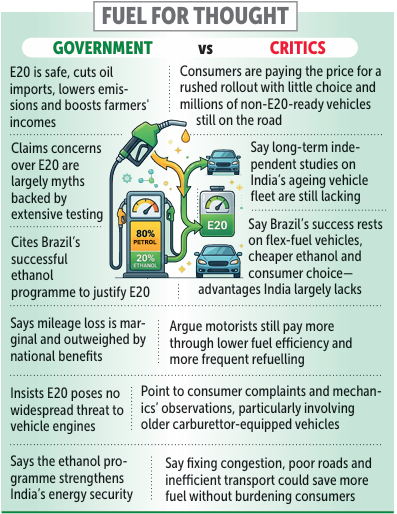
The Union gov ernment’s increasing ly combative defence of mandatory etha nol-blended petrol has done little to quell a widening public back lash, with motorists, me chanics and consumer advocates questioning not merely the science behind higher ethanol blends but also the gov ernment’s insistence on dismissing growing con cerns as ‘myths’ while pressing ahead with a na tionwide rollout. At the heart of the con troversy lies a fundamen tal question: should mil lions of Indian motorists be compelled to use E20 petrol when a significant share of the country’s vehicle fleet was never originally engineered to run on such high ethanol concentrations?

The Centre has repeatedly projected the etha nol blending programme as one of its major pol icy successes. Ethanol blending has risen from less than 1.5 per cent in 2013-14 to 20 per cent in 2025-26, five years ahead of schedule. Accord ing to the government, the programme has saved over Rs 1.90 lakh crore in foreign exchange, sub stituted more than 310 lakh metric tonnes of crude oil, reduced nearly 930 lakh metric tonnes of carbon dioxide emissions and generated more than Rs 1.60 lakh crore in additional income for farmers. Few critics dispute those macroeconomic gains. The growing opposition instead centres on whether those national benefits justify shift ing the costs and risks of the transition onto ordinary motorists without giving them a mean ingful choice.
One of the government’s most frequently cited examples is Brazil, where petrol contains even higher ethanol concentrations than India. Offi cials have repeatedly pointed to Brazil’s wide spread use of E27 as proof that E20 is safe and practical. Critics, however, argue that the comparison is fundamentally flawed because it overlooks the vastly different automotive ecosystems in the two countries. Brazil spent nearly three decades building its ethanol economy after launching the Pró-Álcool programme in 1975. Today, nearly 80 per cent of new cars sold there are flex-fuel vehicles de signed to operate on varying ethanol concentra tions, including pure hydrous ethanol (E100). Motorists can choose between E27 petrol and E100 depending on prevailing prices, while eth anol itself is typically sold at a substantial dis count to compensate for its lower energy con tent. India presents an entirely different picture. The country’s first flex-fuel passenger car was introduced only recently, while most vehi cles currently on Indian roads are fixed-ratio systems designed around E10 or lower blends. Yet India advanced its E20 target from 2030 to 2025, compressing what took Brazil decades into just a few years.
Unlike Brazilian motorists, Indian consumers have virtually no choice at fuel stations. E20 has effectively become the default fuel nationwide, even though ethanol contains less energy than petrol, resulting in more frequent refuelling without any corresponding reduction in pump prices. For many critics, therefore, Brazil is less a val idation of India’s policy than an illustration of how a successful ethanol transition depends on consumer choice, vehicle readiness and gradual adaptation—conditions they argue India has yet to achieve. The government’s defence has been equally emphatic on engine safety. It says extensive testing by the Society of In dian Automobile Manufacturers (SIAM), Auto motive Research Association of India (ARAI), Indian Oil Corporation and vehicle manufac turers found no widespread evidence of engine damage attributable to E20. Maruti Suzuki, Toy ota and Hero MotoCorp also jointly defended the fuel following mounting public criticism. Critics counter that much of this reassurance relies on manufacturer testing and aggregate service data rather than long-term independent studies covering India’s ageing vehicle fleet, par ticularly the millions of older two-wheelers and cars that continue to dominate Indian roads. One Goan rider described a problem that has left him uncertain about whether the fuel played any role. “The bike starts normally but after riding for some time it begins giving jerks even though there’s still petrol in the tank.
It’s only a few months old, so naturally I’m worried. This wasn’t happening earlier. Since so many people have been talking about E20 recently, I started wondering whether that could be the reason.” His experience reflects the uncertainty con fronting consumers who have little means of determining whether fuel quality contributed to vehicle problems. Mileage has become another major flashpoint. Officials have rejected viral claims that E20 re duces fuel efficiency by as much as 30 per cent, arguing that the actual decline is only around three to four per cent. However, that comparison refers to E10 versus E20. Based on the govern ment’s own figures regarding ethanol’s lower calorific value, the overall reduction from pure petrol is closer to seven per cent. Since ethanol inherently contains less ener gy than petrol, critics argue that no amount of engine calibration can completely eliminate the loss in fuel economy. Their concern is less about the exact percentage and more about who bears the financial burden of more frequent refuelling while continuing to pay the same taxes.
Chari, a Goa-based motorcycle mechanic, ex plained a deeper issue, “People have been asking about E20 because they are worried after hear ing so many things. The real difference is that newer BS6 vehicles use fuel injection while older ones have carburettors. In a carburettor, petrol stays inside the system. If the vehicle isn’t used regularly, ethanol can leave moisture behind. Ethanol absorbs moisture and what you notice is almost like vapour forming inside. That’s why people sometimes notice rough running after the bike has been parked.” The government has similarly dismissed con cerns over ethanol’s hygroscopic nature, saying modern fuel systems adequately prevent water ingress. Yet ethanol’s ability to absorb atmospheric moisture is not disputed. Under humid con ditions or when vehicles remain unused for prolonged periods, absorbed moisture can contribute to phase separation and corrosion — conditions mechanics say are hardly unusual in Goa. Ponda mechanic Kishan Naik says older vehi cles used by lower-income households are espe cially vulnerable. “Once the ethanol gets into that cap, it does not even open, it is completely jammed. The ethanol gets stored in the carburetor and it gets blocked. It’s like jelly. We have to clean it.
The thing is, many people from lower-income house holds still use older carburettor-equipped vehi cles. If ethanol is mixed like this, those people will suffer the most.” He added, “There are a lot of such cases com ing. If ethanol goes into the car or scooter and the vehicle remains unused for 8-10 days, there will be a lot of problems. The biggest problem is that if the vehicle is unused for 10-15 days. The entire carburettor gets damaged.” Even as such concerns continue circulating, public sector oil companies insist no widespread problem exists. Responding to queries from O Heraldo, Girish Jain, Executive Director (CC & Branding), Mar keting Head Office, IndianOil, said, “PSU OMCs have not received any adverse feedback from any of our customers or any other stakeholders with regards to negative effects of ethanol blend ing in petrol.
Social media posts have been found to be based around myths and IndianOil, along with other public sector oil companies, is trying its best to clear the misconceptions and myths around the blended fuel.” That assurance, however, sits uneasily along side the experiences reported by several motor ists. Ivan Nazareth, a motor enthusiast, said re peated fuel-system failures forced him to aban don regular petrol altogether. “I replaced three fuel pumps on my Mercedes Benz C200, each costing around Rs 16,000. I lat er started using XP95 in all my vehicles and have had no problems since.” He added, “This issue was caused due to the ethanol mixture. The piston and cylinder were covered in sludge and the engine wouldn’t run because of the friction caused by it. The sludge would not dissolve in petrol and had to be cleaned using a solvent like thinner. I have also faced fuel pipes bursting and fuel pumps getting seized.” While such claims remain anecdotal and have not been independently verified, they under score the widening gulf between official state ments and public perception. Energy security remains the government’s strongest justification. Reducing India’s depend ence on imported crude undeniably strengthens strategic resilience and insulates the country from geopolitical disruptions. Critics, however, argue that the government has framed ethanol blending as the primary solution while paying comparatively less atten tion to far larger and more immediate sources of fuel wastage — from chronic traffic congestion and poor road engineering to potholes, ineffi cient freight movement and weak urban trans port planning.
Addressing those inefficiencies, they argue, could deliver substantial fuel savings without imposing additional costs on motorists whose vehicles were never designed for E20. Perhaps the sharpest criticism of the rollout is that consumers have been left with little agency. Owners of premium vehicles can often side step the issue by switching to higher-grade fuels. A representative of a German automobile brand said, “Normally we advise customers to use premium fuel because these are high-end engines with higher performance requirements. Better fuel helps the engine perform the way it is intended to. So most owners of these high-end vehicles don’t use blended petrol anyway — they prefer premium fuel.” For wealthier motorists, that remains a prac tical option. But for millions of ordinary vehicle owners, it does not.
The controversy appears to be nudging some consumers towards an altogether different tech nology. An electric mobility representative observed, “The government is increasing ethanol blending and that’s one of the reasons many customers have started enquiring about electric vehicles. People don’t want to spend their savings on a ve hicle and then keep worrying about which fuel they should or shouldn’t use.