Vivek Menezes
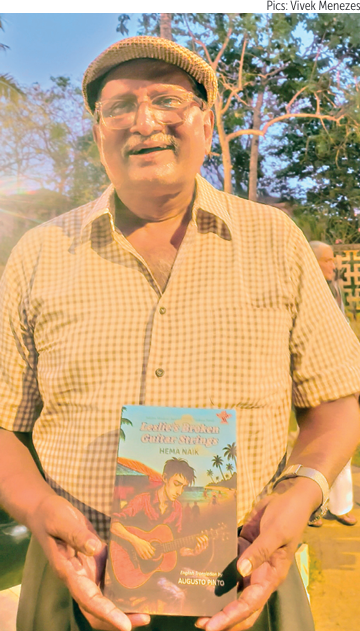
Our steadily burgeoning shelf of quality Konkani literature in English translation has an important new addition as Hema Naik’s 1997 novel Bhogadand (which won the Sahitya Akademi Award in 2002) has been deftly translated by Augusto Pinto, and published by that same Sahitya Akademi as Leslie’s Broken Guitar Strings. It’s an outstanding book that kept me riveted throughout its 284 pages, easily ranking amongst the most significant contemporary literary achievements on and from Goa.

Bhogadand’s mise en scene is Santo Estêvão in the 1980s, where “there aren’t any fights or conflicts among the two communities who populate the village but this doesn’t mean that they live unitedly. There is scant friendship among them. They all live on the same island, it’s true, but nobody visits the other for anything apart from their work. Hindus from outside Jua eat and drink at the homes of the Christians here, but the Hindus from Jua itself will not even have a cup of tea in the houses of the Christians. The one thing that both of them readily share is money because there’s nothing untouchable about money. The village bristles with money: there are no less than three banks in this little village and all three do good business.
The money that gets deposited in these branches is used to advance loans in other branches. All this money comes from abroad. Every day money comes from postal drafts; besides this, every now and then some agents come to the village to exchange money sent through hundis, a kind of unofficial bill of exchange. But although there is a lot of money flowing in the village, the people aren’t good at accounts. When it comes to counting above twenty, their foreheads begin to crease and they break out into cold sweat.” In this way, we see that Hema Naik possesses an unerring eye for revealing details, and it is also clear how meticulously hard Augusto Pinto has worked to bring that rare sensibility into English, so Leslie’s Broken Guitar Strings races along without any of the flubs and faltering that so often lets down Konkani translations.
I found myself very quickly drawn into the rich interior worlds of these unforgettable characters: the hapless protagonist and his mother Antonette, and Gemma, the new bride they bring into their world in transition. What is more, I am already sure they are going to stay with me for a long time, an unexpected gift that has earned my gratitude as well as the conviction this book is an instant classic that will be read, studied and appreciated for many years to come. To be sure, this is not the first time that Pinto has demonstrated remarkably good taste in expanding the canon of Konkani literature in English translation. And, in recent years he has indeed – as the bio-note on the back of this book says – “played an important role in making this region’s writing accessible to a broader readership.” In the translator’s note for this new book, the Moira-based ex-Professor of English and incisive critic/essayist says his engagement with this text began with an online review in which “I explained how Bhogadand portrays the trials of Goans who migrated to countries like Kuwait, Bahrain, Qatar, Oman, the UAE, and Saudi Arabia. These countries drew Goans seeking escape from unemployment and poverty, especially after the 1970s oil boom.
However, while professionals could take their families along, workers such as drivers, cooks and servants could not and had to live apart from their spouses for long periods. These forced separations and their emotional costs lie at the heart of Naik’s novel.” An overseas journal asked Pinto to translate some of the text, and he says “when I approached Hema Naik for permission to publish the translated excerpt, she urged me to translate the entire novel for the Sahitya Akademi, which supports translations of their award winning works.
Incidentally, Naik revealed that Bhogadand began as a radio play entitled The Account May Be Closed before she translated the story into a novel.” It was a fortuitous conversation, which yielded an impressive result. Pinto has done an excellent job bringing Naik’s superb novel into English, while simultaneously situating her work in the context it deserves. Here’s his insightful summary: “Hema Naik, now 73, is a pioneering voice in Konkani literature – a fearless storyteller who brings Goan womanhood into sharp focus.
Her short stories like ‘Nimane Sanskar’ and Durgavatar’ explore women reclaiming agency amid societal change. The rhythms of Goa – its beauty, contradictions and quiet defiance – reverberate throughout her work. A key figure in the Konkani movement since the 1970s, naik also founded Apurbai, a publishing house dedicated to marginalized voices. A gifted translator herself, she bridges worlds through her literary work. Bhogadand, which I have rendered as Leslie’s Broken Guitar Strings, delves into themes of women’s identity, love and resistance.
Naik drew inspiration from her observations of village life while working as a bank clerk from 1975 to 1995 – a period when Goan society was undergoing dramatic shifts. Educated women were asserting themselves more strongly, and Naik captured this change through her characters. Though the novel centers on the Goan Catholic community, its insights extend across communities. Naik herself exemplifies this assertive spirit through her leadership in the Konkani literary world.”