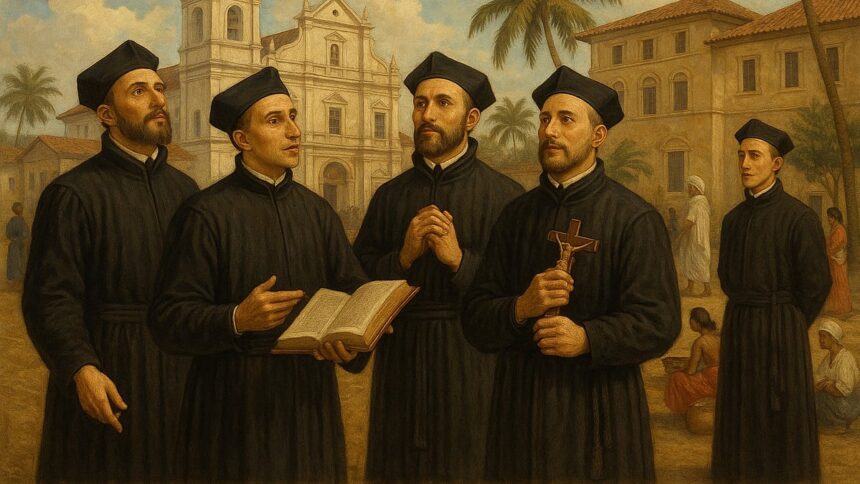
Goa’s 16th century witnessed a religious and cultural transformation as missionary zeal turned the territory into a hub of Christianization. The Franciscans were the first to arrive with the Portuguese, followed by the Jesuits in 1542 and the Dominicans in 1548. By 1554–55, the Portuguese authorities were compelled to divide Goa’s religious jurisdiction among the three orders: the Franciscans were assigned Bardez, the Jesuits Salcete, and both Jesuits and Dominicans shared Ilhas. The Augustinians joined later, in 1572.
The arrival of St. Francis Xavier in 1542 and the establishment of the Seminary of Santa Fé in 1544 paved the way for a steady influx of Jesuits into Goa. Known as the “schoolmasters of Europe,” many were highly educated, with several trained at Paris’ Sorbonne. Their intellectual rigor, organizational methods, and missionary zeal won admiration but also stirred controversy. Their influence grew so strong that they were eventually expelled from Goa in 1759, though their legacy endures more than 250 years later.

Salcete: The Jesuit Stronghold
Salcete became the mainstay of Jesuit activity. Here, they built 25 churches, each distinct in size and façade, yet all carrying identifiable Jesuit motifs. The Jesuit monogram IHS appears prominently, alongside the dove of the Holy Spirit, often above the main altar or façade. The Church of the Holy Spirit in Margão famously features a dove with an unusual torso, a design believed to have been outlined by Jesuit architect Br. Francisco Aranha.
Devotions introduced by the Jesuits also shaped Goan spirituality. Many churches and homes housed altars to St. Michael, St. Sebastian, St. Roque, and St. Anna, saints particularly venerated in the Iberian Peninsula. Curiously, St. Bartholomew, despite being patron of some churches, was gradually sidelined, possibly because of the similarity of his name to the local deity Betal.