AMAN VERMA
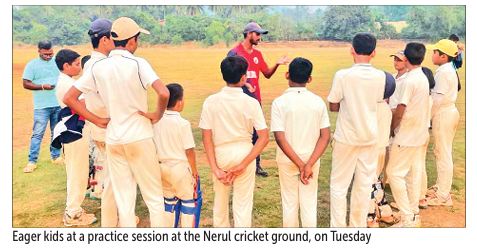
A young batter takes guard at an acad emy ground in Goa, eyes steady and bat raised — ready not just to meet the ball, but to meet a dream. Around him, there are no roaring crowds, only the continuous thud of leath er on willow and the qui et intensity of practice. In his mind, though, it is a World Cup final. It is not the first time a World Cup has stirred a generation. When India first lifted the trophy in 1983 under Kapil Dev, it ignited the imagina tion of a young Sachin Tendulkar — a spark that would grow into one of cricket’s greatest careers. Decades later, that ripple effect is qui etly taking shape again, this time across Goa’s academy grounds and training nets. For 13-year-old Sat yam Rana, an under-14 State fast bowler, the inspiration is clear. “My dream is to play for In dia and win the World Cup for the country,” he says. A pacer who looks up to Jasprit Bumrah and Mitchell Starc, Sat yam has already built a disciplined routine. His day begins at 4 am with fitness training, fol lowed by long hours in the nets. Once a batter, he was guided by his coach to switch to fast bowling — a decision that now defines his path. “I keep working on my pace, line and length. I just want to improve every day,” he says, adding that India’s World Cup win has sharpened his focus. “When you watch bowl ers perform on that stage, you feel like you also want to be there one day.” Like many his age, Satyam remembers not just the result, but the moments — the pressure overs, the celebrations and the sense of a team winning together. Those memories now travel with him into every practice session. Beside him, Ayush Yadav, another under-14 State cricketer, has mapped his journey with striking clarity. A right-handed opener inspired by Rohit Sharma, Ayush out lines his goals step by step. “I want to first play for Goa, then the Ranji Trophy, then the IPL and finally for India,” he says. His approach at the crease reflects patience. “I like to set tle first and then play my shots,” he explains, noting that India’s victory has strengthened his belief. “It shows that if we work hard, we can also reach that level.” For Ayush, the World Cup was also a lesson in temper ament. Watching players handle pressure on the biggest stage has reshaped how he approaches his own game — staying calm, building innings and finishing strong. At the grassroots level, the spark is even more intense. Naveen Chauhan, an under-12 cricketer training at the Kreeda Prabodhini Cricket Academy in Porvorim, repre sents that early stage of ambition. A right-handed batter and wicketkeeper inspired by MS Dhoni, Naveen is already developing his approach. “I like to start slow and then build my innings,” he says. “Watching India win feels great. It makes me want to prac tise more.” For players like Naveen, the impact is visceral — the vis uals of lifting the trophy, the celebrations, the energy of the moment — all of it feeds into everyday training, making each session feel purposeful. Beyond individual stories, the system around these young cricketers is also evolving. Sahil Dhuri, Chairman of the Junior Selection Committee of the Goa Cricket Asso ciation (GCA), says participation at the grassroots level is clearly on the rise. “We are seeing more youngsters coming for selections and camps. The interest at the grassroots level is definitely increasing,” Dhuri says. Yet, he emphasises that talent alone is not enough. “Tal ent is important, but consistency is what makes a player. Children need to practise regularly and stay committed to the game,” he adds. The GCA, he notes, is working to strengthen junior struc tures by creating more opportunities and exposure. At the same time, he flags a recurring challenge — parental pressure. “Sometimes parents expect quick results or push chil dren too much. Cricket is a long journey. Kids need time to learn and grow,” he says. “If parents support their children with patience and allow them to develop naturally, the re sults will come.” Coach Malinder Singh, who works closely with young players, echoes that concern. While opportunities have ex panded, he says, a lack of focus can hinder progress. “Nowadays, some parents put their kids into multiple ac tivities at the same time. It creates confusion and affects focus,” Singh says. For him, clarity and routine are non-negotiable. “If a child wants to pursue cricket seriously, they need to give it proper time and consistent effort,” he says, reinforcing it with a line he repeats to his trainees: “If your practice is easy, trials will be tough. But if your practice is hard, trials will be easy.”