Following Goa’s Statehood in 1987, the State operated with North Goa and South Goa districts until December 2025. Under Section 3(1) of the Goa Land Revenue Code, 1968, the government has now created the Kushavati district. Carved from South Goa’s hinterland, this new district aims to decentralise governance with a focus on the tribal, forest-rich southern belt.
VITHALDAS HEGDE and SHYAM ZAMBAULIKER report

The formation of Kushavati district aims to bring governance closer to communities that previously depended on Margao for even basic administrative services. The new district comprises Quepem, Sanguem, Dharbandora and Canacona talukas with its headquarters in Quepem. Nearly 27 per cent of the population of these talukas belongs to Scheduled Tribes (ST) communities, making Kushavati a priority zone for social justice and inclusive development.
An identity rooted in nature
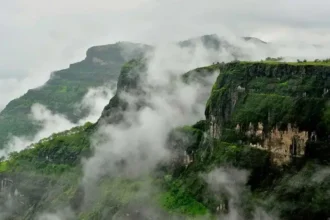
Far removed from the nightlife-driven image of coastal Goa, Kushavati represents a quieter, deeper landscape defined by dense forests, sacred rivers and the rolling hills of the Western Ghats. The Kushavati river lends more than just its name. Its banks host the renowned Usgalimal Petroglyphs, prehistoric rock carvings estimated to be 20,000–30,000 years old, among the earliest known evidence of human habitation in India. Kushavati contains the largest share of Goa’s forest cover and protected wildlife zones, making it the ecological backbone of the tiny State.
Iconic landmarks
Bhagwan Mahavir Wildlife Sanctuary; Netravali Wildlife Sanctuary, a haven for birdlife and trekkers; and Cotigao Wildlife Sanctuary, famous for its rare multi-storied forest canopy, besides the lone Mollem National Park, fall in the Kushavati district. Dudhsagar Falls, one of India’s tallest waterfalls, now falls within Kushavati’s district boundaries. Besides Salaulim dam, known for its “duckbill” spillway design, Palolem and Agonda beaches—holding some of South Goa’s most tranquil coastlines—will have strong potential for eco-tourism centred on forests, rivers and tribal culture.
Strengths and challenges
The residents of the new district welcome improved access to government services, administrative convenience and increased government funding. As far as challenges are concerned, Quepem requires major infrastructure upgradation to function effectively as a district headquarters. People have sought better public transport connectivity in the new district, while for residents of Canacona, taluka access to Margao was more familiar than Quepem.
Kushavati is far more than a new administrative boundary—an acknowledgment of Goa’s hinterland identity. For residents, the new district represents the promise of responsive governance and targeted development, while rivers, forests and ancient cultures still shape everyday life. While the transition may bring short-term challenges, the district’s emphasis on tribal welfare, ecological preservation and sustainable growth makes Kushavati a meaningful administrative reform in Goa’s recent history.
However, critics maintain that Goa has functioned effectively with two districts for decades and that improved management and digital governance could address current challenges without creating a new district. Concerns have been raised over the high costs involved in building new district-level infrastructure, including offices, staff housing and roads, which could eventually place a financial burden on the public. There are also fears that the announcement could lead to a sharp rise in land prices in the proposed district, benefiting investors but making housing and commercial spaces less affordable for ordinary citizens.
“The new Kushavati district will not only strengthen administrative efficiency but also accelerate the region’s economic and social development,” says former Deputy Chief Minister Chandrakant ‘Babu’ Kavlekar. Thanking the government for naming the new district Kushavati and designating Quepem as its administrative centre, Kavlekar said, “Previously, Quepem held sub-divisional and administrative importance for South Goa. The offices of the Deputy Collector and the Sub Divisional Police Officer (SDPO) for Quepem, Sanguem and Canacona operated from here, and candidates from these talukas would file their nomination papers for elections in Quepem itself. Hence, Quepem was the natural choice for the Kushavati district headquarters.” “The creation of this district will not only ease administrative processes but also usher in long-term socio-economic transformation,” he said.
“The new Kushavati district will not only strengthen administrative efficiency but also accelerate the region’s economic and social development.”
— Chandrakant ‘Babu’ Kavlekar, former Deputy Chief Minister
“South Goa lacks essential institutions such as benches for the Administrative Tribunal, Real Estate Regulatory Authority (RERA), the Human Rights Commission, the Children’s Court, and the Police Complaints Authority.”
— Adv Pritam Morais, former Special Public Prosecutor
“The establishment of new government offices could generate employment opportunities for local youth and lead to faster delivery of services such as revenue matters, certificates, welfare schemes, and grievance redressal.”
— Vidhata Dessai, prominent civil advocate
“I welcome the government’s decision to create the third district Kushavati. The move would be meaningful only if proper infrastructure is provided.”
— Adv Sanjit Desai, Quepem and Sanguem Advocates’ Association president
From ‘Atal’ to ‘Kushavati’
The Kushavati River is a tributary of the Zuari River, one of Goa’s major waterways, and flows mainly through the South Goa region. The river originates near Nunde in the Sanguem taluka and flows through areas including Netravali Wildlife Sanctuary, Quepem and other villages, before meeting the Zuari River at Xelvona, near Curchorem.
After the government finalised the creation of the third district, it initially considered naming it ‘Atal’ after former Prime Minister Atal Bihari Vajpayee. The name was widely mentioned, but a day later the government took a formal decision and officially named the new district after the Kushavati River that flows through the region. According to former Deputy Chief Minister Chandrakant ‘Babu’ Kavlekar, naming the third district Kushavati is apt because the river flows in the district. Various names were considered, including Atal, before announcing Kushavati.
“When we were discussing with Chief Minister Pramod Sawant, the latter told us that it came to his mind to name the new district as Kushavati. We all liked it because the river flows in this district,” Kavlekar said.
Canacona opposed to inclusion
Residents of Canacona taluka are against the inclusion of the Canacona taluka in the third district. They have also passed a resolution in this regard and have warned the State government to be prepared to face an agitation if the decision is not reconsidered.
Though the villagers claim that the decision was taken unilaterally and without public consultation, they are mostly worried about the lack of transport connectivity from Canacona to Quepem, besides the lack of infrastructure in Quepem, which will be the headquarters of the new district.
The villagers are of the strong opinion that routine travel to Quepem will be difficult due to poor transport connectivity. They have also highlighted other issues such as the district hospital and the district courts.