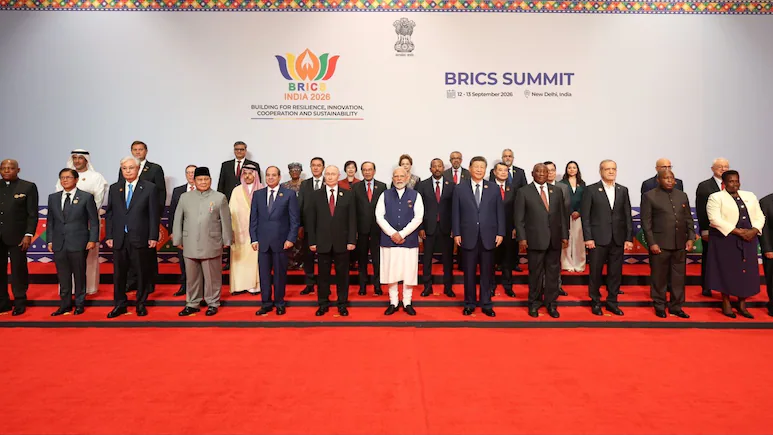
India’s hosting of the expanded BRICS summit in New Delhi has emerged as a significant diplomatic moment, with the grouping bringing together countries with competing geopolitical interests at a time of wars, economic uncertainty and growing global divisions.
Speaking on Hindustan Times’ Point Blank, Executive Editor Shishir Gupta said the summit demonstrated India’s ability to maintain relationships with rival power centres while avoiding a rigid alignment with any one bloc.

The presence of leaders and representatives from countries including China, Russia, Iran, Saudi Arabia, the UAE, Egypt, Ethiopia, Malaysia and Indonesia highlighted BRICS’ growing importance as a platform for the non-Western world.
Gupta said the grouping should not be viewed as a military or ideological alliance, but as an increasingly influential forum for discussions on global governance, security, technology, finance and the interests of the Global South.
One of the biggest talking points was Chinese President Xi Jinping’s visit to India after seven years and his meeting with Prime Minister Narendra Modi. Gupta said the talks appeared substantive, but cautioned against viewing them as evidence of an immediate India-China thaw.
For New Delhi, the border remains central to the relationship. India wants peace and tranquillity along the Line of Actual Control before broader ties can make sustained progress. Past episodes, including the Chumar incident, Doklam and the 2020 eastern Ladakh tensions, have reinforced India’s caution.
Gupta described India and China as competitors rather than inevitable military adversaries, suggesting that competition could still be managed through dialogue and diplomatic engagement.
The summit also placed BRICS’ potential role in ongoing conflicts under the spotlight. On Ukraine, India has continued to call for dialogue and a negotiated settlement while maintaining communication with both Russia and Western countries. The presence of Russia, China and India within BRICS could provide an additional channel for diplomatic messaging, although the grouping alone is unlikely to resolve the conflict.
West Asia presented another major challenge. Growing tensions involving Iran, Israel, Gulf countries and Iran-backed groups have threatened key maritime routes, including the Strait of Hormuz and Red Sea. Any disruption could affect energy supplies, shipping costs and global trade.
The participation of Iran, the UAE and Saudi Arabia was therefore particularly significant. Their presence demonstrated that countries with serious regional differences can still engage within the same diplomatic framework.
Gupta also highlighted India’s strategy of multi-alignment. New Delhi continues to work with Russia and China through BRICS while simultaneously deepening defence and technology cooperation with the United States and its partners.
India’s engagement with GE Aerospace, including the supply of F404 engines for Tejas and progress linked to F414 engine technology, reflects this approach.
The larger significance of the summit, therefore, may not lie in an immediate breakthrough on any single conflict. Instead, it showed India’s growing ability to convene competing powers, keep diplomatic channels open and push for a more representative international order.
As Gupta’s assessment suggests, New Delhi’s BRICS strategy is less about choosing sides and more about ensuring India remains influential across multiple centres of global power.