Hindi Diwas is observed every year on September 14 to mark a crucial moment in India’s constitutional history, when the Constituent Assembly adopted a compromise on the language question in 1949.
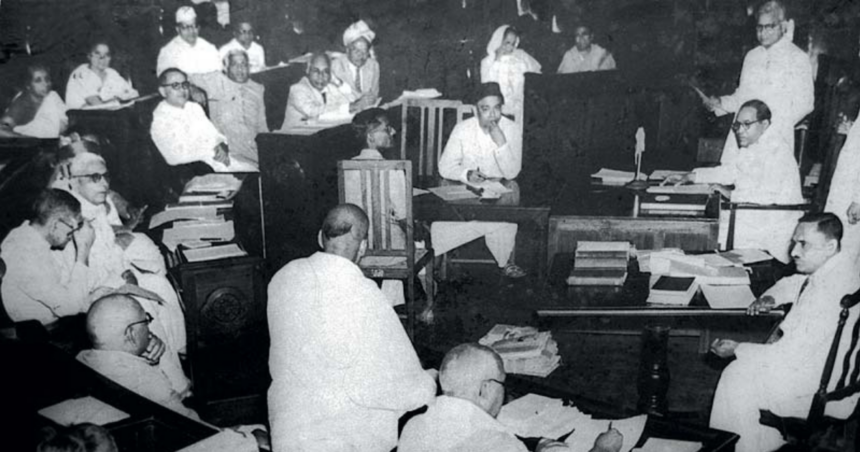
The issue of language was among the most contentious subjects debated by the Constituent Assembly as independent India worked on framing its Constitution. Members held sharply different views on whether Hindi, Hindustani or English should have a central role in the country’s official functioning.

The intensity of the debate was visible during one of the Assembly’s early sessions when RV Dhulekar, a Congress leader from the United Provinces, strongly argued that Hindustani should be used in the proceedings of constitution-making.
When it was pointed out that several members of the Assembly did not know the language, Dhulekar responded aggressively, arguing that those who did not know Hindustani were not fit to be members of the Assembly. His remarks triggered an uproar in the House, forcing the Chairman to intervene and restore order.
The episode reflected the larger disagreement over language in a country marked by enormous linguistic diversity.
After years of discussion and political negotiations, the Constituent Assembly eventually reached a compromise on September 14, 1949. The arrangement is commonly associated with the Munshi-Ayyangar formula, named after KM Munshi and N Gopalaswami Ayyangar, who played important roles in shaping the language provisions.
The compromise avoided describing Hindi as India’s ‘national language’. Instead, Hindi in the Devanagari script was designated as the official language of the Union.
At the same time, English was allowed to continue being used for official purposes for 15 years after the Constitution came into force. The arrangement was intended to provide a transition period while allowing the government and administration to gradually adapt to the new linguistic framework.
The language provisions eventually became part of the Constitution under Article 343 and related provisions.
However, the debate did not end with the Assembly’s decision. Language continued to be a politically sensitive subject, particularly in states where there was strong opposition to the idea of Hindi being imposed as the sole language of official communication.
The eventual continuation of English beyond the initial 15-year period also reflected the practical difficulties of replacing it across administration, higher education, judiciary and other areas.
September 14 came to be observed as Hindi Diwas in recognition of the Constituent Assembly’s 1949 decision. The day is marked through programmes, literary events and official initiatives promoting Hindi.
The history of Hindi Diwas, however, goes beyond celebrating a language. It also offers a reminder of the complicated negotiations that shaped India’s linguistic framework.
Rather than choosing a single ‘national language’, the Constitution established an official-language arrangement while recognising the country’s wider linguistic diversity. The compromise remains an important example of how India’s Constitution sought to balance competing regional, cultural and administrative interests.