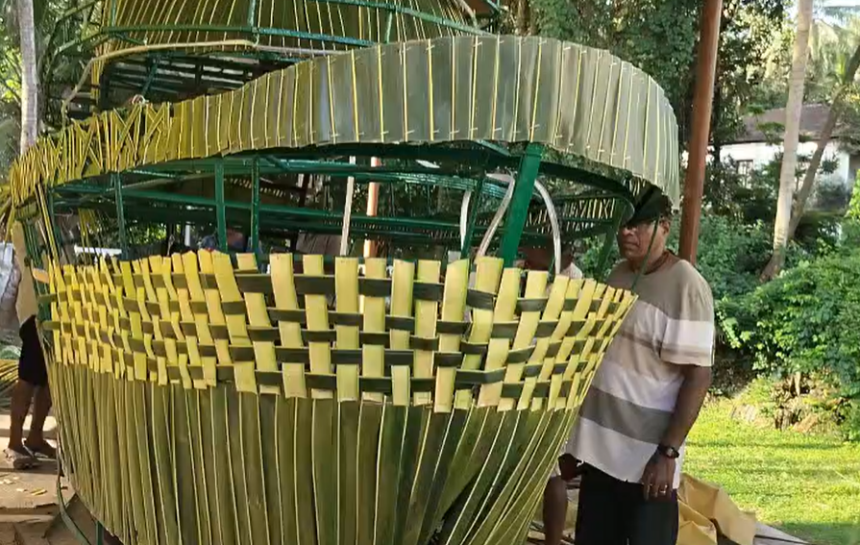
MAJORDA: A unique tradition that has survived generations continues to bring the people of Majorda together during the feast of Our Lady of Monte. On the feast day, beautifully crafted boats made from bamboo and decorated entirely with palm leaves are brought to the church, laden with flowers to be offered to Mother Mary.
While the religious celebrations of the feast, formerly known as the Monte Saibinnchem Fest, are similar to those held in churches across Goa, this distinctive boat tradition sets Majorda apart.

According to Cleto Godinho of Majorda, along with inputs from other members of the community, the tradition has its roots in an old vow made by local seafarers.
A vow made at sea
In earlier times, it was customary for villagers to collect flowers from their home gardens and fields for the novenas and feast of Our Lady of Monte. The flowers were carried in beautifully decorated palm-leaf baskets known as banjetio.
Many people from Majorda were seafarers, and according to the community’s oral history, one group of villagers once faced a life-threatening storm while at sea. Fearing that their boat would sink, they prayed to Mother Mary and vowed that if they survived, they would bring flowers to her feast in a boat rather than in the traditional banjetio.
The seafarers survived the storm and, in fulfilment of their vow, began the tradition of carrying flowers in a small boat-like structure made from bamboo and decorated with palm leaves.
In the earlier years, two boats were made — one by the people of Majorda and another by the people of Calata. The boats were brought into the church and placed before the altar. Following the High Mass, the flowers were blessed and offered to Our Lady, after which the boats were taken back to their respective wards or villages, with crackers being burst along the route.
Today, the flowers are generally offered at the beginning of the Mass, while the decorated boats are displayed in front of the church.
A tradition more than a century old
The exact origins of the custom are difficult to establish, but its continuity through generations points to a history of more than a century.
The oldest surviving boat decorator, now in his late 80s, learnt the craft from his father. This oral transmission of the skill provides an important link to the tradition’s past.
Over the years, however, the custom faced several interruptions. Migration from Goa in search of better opportunities, the advancing age of those involved in making the boats and financial difficulties contributed to its decline.
Around four decades ago, the Active Youth Association made an attempt to revive the tradition. However, the initiative eventually came to an end following differences within the community.
The tradition was revived again around 14 years ago and has continued ever since, apart from the two years during the COVID-19 pandemic.
From competition to community spirit
For many years, the making of the boats was viewed as a friendly competition between Majorda and Calata. Today, however, there is no competition. Instead, the tradition has become an exercise in community participation and cooperation.
Members from different wards and vaddos come together, sharing ideas and dividing the work involved in constructing and decorating the boats.
From Calata, Augusto Crasto and Belinda ‘Sweety’ Rodrigues highlighted how the activity has helped strengthen community bonds since its revival.
From Dongorim de Majorda, Milagres Pereira said elders, youngsters and children all come together like one family to prepare the boat. Once completed, the boat is taken to the church and filled with flowers for offering to Mother Mary.
Xavier Pereira of Majorda said members from various wards affiliated with the Chapel of Our Lady of Milagres come together to decorate the boat, united by a desire to preserve the tradition of their forefathers. For the community, the activity is as much about teamwork and togetherness as it is about religious devotion.
Godinho, a former member of the Active Youth Association and past member of the Parish Pastoral Council, was among those involved in the revival of the tradition.
Why only palm leaves?
One of the most striking aspects of the boats is their decoration. No elaborate modern materials are used. The boats continue to be covered with palm leaves, just as they were traditionally.
The community believes that palm leaves were used because they were readily available locally in earlier times. Continuing to use them today not only preserves the authenticity of the tradition but also makes the practice environmentally friendly.
Keeping an old promise alive
What began, according to local oral tradition, as a vow made by seafarers caught in a storm has evolved into a cherished annual expression of faith, memory and community spirit.
With younger generations now taking part in the making of the boats, Majorda’s palm-leaf vessels continue to carry more than flowers. They carry the story of a community, the faith of its ancestors and a tradition that has survived changing times.
In an era when many traditional customs are gradually disappearing, these humble boats remain a reminder that heritage can survive when a community chooses to keep it alive.