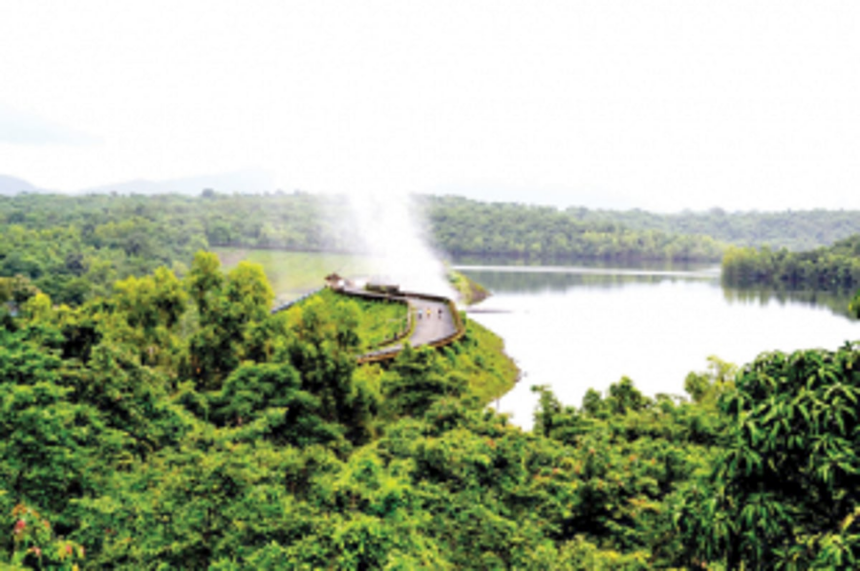
Earlier this week, the PWD issued a notice that water supply to South Goa from the Selaulim 185 MLD water treatment plant would be shut for 2-3 days till the high manganese content in the raw water is brought within permissible limits.
An alert of this kind naturally evokes a sense of alarm given that the Xelpem based treatment plant supplies to Salcete, Quepem, Mormugao and part of Sanguem.
However, for the PWD, this is a ‘routine’ notice that has been issued every year even after the mining ban was imposed in 2012.
In fact, manganese levels peak three times a year – during the monsoon in June and July, in November when they open the canal to release excess water and lastly during May when water level decreases at the bottom level of the reservoir and concentration of manganese in soluble form is high.
The situation is such that when manganese level is within the manageable level the PWD is in a position to lower manganese content by filtration.
So when the manganese content exceeds the permissible level, it affects the water supply as the filtration process requires more time for filtration, thereby bringing down the rate of filtration which results in a shortfall in supply of treated water considerably.
“There are several reasons why this is a recurring issue. The biggest is the perception of the government that they had done their part with regard to the mining ban and the environment will take care of itself and conditions would be restored to normal just because mining has ended. The damage done in the catchment area and within the buffer zone of the treatment plant due to years of unregulated mining is severe,” said Amit Shetye, a Quepem resident who has been following up the issue.
“This is an old water treatment plant that was constructed in the 1990s and so the technology is outdated. The plant needs a revamp and renovation and large scale upgradation can happen only once the 100 MLD JICA plant is made operational,” said staff at the site.
They also pointed to an increased demand for water which does not leave much time for the treated water to settle down.
PWD Minister Ramkrishna ‘Sudin’ Dhavalikar however, insisted that the PWD was keeping a check on the dam on absolute priority and taking care of all adversities including technical issues like power outages at time and yet ensuring that the water supply was not disrupted and people not inconvenienced.
PWD officials said that all the 14 filters are being cleaned everyday and soluble manganese removed along with turbidity, simply by flocculation followed by sedimentation and filtration.
Concurring, Dhavailkar pointed out that the PWD cleans the filters more frequently than before and that earlier 700 kg lime stone was used to treat the water but now the department is using 1,200 kg of lime stone for treatment.
The staff explained that the mixture of alum in the water treatment process is kept to the bare minimum on account of low turbidity of raw water at the plant.
Elaborating on how the increased concentration of manganese in raw water is dealt with, they said that one way is by increasing aeration, so that the manganese on coming into contact with air forms manganese dioxide and goes out; whereas the alternate method is by subjecting water stored in a settling tank to diffused air.
Thus the restricted water supply can’t be avoided as it is needed to facilitate thorough cleaning of the filtration bed, to bring down the high level of manganese content.
Admitting that the filter beds get chocked often, they said that presently manganese, sand particles and other minerals in insoluble form are chocking filter beds and this increases the treatment time due to frequent back-washing, excess pumping of raw water and thereby decreases efficiency of the treatment plant
They added that the laying of a pipeline on the entire route of the 100 MLD water supply scheme is done and the pending work should be completed soon.
The inauguration of the 100 MLD water supply scheme would enable authorities to start work on rehabilitation of the existing water supply scheme.
However, he also said that once the new plant of 100 MLD water gets commissioned, two different pumps will be installed at different depths. He said that waste water will not be discharged in open soil which is done at present but it will be treated before discharge.
Dhavalikar confirmed this and said the whole problem would be resolved only when the other treatment plant at Sanguem is commissioned.
Incidentally, as per Dhavalikar’s prior announcements, the 100 MLD water supply treatment plant was to be completed in January 2014 then January 2015, to April 2015 to December 2015 but ‘technical’ delays have only compounded the problem.
Ironically the local population that lives in Selaulim near the dam does not receive water from the treatment plant even though they were displaced to accommodate the damn. Their condition has not improved as the 3,500 people who live in rehabilitated area near Selaulim dam, had been suffering from water shortage.
Worse, all the panchayats of Sanguem have been suffering from water shortage and to their cries, Dhavalikar has used the same promise that once the 100 MLD plant is commissioned, their problems would be solved too.
“Sanguem is the largest taluka of Goa with an area of 836 sq km. This taluka has to its credit 295 mining leases. It has a forest area of 578 sq km with Goa’s largest reservoir called Selaulim which supplies water to majority of Goa’s population. The irony is that people from Salcete taluka hold maximum mining leases in Sanguem and consume 23% of the total water supplied, where as Sanguem people consume only 2% of tap water,” said anti mining crusader Ramesh Gawas.
He added that the 15 plus mining leases in the catchment of this reservoir where there were illegal mining operations led to contamination of the catchment area in the catchment area, the adjoining reservoir banks, endangering the reservoir and rapidly increasing its siltation rate.