While about two centuries and four decades ago, through a royal decree the village of Mathgram was elevated to a town by the then Queen Dona Maria I of Portugal on April 3, 1778.
However, the focus of the city and town planners today is perhaps on new buildings, malls, shopping arcades, mega projects and expansion into the suburbs of Fatorda, Borda, Aquem, Housing Board, Ambajim and other parts, while history and heritage lies literally in the ruins and is long forgotten.
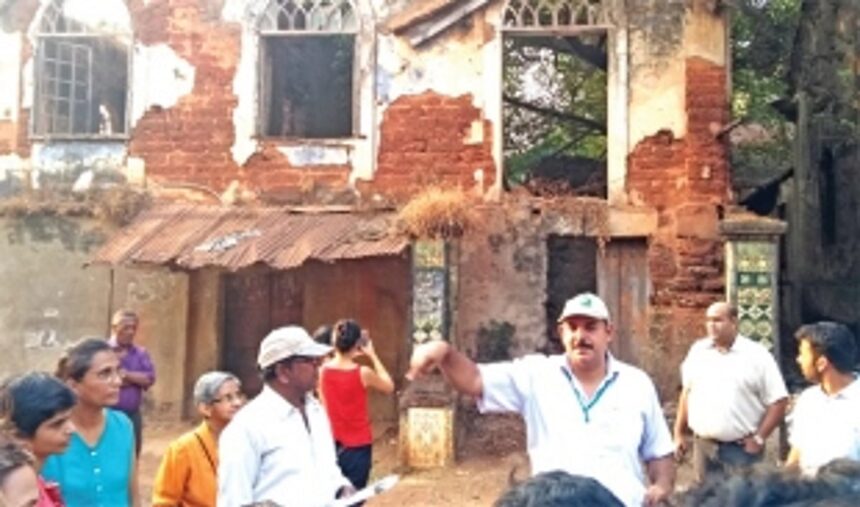
We start the week by attending a heritage walk to reiterate the neglect of the city’s heritage, which were once points of business, trade and bustling with social life.
Earlier, the city centered around the Holy Spirit Church Square, where village mannd once existed and also the place where village elders met in the evenings.
Also in the vicinity is the site of the grim reminder of the famous massacre of 1890 that saw 23 people dead. The bullet-riddled walls and marks elsewhere on a few homes around still bear testimony to the gruesome act. But sadly, what should be preserved for posterity is now crumbling and on verge of turning rubble from ruins. Most of these conservation zone homes are crumbling and most are in a dilapidated condition with desperate owners hoping that the government would provide some relief through funds to repair and restore these homes to its past glory.
One of the first structures that presents itself, besides Holy Spirit Church, is the former Multipurpose College or rather Technical College building named after the famous Doctor Agostinho Vicente Lourenco, founder of the popular Bansen Labs and very well-known in Portugal.
In fact, there is even a bust of this the late scientist in the Margao Garden. The building now houses the Education Department office and a primary school.
Ironically, lack of proper signboards, coupled with poor knowledge regarding the historical place, this heritage building, which has a RCC extension now has its architecture desecrated by government-employed drivers, who have shabbily painted the registration numbers on the front of the building hoping to reserve their parking.
“We are not told how to reserve our parking or neither are we provided barricades for parking. The Sarva Siksha Abhiyan officials in charge of this building gave us permission to write the vehicle registration numbers on the walls and hence we went ahead and did this,” states one of the official drivers.
A few paces away, the old market complex, named after the famous Portuguese explorer Vasco da Gama too lies uncared and unkempt.
In fact, this market, which was once the main market of the city, has today become a gambling and Matka den, with gambling agents taking bets illegally for IPL, World Cup, ISL and matka. Yet, those who wield powers to end this menace instead prefer to look the other way!
“These Matka agents are sub leases of the previous vendors that once occupied this market. These are also a lot of illegal encroachments and gaddas. We want to acquire this entire space and push for a nice heritage styled tinto, currently the budgets are being worked out and next is the challenge of acquisition, explains the councillor of this area, Glen Andrade.
Glen underlines that Rs 11 crore is sought to acquire the old Municipality building, which is currently in ruins, but still houses a coffin shop and two other structures that belong to the Margao Monte Chapel and others.
He said the original owners and tenants will be bought out and an attempt will soon be made to restore, complete and re-create this structure known for shoot-outs and massacres, which is believed to have collapsed in 1905.
While Chairperson Babita Prabhudessai hopes the government announces a heritage policy and conducts surveys to identify structures within the city that are to be restored and maintained.
Expressing the need for proper documentation of historical records, she said for the first time MMC has set aside a budget to maintain the furniture and building of the 138-year old municipal building, which she says is impossible to maintain and manage.
Lynn Barreto Miranda explains that it’s not just the old market which is now a gambling den, but the famous New Market in Margao town, built in 1912 is filled with encroachments and has unsafe electrical tapings. This historical building named after Afonso Albuquerque is now forgotten and is better known now as New Market or MMC Market.
Similarly, among other heritage structures is the 150-year-old chapel, attached to the Hospicio hospital, which celebrates mass every Sunday at 8.15 am, but unfortunately is not accessible to locals as the front gates of the Hospital are never open.
“The chapel is maintained and managed by the nun of Missionaries of Charity and we even distribute communion to ailing patients at the Hospital. While three of the Missionary of Charity nuns work full time at the hospital, a priest from Holy Spirit Church celebrates mass here,” explains Sister Lydia. Businessman Ameet Pinto tells us how he was never aware of the beauty of this chapel only because of the unwelcoming closed gates.
It is also sad to see the condition of the old guardhouse besides the civil court. The guardhouse once synonymous to the jailhouse within the court premises is now a dumping ground for garbage.
“The old civil court itself houses a chapel of St Francis Xavier and even Fatima Convent ran from these premises once but the chapel and the old barracks are in shambles and these spaces are hardly open to general public,” states lawyer Rajiv Naik.
The court is to be shifted soon at it is under construction, plans are on to convert the old court into a museum kind of a structure.
“The saddest aspect is how the Damodar Sal once housed the famous Swami Vivekanand and the room still exists in pristine conditions just the way it was when he left, but the government does nothing to create this space into a public viewing. Even the constant traffic adds to the dust and deterioration of the items in the room, explain the devotees who visit the temple.