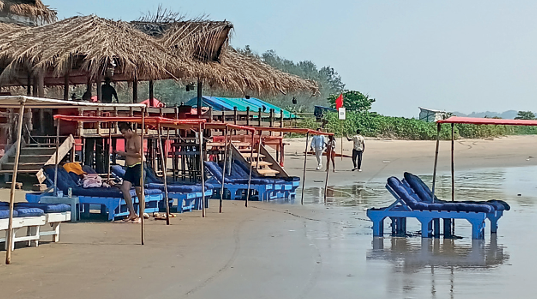
The manner in which the Department of Tourism has demar cated spaces for shacks and beach beds at Mor jim beach this season has raised serious concerns within the Department of Forests and left wildlife enthusiasts wondering why the conservation of Olive Ridley turtles — an endangered species un der Schedule I of the In dian Wildlife (Protection) Act, 1972 — appears to have been pushed to the backburner. On Thursday, O Heraldo reported how a wedding reception with loud music, bright lights and fireworks was held less than 50 me tres from the high tide line at Mandrem beach, a site officially notified as an Olive Ridley turtle nesting beach during peak nesting season. Four other beaches — Morjim, Galgibaga, Ashvem and Agonda — were officially recognised as turtle nesting sites through the Coastal Regulation Zone (CRZ) notification in 2011, with Morjim being the first beach where turtle con servation began in 1996. “After watching the way shacks were erected and the manner in which deck beds were placed on the beach, the (forest) department wrote to the Goa Coastal Zone Man agement Authority (GCZMA) and the Department of Tour ism raising the issue,” disclosed AtmaramGauns, Range Forest Officer (Wildlife, North Goa). A total of 18,243 eggs were laid during the 2024–2025 season across beaches in North Goa, of which 11,550 were laid in 112 nests at Morjim alone, according to figures ob tained through an RTI from the Forest Department. Forest officials are upset that despite the GCZMA being officially warned on January 20, 2025 that “no beach beds are to be set up in the intertidal zone,” the instructions are not being followed. “The existing practice in Morjim,” read the January 20 letter to GCZMA, “is to lay the beach beds very close to the waterline, leaving little scope for the turtles to move up.” Forest Department officials say they were informed by the Tourism Department that shack locations were repeat ed from last season at the request of licencees. Gauns not ed that the sand had eroded over time and that the shacks should have been moved further inland. “By letting them build where they were last year, the Department has com plicated matters,” he argued. “I do not know what the Department of Tourism is doing but I saw the GCZMA officials come and measure the dis tances of the shacks from the HTL a few days back. We are awaiting their report and waiting to see what the Depart ment of Tourism will do,” said Gauns. Director of Tourism Kedar Naik told O Heraldo on Tues day that a demolition drive was underway at Morjim beach, but a visit on Thursday showed no signs of such action. “My staff was out demolishing all the illegal structures at Morjim,” Naik had said while watching WhatsApp vide os shared by his staff. However, on Thursday, several deck beds were found touching the high tide line and some shacks stood only a few metres away from it. More worryingly, the closest shack was just a few metres from the site where the hatchery will be built. “The story was not the same a few years back. Then, the locals thought about the turtles. Now, it’s all about money,” lamented taxi driver Yogesh as he waited for customers. As sunset approached, noise from shacks remained low and lights dim, yet several visitors wondered where the sunbeds would eventually be shifted. “I do not know why different yardsticks are used for North and South Goa. While no sun beds and shacks are allowed in Agonda and Galgibaga during the nesting season, they are allowed in Morjim,” said herpetologist Aaron Fernandes, a member of the sub-committee of the Goa State Biodiversity Board Strategic Action Plan (GSBBSAP)
Morjim Shack Violations Raise Alarm as Olive Ridley Conservation Takes a Hit