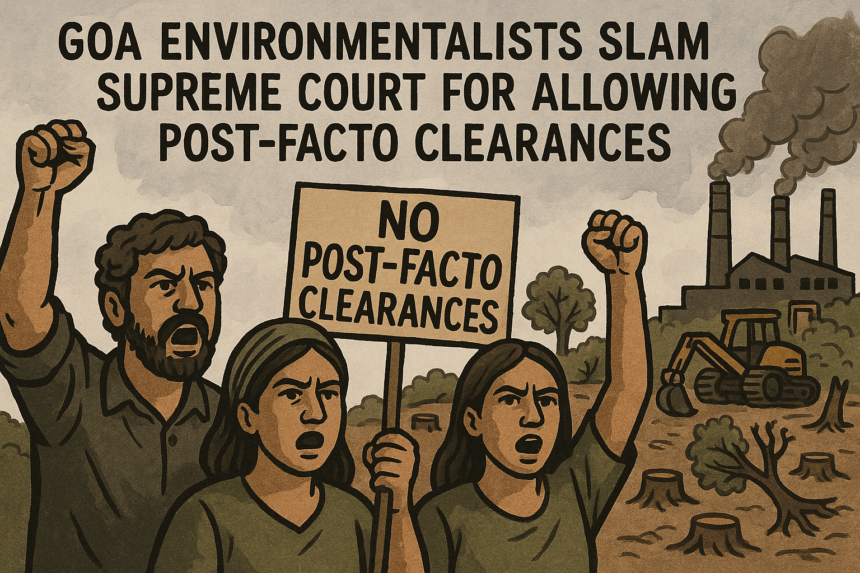
Environmentalists across Goa have slammed the Supreme Court’s decision to recall its own earlier judgment that barred post-facto environmental clearances (ECs), calling it a ruling that under mines environmental jurisprudence, weakens deterrence for violators, and threatens to erode public faith in the nation’s highest court. The Supreme Court’s latest deci sion — delivered after a review pe tition — permits the Union govern ment to regularise major projects that had commenced construction without mandatory ECs. For envi ronmental activists, the order has opened a fearsome Pandora’s box. O Heraldo spoke to some of Goa’s most prominent environ mental voices, who expressed grave concern.
They opined that the ruling will embolden violators, weaken environmental safeguards, and damage the cred ibility of the Apex Court itself. Director of Goa Foundation Dr Claude Alvares delivered a scathing critique, saying the real fallout of the judgment is institutional, not monetary. “Goa is not particularly affected by this judgment — In dia is,” he said. “This is not about Rs 20,000 crore being saved. What the Supreme Court has done is undermine the sanctity of its own judgments. The damage to the institu tion is far greater.” According to him, the Apex Court committed a proce dural violation by initially excluding Justice UjjalBhuyan — one of the judges on the original May 2025 bench — from the review process. The judge was added only after media scrutiny. “You cannot review a judgment without the participation of the judge who authored the earlier order, if he is still serving. This is black-letter law,” Alvares said. “But here, effectively, a two-judge bench has overruled another two judge bench. This is unheard of.” Alvares warned that the ruling sends a clear message to corporate lobbies that “environmental violations can be washed clean with money and a review petition.” “CREDAI filed the review. Tomorrow, every major devel oper or public institution will do the same,” he said. “The Court has, in effect, rewarded violators — large institutions like the greenfield airport authorities and AIIMS — who knowingly built without ECs despite having full legal de partments advising them.” Drawing a comparison with ordinary citizens, he asked: “If a villager constructs a house without permission, he is demolished or penalised. But large institutions violate the law and get protection because they have spent crores? What logic is this?” He noted that the dissenting judge on the review bench had warned the ruling “sets a bad precedent for environ mental law across the country.” Environmentalist Rajendra Kerkar said the judgment could have a direct bearing on Goa’s already stressed ecosystems. “Post-facto clearances for projects of ‘public importance’ cannot become a template for future decisions,” he said. “Forests, wetlands, and ecologically fragile habitats require strict scrutiny. Environmental and wildlife clearances must remain mandatory and non-negotiable,” said Kerkar. Kerkar cautioned that the order must not be allowed to mutate into a broader practice. “There needs to be a strong mechanism to prevent such exemptions from becoming the norm,” he added. Environmentalist Avertino Miranda argued that the Su preme Court’s reversal will erode the deterrent value of en vironmental regulations. “The order allowing ex-post facto clearances will have far-reaching destructive implications,” he said. “This decision effectively gives violators a free hand to destroy whatever little remains of Goa’s ecology. Once violations can be regularised after the fact, compli ance collapses.” He added that activists will now face greater hurdles in holding violators accountable. “The majority order not only legitimises non-compliance but also weakens the regulatory framework meant to pro tect nature,” Miranda said. Activist AbhijitPrabhudessai said that while the Supreme Court has opened the door to post-facto ECs, the ruling ex plicitly restricts them to ‘exceptional circumstances’. “This judgment cannot be interpreted as a blanket per mission,” he said. “India follows the constitutional princi ple of non-regression — environmental protections can be strengthened, not diluted.” He said the Court appeared disconnected from the “real ity of an environmental emergency.” “We are in a climate crisis. Decisions must ensure that humanity’s survival is not compromised. The SC should have upheld stronger safeguards, not weakened them,” Prabhudessai said. Environmentalist Ramesh Gauns criticised the ruling as ‘illogical’, arguing that public institutions must face conse quences for bypassing the law. “Before investing public money, authorities should have ensured the proper clearances. Now, the Court is allowing regularisation after crores have already been spent,” he said. “This will become a trend—build first, seek clearanc es later.” Gauns said the focus should be on health, not finances. “Public health is far more important than public money. What will people do with money if the environment is de stroyed and their health collapses?” he asked. Across Goa’s environmental community, the fear is that the Supreme Court’s decision—driven by a review peti tion from big-ticket developers — signals a shift towards compromising environmental safeguards in favour of large projects. By regularising violations from high-profile bodies such as the greenfield airport and AIIMS, activists warn that the Court has set a precedent that might now be invoked in dozens of other cases across the country. “The ruling not only weakens the environmental regime but also dents the Supreme Court’s moral authority,” one activist said. “Once the highest court signals that violations can be forgiven, the entire regulatory chain weakens.