Alfred Fernandes
sanguem: It’s the only fair price shop in the remote village of Netravali. But nothing is fair in the difficulties; people have to face to get rations from there
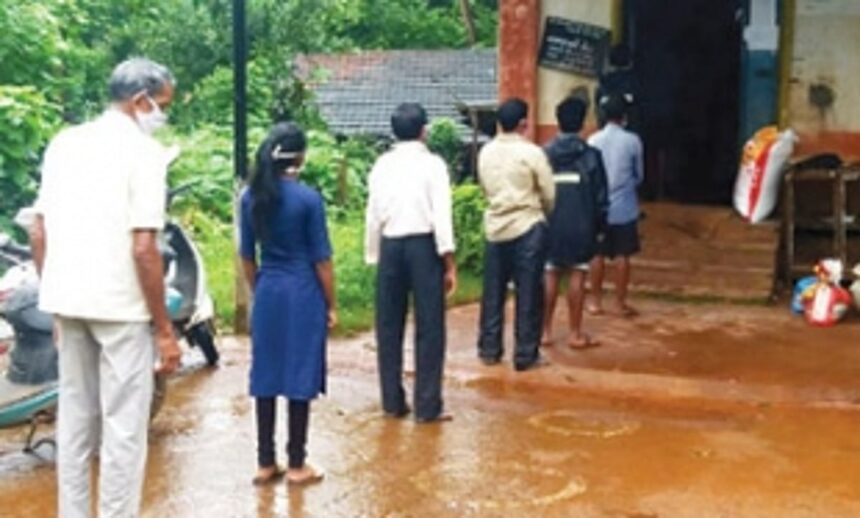
The villagers of Netravali Sanguem are literally sore over long hours they have to spend in collecting their quota of ration from the lone fair price shop in the village.
The problem lies not with the owner of the shop who duly follows the regulated timings of opening and closing the fair price shop. It lies with technology. The difficulty of wasting several hours or at times a couple of days in collecting the ration quota have cropped up since the time of the govt making it compulsory for the fair price shop owners to follow the internet based biometric machines at the time of distribution of ration quota.
While basically, the move of adopting biometric machines for distribution of ration card holds good in town and cities where the internet connectivity is good, in villages like Netravali where internet connectivity is very poor, beneficiaries suffer a great extent as the machine simply fails to function for most time of the day or at times for days together.
The worst-hit are villagers residing in the remote areas as of Verlem, Salgini and Tudov who have to travel a distance of around 18 kms and that of Nunem who have to cover 9 kms to the village to collect their monthly quota. At times, even after waiting in the queue for the whole day, the machine fails to function forcing the villagers to make a return round trip of close to 40 km in some cases the next day, and that too with no surety of getting their rations.
Given the long distances, they have to cover; the villagers from these areas at times come together in groups and hire a rickshaw to travel to the fair price shop to collect their monthly quota in the absence of regular bus service. Add to this are frequent power failures in the village, when the biometric machine stops functioning too. So if the power failure doesn’t come in the way of the villager and his ration, the internet failure will or it could be the other way round.
Amit Naik, a social activist from the village lamented the present scenario in the village and urged the government to permit offline distribution of ration cards to beneficiaries at least in remote villages where the net connectivity is poor. Or in the alternative provide broadband facility to the fair price shop owner to ease the problem faced by the ration cardholders, as the BSNL service in the village is very poor and hardly remains functional.
While the fair price shop owner remains with the people, with his dedicated service of opening and closing the shop on all days of the week, he remains helpless in the matter as he cannot proceed with the distribution of ration without scanning the fingerprint of the ration card holder on the biometric machine.