Situated along the banks of river Sál, between lush paddy fields and surrounded by hillocks, Nuvem has a population of around 18,000 Catholics who are affiliated to the Church of Jesus, Mary and Joseph.
Just like Návelim was to the south, Nuvem was a former ward of Márgão in the north. Both of these wards did not have Communidadesof their own and were under the Márgão gãokari. A few residents from Márgão and Ráchol owned large amounts of land in Nuvem, the rest of it being the estate of the Communidáde de Márgão. Nuvem was predominantly residence to the Christian Gavda community. A few families like the Borges, Colaço and Guia Rebelo shifted from Ráchol and Márgão to Nuvem.
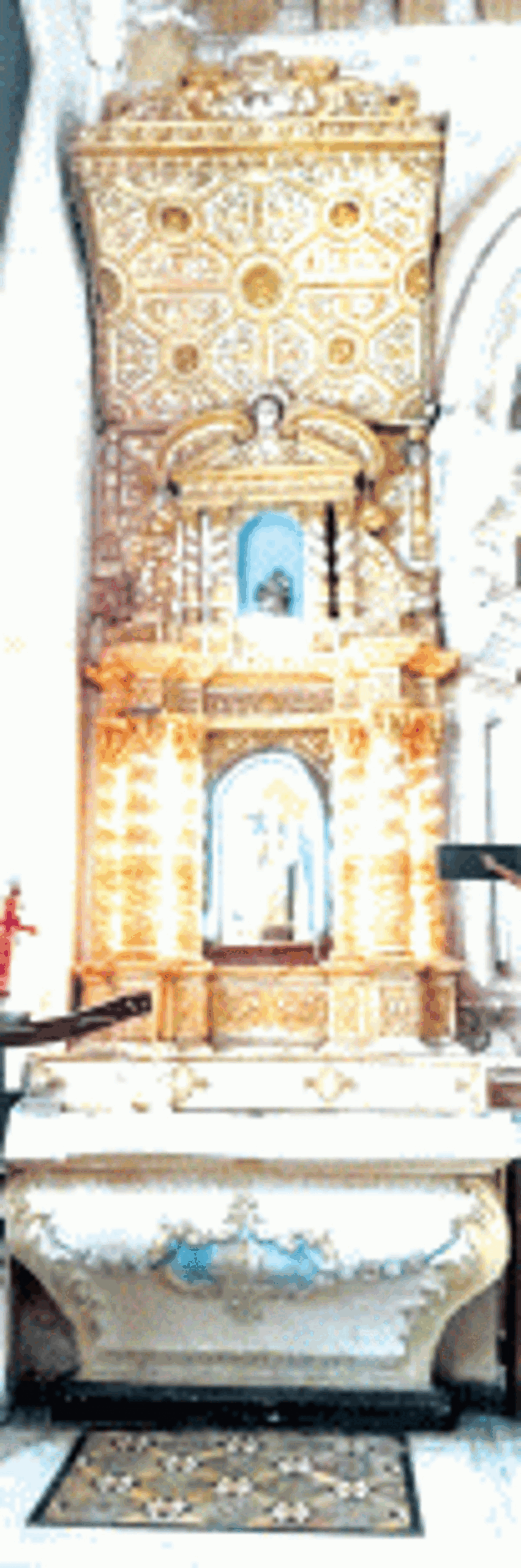
José Coláço was a 17th century successor of Anta Poy, who was converted on his deathbed in Ráchol and renamed as Pedro Coláço. José’s family owned large properties in Nuvem while still residing in Ráchol. The family later shifted to Márgão in the middle of the 18th Century. José built a summerhouse in Nuvem and somewhere 1694, constructed a private chapel at the cost of 21,000 Xerafins attached to the house and dedicated it to the Familia Sagrada i.e. Jesus, Maria e José. The chapel has three altars, a gold gilded retable and once had two towers. On the eve of the first Mass in January 1695, strong earth tremors were felt in the area by Fr António Sálvádor Coláço (possibly from José Coláço’s family) and Jeronimo Bareto (probably from the Baretoganvkar clan from Márgão), which could have been the reason for the northern tower to fall apart. The northern tower since then was never reconstructed.
Over time, the chapel dedicated to the Holy Family, gained devotion from the poor peasant families, not to the Holy Family, but rather to the Mother of the Poor (Mãe dos Pobres), such that the chapel (elevated to a church on March 17, 1903) was and still is better known as the Church of Mãe dos Pobres. The irony is that the chapel of a rich family is actually being known by the Mother of the Poor. In fact, it is noteworthy that the feast of the patron of the church is not celebrated with as much pomp and fervour as that of the feast of Mãe dos Pobres.
The feast of the Mother of the poor is celebrated annually on the first Sunday of November next in line after the feast of the Infant Jesus celebrated in Colvá. On the feast day of the Infant in Colvá, is the fáma of the Mother of the Poor in Nuvem. This feast in Nuvem is popularly known as Gorvam fest (feast of cattle), because of the sale of cattle at the feast fair in the past.
As a chapel affiliated to the Igreja do Deus Espírito Santo de Márgão, and serving a large number of Christians, the Archdiocese appointed Chaplins for the chapel ever since 1761. José Coláço’s decendents have been quite generous in gifting 35 acres of land in Nuvem to the Apostolic Carmel congregation of Nuns and transferring the Nuvem church lands to the archdiocese in 1972. It is thanks to them that the archdiocese of Goa owns the Nuvem Church and its lands and Goa got its first ever college exclusive to women, the Carmel College and its allied institutions. A mausoleum belonging to the Coláço family majestically stands tall, within the Nuvem Church cemetery.
Since ages, the people of Nuvem have always been engaged in activities such as mining and road building. They travelled throughout Goa offering their services, but always came home on November 2, every year to celebrate All Souls’ Daywhen they would pray for the souls of their deceased family members in a special way. Traditionally, due to being completely exhausted after physical exertion, people stayed at home for at least a week and ultimately on the following Sunday, they would feast as they celebrated Mãe dos Pobres. With great devotion and immense faith in Mother Mary, the simple working class of Nuvem would pray for grace and favors to be granted from their beloved mother. They would invite relatives and friends from around and prepare elaborate meals on the occasion of the feast. This was perhaps how the feast of Mãe dos Pobres came into being. “In my younger days, the feast fair would be bigger in size and much varied. The number of people attending the High Mass and the solemn procession which followed, was much more then seen today. Relatives would come home and assist in cooking,” says Conçeição Andrade, a resident of Nuvem.
People still do gather from far and wide for nine days preceding the feast to take part in the Novena. A huge fair builds up around the church and for a whole week the faithful visit stalls set up by various vendors as the sounds of hymns mingle in the air with cries of stall owners adding to the harmonious choir of different voices all around. The fair, since always, has been mainly known for cattle and terracotta pottery. The entire area behind the church used to be once reserved for trading cattle. However as of now, they use only a small strip of land between fields for the same. The sale of earthen pots still continues until this day with potters getting in their pottery from various parts of Goa, such as from Pernem and Bicholim. Even today, earthen utensils draw many buyers, since the best Goan food can only be prepared in an earthen pot using firewood as fuel for the fire.
(The writer is a heritage enthusiast from Ambajim, Márgão.)