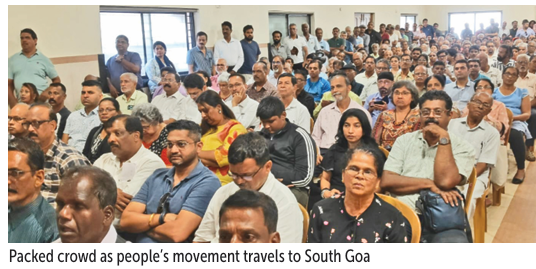
Justice (Retd) Ferdino Rebello on Thurs day delivered a stinging indictment of the State gov ernment, asserting that only sustained public pressure had forced those in pow er to pay attention to peo ple’s demands. Addressing a packed public meeting in Margao, he warned that any dilution of people’s power would embolden what he described as a systematic erosion of Goa’s ecology and rule of law. Addressing the gather ing, Rebello said the Margao meeting marked his return to Salcete, his home taluka, after public meetings held earlier in Panjim and Ma pusa — part of building a broad citizen-led movement. He said the movement had reached a crucial stage, with recent developments indi cating that the government was beginning to listen only because it was feeling the pressure of people coming out onto the streets. Using humour and sharp remarks, Rebello criticised what he described as the hypocrisy of the BJP gov ernment and some cabinet ministers, without nam ing them. He said protests across Goa, including at Chimbel, showed that peo ple were reclaiming their voice and ensuring it was not silenced. He recalled how the present movement gathered momentum fol lowing what he described as a clarion call during the Arambol protest. Reiterating the core de mands, Rebello said the continued cutting of hills remained the gravest threat to Goa’s fragile ecology. He warned that unchecked de struction would result in ir reversible damage. He also stressed that paddy fields, whether tenanted or not, could not be diverted for construction and must be preserved strictly for agri cultural purposes, as their conversion threatened tra ditional farming systems and long-term food security. The key focus of the Mar gao meeting was a detailed legal letter written by Re bello to the Chief Town Plan ner and the Secretary of the Town and Country Planning (TCP) Board, which he read out and explained to under line that the Charter of Ten Demands was firmly ground ed in law. In the letter, Rebello argues that permissions for hill and slope cutting and the filling of low-lying lands are being granted without any valid legal framework under the Town and Country Planning Act. He points out that while Section 17A of the Act requires prior written permission for such activities, the government has failed to frame any rules pre scribing how these permissions can be lawfully granted. He further states that the TCP Board has no authority under the Act to frame guidelines for hill cutting, rendering guidelines issued by the Board, including those approved earlier and revised subsequently, illegal and without legal backing. Despite this, he notes, permissions continue to be issued on the basis of such guidelines. A serious concern flagged in the letter relates to the man ner in which gradients are being calculated. Rebello states that permissions were earlier granted on the basis of contour data obtained from Survey of India topographical sheets, which are authenticated government documents. Howev er, he alleges that gradients are now being calculated using private contour plans submitted by architects, a practice he describes as illegal and contrary to established procedure. “This amounts to granting permissions without any au thority of law,” Rebello states in the letter, adding that such actions cannot be sustained legally. Citing these violations, Rebello has called upon the TCP authorities to immediately stop granting any further per missions for hill or slope cutting and the filling of low-lying lands, irrespective of gradient. He has also demanded that stop-work notices be issued in all cases where occupancy certificates have not been granted and that all such permis sions be suspended. In a strong warning, Rebello states that officers involved in granting permissions contrary to law could be held per sonally liable for their actions, adding that citizens would pursue disciplinary action against officials found to have connived in or facilitated approvals granted in violation of statutory provisions. Explaining why he chose to place the contents of the letter before the public, Rebello said attempts were being made to underplay or dismiss the Charter of Ten Demands, and it was therefore necessary to demonstrate that the demands were legally sound and enforceable. He reiterated that sustained protests and continued public engagement were essential to ensure that Goa’s hills, paddy fields and ecology were protected. After the meeting, which received a great response and saw speakers being applauded, Justice Rebello reiterated his remarks to the media.
Only a sustained fight can protect Goa: Rebello