Team Herald
MARGAO: The recently concluded youth seminar, “Preserving Goa’s Rich Legacy: Our Responsibility,” delivered a strong message of empowerment and civic duty. Organised jointly by Goyche Fuddle Pillge Khatir (GFPK) and The Council for Social Justice and Peace (CSJP), the event saw an enthusiastic gathering of young minds eager to engage in discussions on sustainable development and environmental preservation, at the Rosary School Hall, Navelim.

GFPK President Jack Mascarenhas opened the seminar with a compelling presentation highlighting Goa’s growing environmental crisis, from the pollution of water bodies to the destruction of hills and depletion of natural resources.
Quoting Professor Mariano Pinheiro, Mascarenhas spoke about Goa’s lost opportunities due to leadership challenges and envisioned a future where the state thrives with world-class education, healthcare, and industries—a vision that, he asserted, can be realised through collective action. He stressed the importance of responsible leadership and called on young people to actively shape the future instead of watching their inheritance erode.
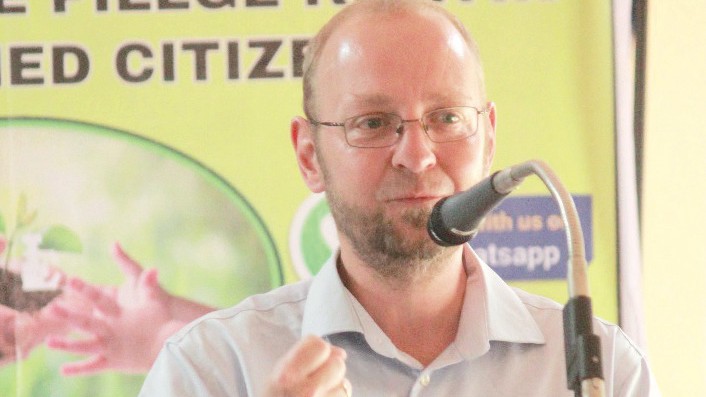
CSJP Executive Secretary Fr Savio Fernandes welcomed the attendees, while the keynote address was delivered by Professor Kenneth Bo Nielsen, Associate Professor of Social Anthropology at the University of Oslo, Norway, and an expert on land and environmental conflicts in India.
Professor Nielsen spoke on the commodification of land in Goa, citing an anecdote about a child questioning a “THIS PROPERTY IS NOT FOR SALE” sign. He emphasised that land is a finite natural resource, and treating it purely as a market commodity has long-term environmental consequences. He detailed the damage caused by mining, coal transportation, real estate speculation, and infrastructure projects like the Mopa airport, warning that unsustainable development could lead to irreversible harm. Drawing from his research in “The Great Goa Land Grab,” he provided a data-backed overview of land acquisitions and their social and environmental impacts.
Despite these concerns, Nielsen offered a message of hope, highlighting the persistence of Goan activists, NGOs, and researchers in documenting these issues. He encouraged youth to leverage available data and research to push for change and to recognize the power of collective action.
Nielsen also spoke about global movements in environmental conservation, including the growing involvement of major world religions in climate advocacy. He pointed to Goa’s rising ecological farming initiatives and organisations like the Goa Foundation and the Goenchi Mati Movement, which promote community-driven environmental stewardship.
“We must rethink our relationship with land and nature,” he urged, stressing the need for community-oriented, rather than profit-driven, approaches to sustainability.
Another speaker, Dr Jorson, emphasized the need for long-term planning in Goa’s development rather than reactive decision-making. Using Goa’s tourism industry as an example, he noted how inadequate planning had led to unregulated growth, environmental stress, and infrastructure deficiencies.
Fr Bolmax delivered an impassioned address on the power of individual resolve, encouraging the youth to believe that determination and sustained effort can overcome even the most formidable challenges.
The seminar concluded with a dynamic Q&A session, where young attendees shared their thoughts, raised concerns, and discussed potential solutions. Many participants expressed a renewed sense of purpose, vowing to take tangible steps in their communities to protect Goa’s environment and culture.