Team Herald
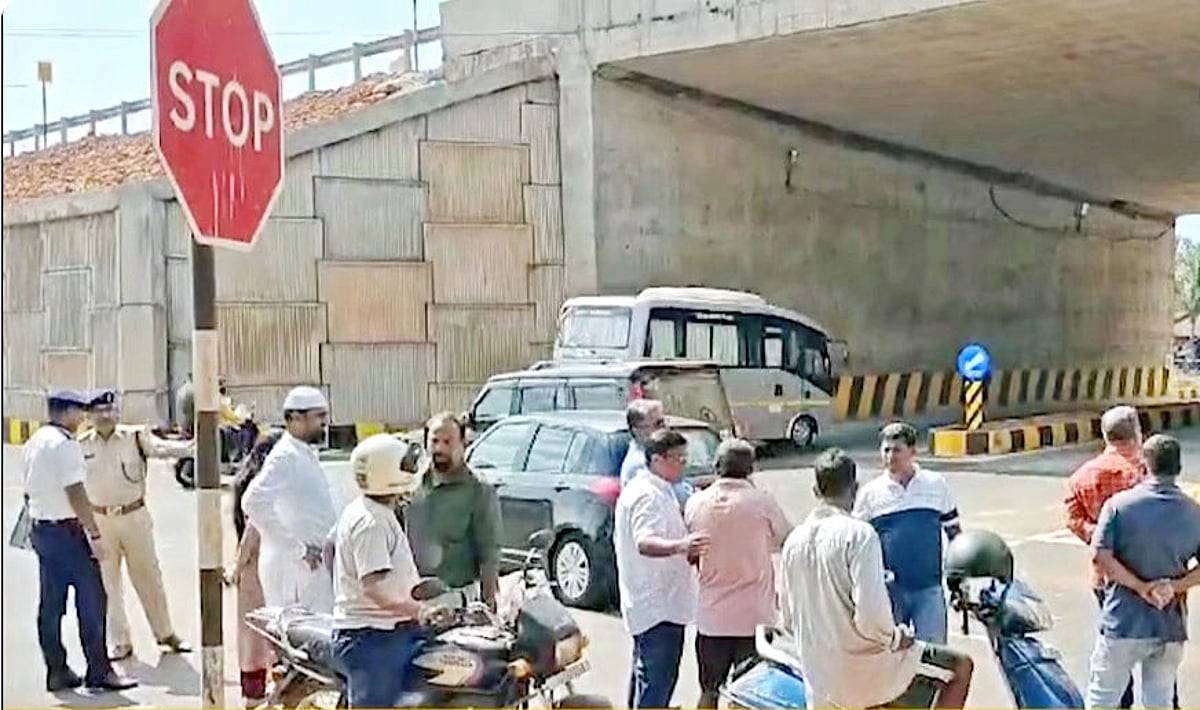
MARGAO: Tensions reached a boiling point in Velsao’s Mollo village on Friday as residents clashed with Rail Vikas Nigam Limited (RVNL) workers attempting to demolish a toilet block on private property. Residents alleged that RVNL acted without prior notice, disregarded ongoing legal proceedings, and ignored appeals to halt their actions.

The conflict erupted early on Friday morning when RVNL workers arrived with heavy machinery to dismantle the structure, despite legal directives that the matter be resolved through an enquiry scheduled for January 6, 2025. Residents, who had been protesting since Thursday night, accused the Railways of acting high-handedly and violating their rights.
The contested toilet block is a vital facility for the Rodrigues family and nearby residents. Property owner Pedro Rodrigues expressed his dismay at the unilateral actions taken by RVNL: “At the site, I was shocked to see heavy machinery ready to demolish our toilet without informing us. My family has no other alternative for basic sanitation. Ironically, while the government emphasises an Open Defecation Free (ODF) India, RVNL and SWR are demolishing toilets without even issuing a notice.”
Rodrigues stressed that RVNL’s actions disregarded not only social norms but also the legal framework. “The Court of the Inspector of Survey and Land Records has already issued a letter asking us, along with 45 others and the Village Panchayat of Velsao-Pale-Issorcim, to attend an enquiry on January 6 to resolve the South Western Railways’ (SWR) claim. Despite this, RVNL has blatantly ignored the law and forcibly continued work,” Rodrigues said.
The issue centres on survey no. 18/1 in Mollo, where RVNL began construction activities without completing a mandatory survey under the Goa Land Revenue Code, 1969. According to Rodrigues, this oversight violated basic legal requirements, including the obligation to notify landowners and demarcate boundaries. “They started construction on my property without adhering to the mandatory survey process. It’s a complete disregard for the Goa Land Revenue Code and other laws governing land use,” he stated.
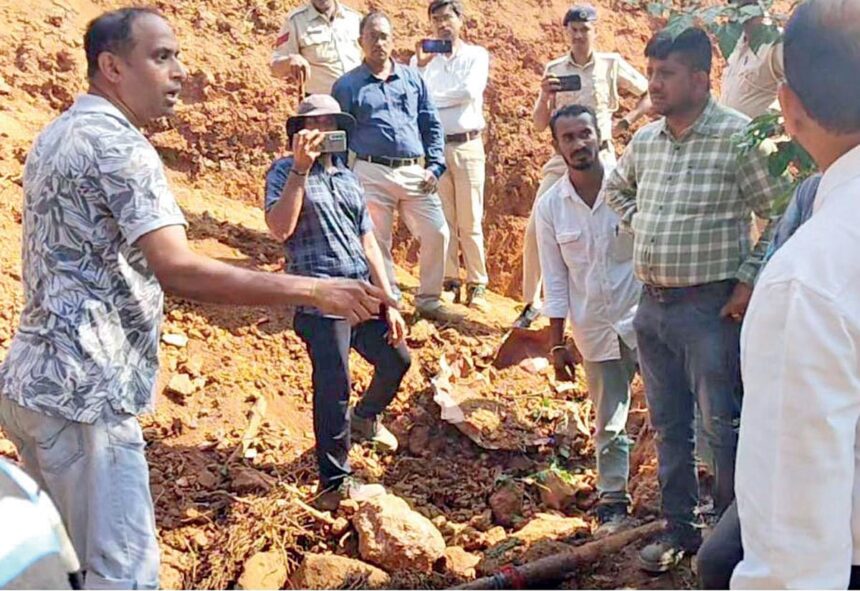
The residents’ ire was further fuelled by the collateral damage caused by RVNL’s work. Excavation activities reportedly damaged a two-inch diameter pipeline, the main source of water supply for the hamlet of Mollo. “We have been left without drinking water for several days, right during the Christmas season,” Rodrigues lamented.
The construction also left ecological and economic damage in its wake. Rodrigues described the destruction of fruit-bearing trees on his property: “During their work, RVNL trampled, hacked, and bulldozed mango trees and other fruit-bearing trees that are an intrinsic part of our livelihood. These trees were cut without obtaining permissions under the Goa Preservation of Trees Act, 1984. The loss is not just ecological but economic, affecting my family’s means of survival.”
The events prompted swift action from local residents and activists. Members of the NGO Goencho Ekvott (GE) joined forces with villagers to oppose what they termed RVNL’s illegal encroachments. The group called for all construction to cease until the January 6 legal hearing, which is expected to adjudicate claims on the disputed land.
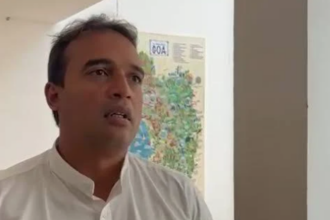
Speaking on the legal aspects of the case, Goencho Ekvott founder-member Orville Dourado Rodrigues accused RVNL of contempt of court. “What is happening here is nothing short of a flagrant disregard for the rule of law. Residents are being pushed into a corner, with no avenue left for redress except to stand their ground and fight,” he said.
These allegations stem from incidents that began on Christmas Eve, when RVNL workers were accused of encroaching on private property and cutting down a mango tree while the family was away. Rodrigues and his family filed multiple complaints with the Verna Police and Deputy Collector of Mormugao regarding these violations. Despite assurances from the Collector following Capt Fernandes’s intervention, residents remain wary of RVNL’s continued disregard for legal procedures.