AUGUSTO RODRIGUES
VAGATOR: The Punjab and Haryana High Court at Chandigarh judgment reiterating that the Collector and Superintendent of Police (SP) will be held personally responsible if they do not enforce the 2019 directive aimed at controlling noise pollution, resonated as villagers from Anjuna and Vagator took a march past venues that play loud music all through the night.

At 9.13 pm, a young lady called Anjuna Police Station and this is what she was overheard saying: “Sir, I am Angelina Moraes calling from Vagator and am trying to study for my twelfth standard exams due next month. I cannot as I am disturbed by the loud music being played at Hotel W. I beg of you, to please stop the noise.”
Despite being promised by policeman that the music would be stopped, it continued with Angelina walking away in a huff and her parents walking to join the group of protesters at a chapel nearby.
Before the start of the silent march, where apathy of owners of clubs run by outsiders was being discussed, the November 4, 2024 ruling of the High Court of Punjab and Haryana at Chandigarh in case no CWP -6280-2024 was deliberated.
Part of the ruling read: “The offence of noise pollution is a cognizable one under The Air (Prevention and Control of Pollution) Act 1981, therefore if any such cognizable offence is informed to the police authorities, they are duty bound to register an FIR Under Section 154 CrPC, Section 173 of the Bharatiya Suraksha Sanhita 2023 (BNSS).”
“In Goa, despite the Goa Bench of the Bombay High Court trying to monitor noise pollution, the police seem to care a damn. Had the police taken cognisance of our complaints, we would not have needed this silent march today,” said Janet Moraes, mother of Angeline.
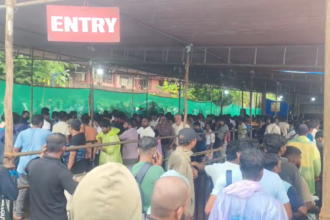
As the protesters reached various venues where loud music was played past 10 pm, without the mandatory permissions, the sound systems were turned off and some clients were seen walking away.
When they walked to the next venue, the music was turned back on. This on and off charade continued till around midnight. The story took a different tone after midnight with music wafting through houses. The noise had begun, once the protesters decided to return home.
“Public mobilisation is one sure way of silencing these noise polluters though it should not be the case, because there is a law in place to protect us. The police care a damn for the law. It is hoped the High Court will come down hard on our police and Collectors. Our cops refuse to register FIRs,” says Janet Crasto, who as coordinator of the Pastoral Parish Council (PPC) social action team of Vagator Anjuna Chapora (VAC), is aiming to get people of all communities under one umbrella.
Traffic towards Anjuna starts increasing after midnight with four-wheelers from Siolim, Assagao and Calangute zooming despite the treacherous conditions of most roads.
“I had a client who stayed with us for five months every year and said he had booked elsewhere as this place is very noisy now. My clients refuse to stay with me because of the noise from Hotel W,” confessed Javish Moniz who has joined the recently started VAC.
“I have no guests coming to my restaurant as there is loud music during the day and night. There is absolutely no respite and the government appears to be pandering to the outsiders instead of us,” complains local restaurateur Rita Ali.
To a few, living in Vagator is turning out to be a nightmare. “Sometimes, I feel like selling everything and settling somewhere else. Things have reached such a sad peak,” vented frustrated hotelier Michael Mendonca.
FIR mandatory on any complaint of
‘offence’ of Noise Pollution: Punjab
and Haryana HC order
The offence of noise pollution is a cognizable one under The Air (Prevention and Control of Pollution) Act 1981, therefore if any such cognizable offence is informed to the police authorities, they are duty bound to register an FIR Under Section 154 CrPC, Section 173 of the Bharatiya Suraksha Sanhita 2023 (BNSS) -November 4, 2024 ruling of the High Court of Punjab and Haryana: Case no CWP -6280-2024
The FARCE of
controlling noise pollution
When protesters reached various venues where loud music was played past 10 pm, without permission, the sound systems were turned off. When they walked to the next venue, the music was turned back on