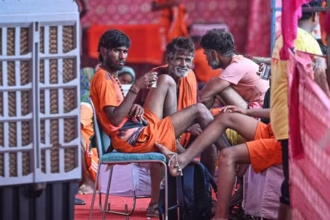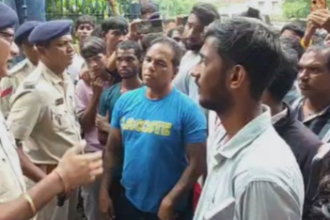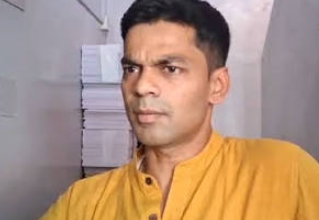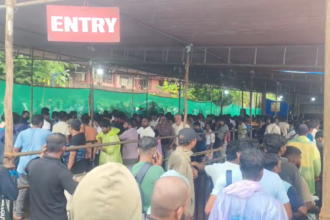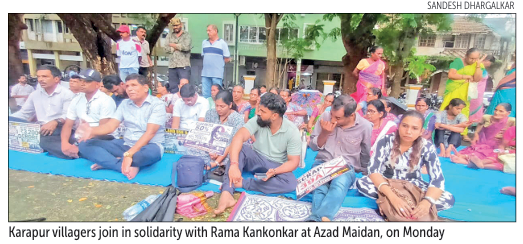
As municipal workers dismantled the shelter shielding social ac tivist Rama Kankonkar from the monsoon rain at Azad Maidan on Monday, the gov ernment may have removed a makeshift tent — but it ap peared to strengthen the re solve of a widening protest movement. Drenched but defiant, Kankonkar refused to leave the protest site even after authorities pulled down the temporary structure, insisting that his agitation over a 10-point charter of demands would continue regardless of the weather or official pressure. The dramatic scenes at Azad Maidan drew villag ers from Karapur-Sarvan, Taleigao, Quepem, Old Goa and other parts of Goa, who arrived through the day to express solidarity with the activist. As rain lashed the city, supporters scrambled to shield Kankonkar and fellow protesters with plas tic sheets after the shelter was removed. “They denied me permis sion to put up a tent. They demolished my makeshift shelter, leaving me exposed and drenched in the rain.
One of my demands is that I be provided with a shelter. I had to take a paracetamol tablet to prevent myself from developing a fever,” Kankonkar said. The demolition also triggered a legal battle. Within hours, Kankonkar’s wife, Rati Kankonkar, ap proached the Goa Human Rights Commission, seek ing immediate suo motu intervention. She argued that forcing peaceful pro testers to remain exposed to incessant rain amounted to a violation of the right to life and dignity guaran teed under Article 21 of the Constitution. Her complaint stated that health officials at the site had warned that prolonged exposure to high humidi ty, constant moisture and the absence of sanitary fa cilities posed immediate health risks, with several elderly protesters already suffering from severe colds and showing early symptoms of pneumonia.

She also announced plans to approach the Goa Commis sion for Scheduled Tribes on Tuesday. The action against Kankonkar drew sharp criticism from protesters, who accused the Corporation of the City of Panaji (CCP) and the police of refusing permission even for a temporary rain shelter while allowing the peaceful demonstration to continue in hazardous weather condi tions. What began as a lone protest is increasingly emerging as a rallying point for multiple agitations. Villagers from Karapur-Sarvan, whose struggle against a proposed mega housing project entered its 121st day on Monday, stood shoulder to shoulder with Kankonkar, warn ing that if the government failed to intervene before August 14, they would block major roads across the State on Inde pendence Day. The villagers accused the government of facilitating real estate interests at the cost of ancestral village lands and demanded the immediate notification of Scheduled Tribe residential areas, protection of community lands and an in vestigation into the utilisation of Rs 3,200 crore earmarked for tribal welfare and Tribal Sub-Plan schemes. “The government must immediately demarcate and no tify Scheduled Tribe residential areas to prevent private developers and corporate builders from acquiring or frag menting our ancestral lands.
Unchecked development is destroying the State’s natural ecology and disrupting inter nal village water catchments that supply drinking water to downstream communities,” Dr Swapnil Salelkar said. Sanjay Naik of Bhoma, who is spearheading the agita tion against the proposed national highway on the Bho ma-Corlim stretch, called upon the State’s four Scheduled Tribe MLAs to stand with the protesters instead of the gov ernment. “If the Bahujan Samaj and ST communities come togeth er, they can defeat the government and secure justice,” he said. Kankonkar also questioned the timing of a proposed pro test by the United Tribals Associations Alliance (UTAA). “Today, Adivasi women from Karapur are protesting in the rain. Why wait until August 13? They should come forward now to support them. The government is test ing the patience of both me and the people,” he said, ap pealing for immediate unity among tribal and people’s movements rather than symbolic demonstrations at a later date. Political support also gathered around the protest.
AAP Goa president Valmiki Naik visited Azad Maidan and ex tended support to Kankonkar’s 10-point charter of de mands, accusing the BJP government of refusing to engage with the people because it feared public opinion. Activist Wilber Ticlo D’Souza from Porvorim also con demned the government’s handling of the protest. “The government should immediately provide protec tion to Rama Kankonkar. It is high time that the people of Goa came together to defeat the government,” he said. By evening, the rain had not stopped, the shelter was gone and the protesters remained seated in the open.