CLAUDE ALVARES
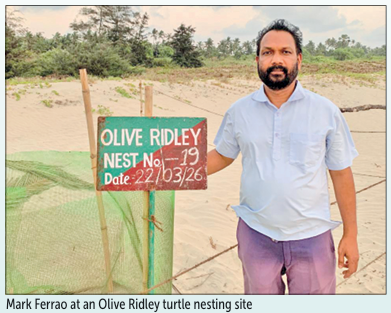
The 2026 tourist sea son is over. Across Goa’s coast line, shack owners and resort managers are counting their earnings in rupees. Along Ashvem beach, how ever, one man measures suc cess differently. For the past 16 years, Mark Ferrao has counted success not in terms of bank notes, but turtles.

The turtles are Olive Ridleys, an endangered marine species that visits a handful of Goa’s beaches every nesting season. Their arrival usually takes place under the cover of darkness, un noticed by most visitors. But for Mark, each nesting turtle repre sents another small victory for conservation. A native of Assonora, Mark joined Denzil Sequeira’s Ashvem resort, Elsewhere, in 2010 as an employee. Among the responsi bilities assigned to him by Seque ira was an unusual one: ensuring that the Olive Ridley turtles that arrive on the beach in front of the resort to lay their eggs were protected from disturbance. At the time, Mark knew little about turtles. Yet his fond ness for animals and his own curiosity soon drew him into a world few people ever get to witness. Over the years, he learned to recognise the signs of a nesting turtle, under stand its behaviour, and record every stage of the nesting process. He trained his staff to locate turtle nests. From his ringside seat on the beach, he watched female turtles emerge from the sea, slowly make their way above the high-tide line, excavate deep nests, deposit their eggs, create decoy pits to confuse predators, carefully cover the nest, and then return to the water before dawn. What began as a resort duty gradually became a voca tion. In the early years, eggs laid on Ashvem beach were relocated to the Forest Department’s turtle hatchery at Morjim for protection. As confidence in local conservation measures increased, many nests were allowed to remain in their natural locations. This not only reduced handling of the eggs but also contributed to increasing nesting suc cess. Today, Mark works closely with Forest Department per sonnel and the resort’s own security staff who patrol the beaches at night. Nesting activity on stretches extending towards Mandrem and Arambol is also monitored, and vulnerable nests are identified and extracted. Every nest is documented through mobile phone records, with the For est Department informed at each stage. The work of relocation requires both patience and pre cision. Turtle eggs cannot simply be picked up and moved like ordinary eggs. Once laid, the embryo inside quickly es tablishes a fixed orientation within the shell. Rotating an egg after this process begins can damage the developing embryo and reduce its chances of survival. Experienced handlers like Mark and his trained helpers therefore take great care to relocate eggs in exactly the same position in which they were found. Nature presents additional challenges. Excessive heat can affect egg survival, while dogs and other predators can destroy entire nests if they are left unprotected. The nest must be covered quickly if there is rain. Protective cover ings and round-the-clock vigilance are often necessary to ensure that hatchlings get a chance to emerge. Mark has observed that nests laid during January and February often show particularly high success rates, with hatchling emergence frequently exceeding 80 per cent. Depending on weather conditions, the eggs usually hatch after about 50 days of incubation. The accompanying ta ble provides data of eggs collected by him for the 2025-26 season. The most rewarding moment comes when the first hatchlings break through the sand. Once informed, For est Department staff arrive and take charge. Soon, doz ens of tiny turtles scramble across the beach towards the sea, beginning a journey that may one day bring some of them back to the very same shoreline. Lucky tourists – among the most recent being actress Zeenat Aman – simply can’t believe their eyes as the process, now going on for centuries, unfolds one more time. Mandrem, Ashvem and Morjim in North Goa, together with Agonda and Galgibag in South Goa, are now recog nised as important turtle nesting beaches. That success is usually measured in statistics: nests recorded, eggs pro tected, hatchlings released (see table 2). The steady in crease in nesting activity over the years reflects the singu lar and dedicated success of the Forest Department’s Olive Ridley conservation programme. Turtles like the Olive Ri dley return to the beaches where they were hatched. Goa’s turtle nesting programme commenced in the early 1990s. The numbers prove the biology: the first turtles hatched on Goa’s beaches are now returning to lay their eggs. The more hatch, more will come. But behind all those numbers stand individuals whose dedication often goes unnoticed. At Ashvem, one of those individuals is Mark Ferrao. Long after the tourists have gone home and the beach has fallen silent, he continues his nightly watch, ensuring that some of Goa’s oldest visitors can safely return to the sea. “These turtles are now part of our family,” says Ferrao. (The writer, Dr Claude Alvares, is director of Goa Foundation)