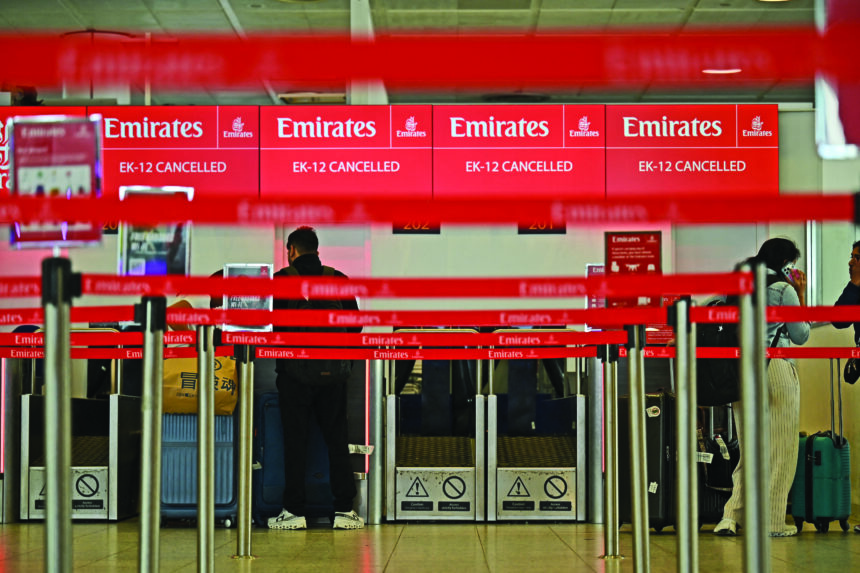
The Israel–US attack on Iran has triggered anxiety, fear and travel chaos for Goans living in the Gulf and those travelling through the region, with airspace closures, flight cancellations and missile sirens compounding uncertainty for thousands of families.
For many in Goa, the conflict is not distant geopolitics but a deeply personal crisis, with relatives working in Saudi Arabia, Kuwait, Qatar, Bahrain and the UAE.

At Dabolim International Airport on Saturday, the disruption became immediate and visible. John De Sa from Cortalim, who had boarded a Goa–Mumbai–Oman flight, was offloaded minutes before departure.
“I was the only passenger travelling to the Middle East and was offloaded around 3 pm, a few minutes before take-off, after being informed that the airspace at Qatar Airport was closed. But the Air India flight later proceeded to Mumbai,” said De Sa.
“We hope the situation de-escalates quickly and returns to normalcy at the earliest,” he added.
Air India Express cancelled its Goa–Dubai flight on Saturday night. Dabolim Airport later announced the cancellation of Air India Express Dubai–Goa and Gulf Air Goa–Bahrain flights on Sunday, March 1.
Manohar International Airport issued a passenger advisory stating that, owing to the evolving political situation in the Middle East, westbound international flights may face disruptions or schedule adjustments. Passengers were requested to check with their respective airlines for the latest updates before leaving for the airport.
While airport announcements created confusion in Goa, panic was unfolding in Gulf cities.
Dennis Fernandes, now working in Kuwait, said the present crisis has revived traumatic memories of the 1990 Iraqi invasion.
“I was eight years old when Iraq invaded Kuwait on August 2, 1990. I remember that one day, when my parents had gone to work, the police knocked on our door and left as no one could open it. We were living next to the Khaitan police station. I am now working in Kuwait and going through the same panic. The fright has remained with me, only to be awakened now after 36 years,” Fernandes said, adding that missiles were being fired and the sirens were “scary”.
He said panic had begun to spread, with people rushing to malls to stock up on food grains.
J P Fernandes of Siolim, who had travelled to Goa from Saudi Arabia for medical treatment, said he was worried about his family still there.
“I am in Goa, and what worries me is my family stranded there. We leave everything in the hands of God. Over the years, there has been a sizeable Goan community living in Saudi Arabia and dependent on their livelihood there. We only hope and pray that our loved ones are safe. If the war lasts longer, it could result in casualties and job losses, which will be detrimental to us.”
Thomas D’Souza of Marna-Siolim, who had returned home following his mother’s death, fears losing his employment if hostilities prolong.
“We are not skilled workers, yet we managed to find employment in the Gulf and look after our families back home. If the war prolongs, I may be unable to rejoin duty and could lose my job,” he rued, praying that tensions ease soon.
Travel operators described the situation as chaotic.
Sita Travels chief operating officer Ernest Dias said arrivals and departures to the Gulf had come to a standstill.
“As of now, all flights to the Gulf have been stopped. We had many bookings because a lot of people use Qatar Airways, and it has been affected. We already have tourist arrivals across the country, and many of them were scheduled to travel tonight and tomorrow, but they are stuck. Similarly, tourists have to stay put in Qatar, while those who were coming via the Gulf may cancel their bookings. Those stranded in Qatar may decide to return, as nobody would like to take a risk. The war has just started, and we are waiting to see what is going to happen,” Dias said.
He added that while flights to Europe remain unaffected for now, charter operations could face disruptions, especially those that halt in Qatar for refuelling. “It could be a worry, and we will have to wait and watch,” Dias said.
Managing Director of Travco Travels Bruno Gomindes said, “There is chaos as flights to Gulf countries have been abruptly stopped. Though IndiGo Airlines had cancelled its flights earlier, the Gulf carriers have now cancelled theirs due to the closure of airspace in Qatar. The airlines are sending SMS messages to passengers stating that there will be no operations until further notice due to airspace restrictions in the Gulf. Many passengers, including students, have been affected.”
Beyond the immediate travel disruption, the crisis has revived concerns about Goa’s long dependence on Gulf employment. With thousands of Goan families reliant on remittances, a prolonged conflict could have serious economic consequences back home.
For now, however, it is the fear of missiles overhead, stranded passengers and unanswered calls that defines the moment, as families in Goa and the Gulf wait anxiously for signs of de-escalation.