AUGUSTO RODRIGUES
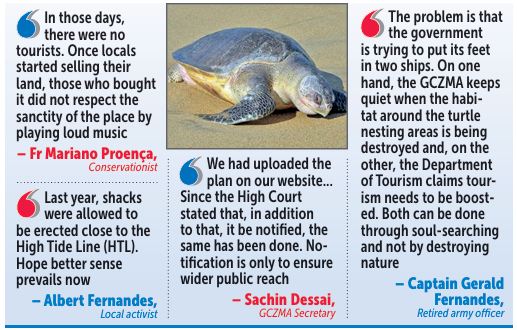
The Goa Coastal Zone Manage ment Authority’s (GCZ MA) notification of the Sea Turtle Nesting and Habitat Management Plan may have fulfilled a direc tion of the High Court of Bombay at Goa, but envi ronmentalists and con servationists contend that the exercise leaves several fundamental questions unanswered — particular ly over the State’s nesting beaches and the continu ing pressure of tourism on turtle habitat. The plan notified by the GCZMA substantially re flects the draft prepared in 2020, raising questions over whether the notifi cation represents a mean ingful update of the State’s turtle conservation frame work or merely formalises an existing document after the High Court sought its notification. More significantly, the notification relies on nest ing figures from 2021-22 despite more recent data being available with the Forest Department, ac cording to conservation ists. This leaves the plan without a clear picture of how nesting patterns and hatchling survival have evolved through subse quent seasons. “Truth is the greatest value, and when we de viate from it, everything goes haywire. If conserva tion of Olive Ridley turtles in Galgibaga is a success, it is because the people of that village relate with God and have respect for na ture,” explained Fr Mariano Proença, who is credited in the notification with “initi ating education and aware ness programmes among the locals of Galgibaga and Agonda”. “In those days, there were no tourists. Once lo cals started selling their land, those who bought it did not respect the sancti ty of the place by playing loud music,” said a resigned Fr Proença.

Reverting to 1999, when he started his conserva tion efforts, Fr Proença recollected paying the lo cals Rs 400 to preserve each nest. “I had to pay them be cause they used to make money by selling eggs. Lo cals believe the eggs of Ol ive Ridley turtles help cure rheumatic problems and are hence sought after,” de tailed Fr Proença. “In those days, I used to drive to Karwar and pay the locals Rs 5 per egg and buy all the eggs in a nest ing, and transplant them in Galgibaga. We have to be self-conscious if any plan is to succeed,” warned Fr Proença.
While admitting that “increased accessibility of the Mor jim area, as well as the presence of shacks in the intertidal area, has led to a decrease in the total number of nests per season”, the notification also admits that “there are still un addressed aspects related to nest conservation and scope to improve egg recovery, rescue, rehabilitation and effec tive hatchery-supported hatchling survival success rate”. “The problem,” says retired army officer Captain Gerald Fernandes, who is also credited in the notification with be ing the first to have initiated an informal awareness and education campaign in Morjim between 1995-96, “is that the government is trying to put its feet in two ships.” “On one hand, the GCZMA keeps quiet when the habitat around the turtle nesting areas is being destroyed and, on the other, the Department of Tourism claims tourism needs to be boosted. Both can be done through soul-searching and not by destroying nature,” reasons Fernandes. Selected as a member of the Noise Monitoring Commit tee (NMC) of the High Court of Bombay, Fernandes’s role has shifted from being a conservator of Olive Ridley turtles to that of saving their habitat. “It pained me that I had to approach the Goa Bench of the High Court of Bombay to get a stay on the work of the Department of Tourism when sand dunes around the turtle nesting site in Morjim were being cut in the name of devel opment,” recollected Fernandes. “Just because the voice of turtles cannot be heard, it does not mean that their space can be destroyed. Just like tur tles, development has its own space,” he added.
The notification admits that no shacks are allowed on Galgibaga beach; that Agonda beach is declared a No Shack Zone; and that ten shacks are allowed at Morjim Beach. An inspection at Morjim beach revealed that the Depart ment of Tourism had allowed twelve shacks instead of ten last season. “We were forced to allow two extra shacks on the order of the local MLA. We will see that it does not hap pen again,” stated a senior member of the Department of Tourism based in North Goa. When asked why recent figures of turtle nesting from 2021-22 were used instead of figures up to 2025-26, GCZ MA Secretary Sachin Dessai replied: “Please check the date when it was notified… it has only been notified as directed by the court. The plan has been on our website for a very long time. It has just been notified in the Gazette.” “We had uploaded the plan on our website… Since the High Court stated that, in addition to that, it be notified, the same has been done. Notification is only to ensure wider public reach,” stressed Dessai.
Dessai did not respond when asked to specify when the draft plan was uploaded on the website. Locals in Morjim hope the notification will force the De partment of Tourism to rethink its approach when work on demarcation of shacks begins this year. “Last year, shacks were allowed to be erected close to the High Tide Line (HTL). Hope better sense prevails now,” said local activist Albert Fernandes.