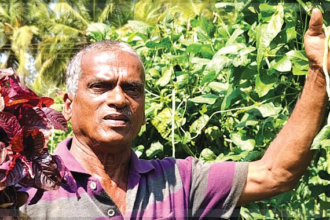
PERNEM: Uday Prabhudessai, the driving force behind ‘Jaidatt’ Agro-farm, has been a full-time farmer for the past 20 years, cultivating his 10-hectare land. He inherited the farm from his ancestors and, after exploring various other professions, realised the immense potential of his land. “I worked in various industries like politics, the hotel industry, and transportation. But I felt a strong connection to my land and realised that agriculture was my true calling,” says Uday. “I use my education and skills to improve my own farm. There is no substitute for agriculture because ultimately, we all need food on our tables.”
“People often undermine the significance of agriculture and fail to see its potential as a high-income generating sector. By cultivating my land, I earn around Rs one lakh per month, after adjusting losses due to natural calamities, bison attacks, etc,” says Uday Prabhudessai. “Not all families in Goa are involved in tourism or mining, but all families in Goa are connected to agriculture in some way or the other. It’s time to recognize its importance and provide the much-needed boost from the government.”
Driven by his appetite for new challenges, Uday ventured into black rice farming four years ago. “As a farmer, I am never satisfied with what I grow. I constantly experiment with new crops, technologies, and methods,” he explains. He purchased black paddy seeds, specifically the Burma Black variety, at Rs 400 per kilo, from an agricultural officer at the Krishi Vigyan Kendra in Sindhudurg.
“I had initial doubts because the seed was not up to my expectations. But with a good water source, I decided to cultivate the black rice during the Rabi season,” says Uday. To his surprise, he obtained a paltry yield of 15 kilograms. Undeterred, Uday persisted and refined his techniques.
Uday Prabhudessai prides himself on being an eco-friendly farmer who practices organic farming in his fields. “I believe in the health of the soil and its
connection to human health. That’s why I use vermicompost and other organic fertilisers,” he emphasizes.
During the last kharif season, Uday reaped a bumper harvest of black rice, yielding around 400 kilograms from 1,000 square meters of cultivated land. “I use the system of rice intensification method (SRI) for growing my crop, and this gives me exceedingly good results,” he proudly shares. He believes that local, chemical-free rice has a huge market potential.
“While black rice may be relatively unknown, its cultivation time of around 130 days, cooking process, and quality are no different from other varieties,” Uday explains. “We need to raise awareness and make it more popular. Right now, it may be expensive, but with government support, we can make it more affordable and accessible to everyone.”
Uday advocates for stronger government support for farmers in Goa. “The farming community deserves stronger promotion and assistance. While cheap vegetables are usually brought in from other States, in times of crises like the Covid-19 pandemic, people rushed to buy vegetables from my farm, proving the value of local produce,” he says. He believes that the market should come to the farmer, especially for those practising organic farming.
Dispelling the notion that farmers always face losses, Uday emphasizes the importance of cultivating food for personal consumption. He conducts camps for children, educating them about the significance of agriculture and involving them in the farming process. “Agriculture should never be underestimated or undervalued. If someone looks down on a farmer or disregards the value of agriculture, they have no right to take food onto their plates,” he asserts.
Uday Prabhudessai remains optimistic about the future of farming in Goa. “We have the capacity to be self-sufficient in agriculture, but it requires the desired support from the government. Every family should grow their own vegetables or paddy, and the government should take over abandoned fields,” he concludes.