JENIFER FERNANDES
[email protected]
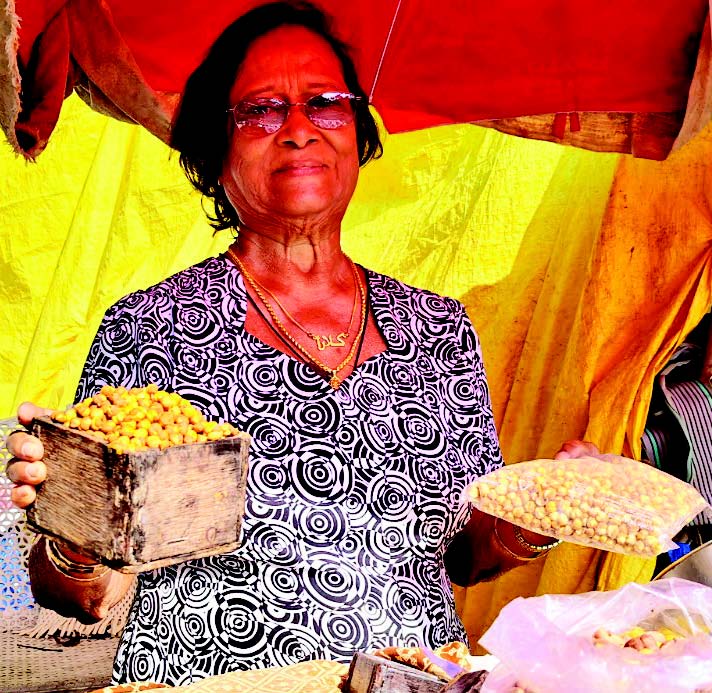
Aldona : At 78, Clara Fernandes of Candolim still begins her mornings with the same quiet determination she learned as a young girl—standing behind a basket of festachem chonne, the humble grams that have remained a cherished part of Goan feasts for generations. Her family has been selling grams for 85 years, and Clara herself has devoted 55 years to the trade, a legacy passed lovingly from mother to daughter.
Clara grew up watching her mother sell grams at a time when a podd cost only Rs 2. The grams were bought directly from the person who fried them—a skillful, labour-intensive task. Selling grams was never just a business; it was a tradition woven into the fabric of Goan festivals. “Without festachem chonne, no feast was ever complete,” Clara often says. Big grams, small grams, salted, spiced—the variety may have grown, but the emotion attached to them remains the same. Back in those days, job opportunities were scarce. Families survived by doing any honest work available, and Clara’s family was no exception. Her mother worked long hours in the fields to support them, and the hardships of that life left a deep imprint on Clara. It was a neighbour who once suggested selling grams in the market instead of toiling in the fields all day. That small suggestion changed everything.
Clara studied only up to the 7th standard—education ended at the 8th in those days—and financial constraints meant she couldn’t go further. But what she lacked in formal education, she made up for in hard work, dignity, and a lifelong connection with her customers.
Over the years, Clara sold grams at different spots in Goa, including at the entrance of the main church before shifting to her current space. Her presence at Mapusa market became familiar to generations of locals. People sought her out, trusted her, and supported her family through their purchases. Many of her long-time customers still come looking for “Clara’s grams,” grateful that a true niz Goenkar continues this traditional trade.
Today, a podd of grams costs Rs 200, but Clara remembers how even the Rs 2 they earned decades ago was sufficient for survival. “We managed with whatever we had,” she recalls. The grams are still sourced from other states and fried in Goa, with Clara and many like her selling them in different forms during feasts and festivals.
Her daughter now accompanies her, proud to help keep the tradition alive. Clara takes pride in this continuity. “There is no shame in this work,” she insists. “It fed our family, educated our children, and earned us respect.”
But Clara worries that the younger generation distances itself from traditional livelihoods. With higher education comes aspirations for office jobs and modern careers—yet many forget the sacrifices their parents made doing humble work. “If our youth don’t take up these traditional businesses,” she says, “they will disappear, and Goa will depend only on migrants and packaged foods.”
Every day, Clara arrives by vehicle and spends long hours at her stall, determined to continue as long as her health allows. For her, selling grams is more than earning a livelihood—it is preserving a piece of Goan identity.
Her message to the youth is clear and heartfelt:
“This is our own Goan traditional business. If we want it to survive, the younger generation must step forward. These traditions are our roots, and if we don’t protect them, they will vanish forever.”