JENIFER FERNANDES
joseph@herald-goa.com
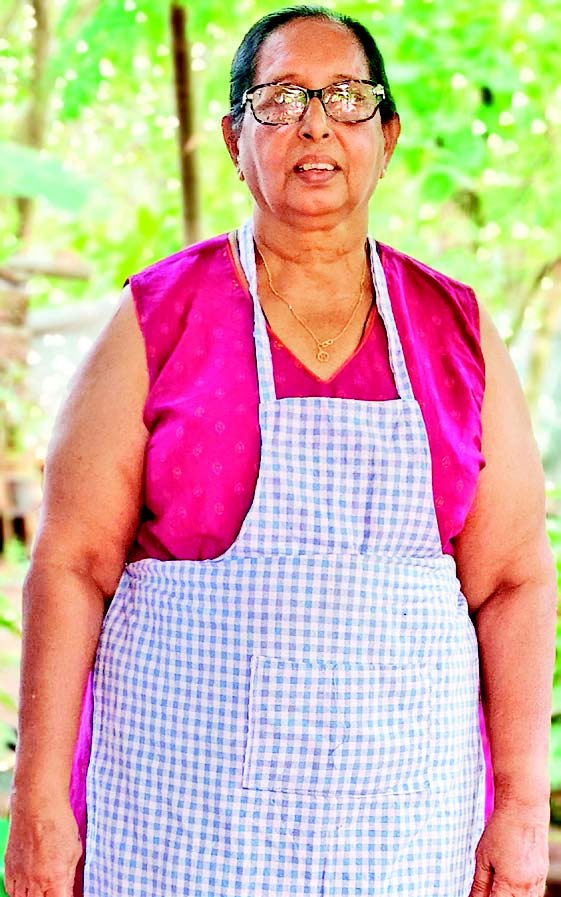
Aldona : Nhympha D’Souza stands as a quiet guardian of Goa’s culinary heritage. For the last 18 years, she has dedicated her life to making authentic toddy-fermented sannas, a craft she built patiently, lovingly, and entirely from the soil and spirit of her homeland.
Her sannas have earned a reputation across Aldona, Calangute, Mapusa and Porvorim—not through marketing or modern packaging, but through their unmistakable Goan taste. She insists on using only local ingredients: Jaya rice and coconuts from Parra, Calangute, Anjuna and Ucassaim, and toddy sourced from Aggacaim and Goa Velha. “Nothing from outside,” she says, believing that real Goan food must begin with real Goan produce.
Her process is a story in itself. After the harvest season, when families boil paddy at home, she buys the rice she needs and preserves it using traditional methods, drying it herself and mixing it with tirphal (teppal) and bitter lime leaves for storage. Each batch begins with meticulous cleaning—removing anything that could disturb the pure white finish.
Every order starts two days earlier. The rice is soaked at noon, ground at night, and mixed with toddy to ferment through the early morning. By 3 or 4 am the batter is ready, and the steaming begins. On an average day, she produces over 600 sannas. Her large custom-made ‘coffrow’—designed because conventional ones were too slow—turns out 140 sannas in 30 minutes. Her daughter, son and two helpers join her through the dawn hours, transforming a home kitchen into a small, steady factory of tradition.
Nhympha never compromises on taste. Her sannas last three days, and even when they turn slightly sour, she recommends frying them with banana leaf. “They taste even better,” she smiles, recalling her childhood.
Her passion for food comes from her mother. As a child she was never allowed to cook, so she learned by watching secretly from behind doorways. “I didn’t know to cook even simple things,” she laughs now. But what she inherited was intuition and heart. Today she prepares sorpotel, caffreal, vindaloo, roulade, caldin, patties and more for church events, community functions and months’ mind ceremonies.
The journey has not been easy. Years ago, she and her family owned 350 pigs, until swine fever wiped out their livelihood despite her best efforts and veterinary care. She even worked night shifts with a doctor during those months, but her heart longed for her own business. Slowly, the sanna trade grew, even through early losses. Faith carried her through, and she still prays before beginning each day’s work.
Rising costs remain a challenge—rice that once cost Rs 20 per pod (measure) now costs Rs 80; coconuts that were Rs 8 are now Rs 40–50. Still, she continues, believing tradition is worth the struggle.
Today, age and health have slowed her. The 3 am wake-ups have shifted to 5:30 am, and her children now shoulder much of the physical load while she handles billing and management. Alongside her business, she serves as a PPC member of her parish, attends meetings, gives injections to those in need, and helps with post-death rituals for women in her village. She prefers supporting people through necessities rather than money—because she believes in encouraging self-reliance.
Her children grew up helping her prepare masala on grinding stones before mixers existed, packing sannas before running out to play, collecting dry leaves to heat water, and learning that no work is beneath them. Today they are educated—her son is even an advocate—but remains humble and proud to assist in the family tradition.
She worries that Goan youth hesitate to take up local trades because families no longer teach them early. “We give everything ready-made,” she says. “We don’t teach them small things—warming food, helping at home.” She fears Goan culture will fade if parents do not pass it on. “If not now, we will lose our puddem, pattoleo, siroyo, even samarachi kodi. Our children will ask what these are one day.”
Despite her age, Nhympha still makes Goan sweet delicacies siroyo, manos and pattoleo, and even crafts homemade Goan sausages when time allows. Her dream is simple: That her daughter will carry the legacy forward—and she already has.
Nhympha D’Souza is not just a sanna maker. She is a custodian of Goan culture, a woman whose life shows that tradition survives not in festivals or museums, but in kitchens, in family labour, in the still-dark hours before sunrise, in faith, and in the hands that continue what generations began.
Her message to the youth of Goa is clear and heartfelt:
“Be proud of our Goan food. Learn it. Keep it alive. Only then will Goa remain Goa.”