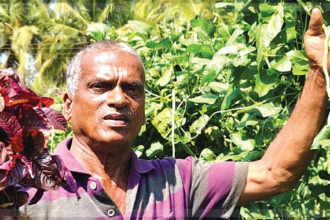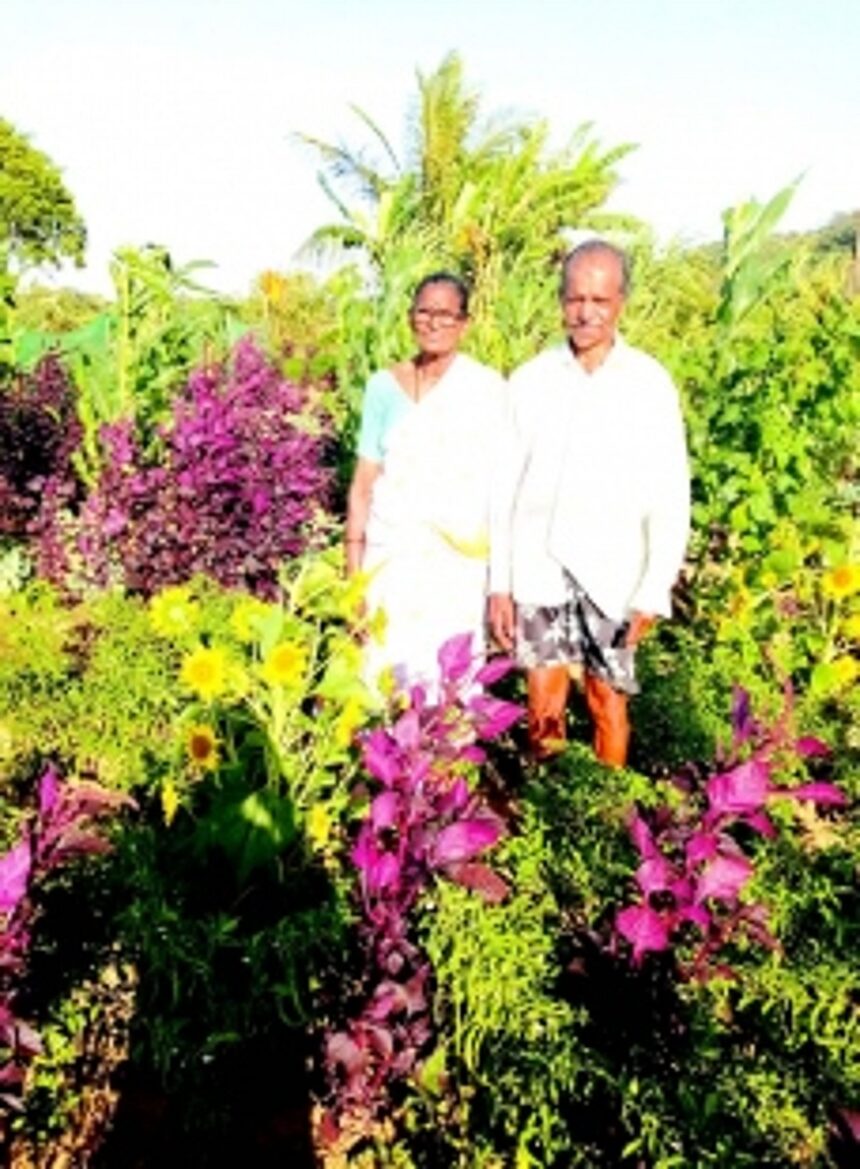
MAPUSA: It’s commonly believed that farming is an unprofitable sector and few farmers prosper. While farming demands time and labour, there are dedicated farmers who thrive. Dashrath Madgaonkar from Guirim is one such farmer. For the past 10 years, he has cultivated vegetables on his 2,700 sq metre plot, demonstrating exceptional land utilization by growing 30 different types of crops, including vegetables, fruits, and useful plants.
Dashrath, one of eight children, is both a rickshaw driver and a farmer. Now 68, Dashrath attributes his love for farming to his parents, adding that he has now been cultivating paddy for more than 50 years. “I studied in Monte Guirim school and our parents instilled in us the love of farming. We used to get up early morning at 4 and go with our parents to work in the fields, then return and go walking to school. After a full day at school, we would return to the farm to assist our parents. Unlike today where children are sent for tuitions, our parents could not afford to give us that luxury. They ensured we gave equal importance to academics and agriculture,” recalls the farmer with a wistful smile.
While growing paddy and driving his rickshaw for additional income, transitioning to vegetable cultivation a decade ago wasn’t easy. Dashrath brought together many farmers in the area and set out to overcome the many challenges they faced in Guirim – wildlife raiding their fields, lack of water for irrigation and soil that needed a boost in fertility. Together, the farmers invested in solar-powered community fencing and dug a well for water, overcoming challenges like lack of electricity. He says he also had to spend a hefty sum to enhance soil quality by buying new soil and adding organic manure. His hard work paid off when his vegetable harvests were bountiful, earning him the admiration of other farmers and visits from people keen to learn how he turned his farming operations around.
Dashrath practices sustainable farming and uses every inch of his land efficiently. With his wife’s support, he grows a variety of crops, constantly motivated to try new things. “I don’t depend entirely on our Agriculture Department for seeds, I procure some seeds from other States. After a high initial investment, I am happy with the high returns, and the fact that people are patronising us and buying our vegetables. We don’t have to sit outside our fields and sell our produce. Customers themselves come knocking and if I have anything leftover, I sell it to the Horticulture dept,” adds Dashrath.
The success however hasn’t allowed Dashrath to lay back and take life easy. His daily routine is still as rigorous as a struggling farmer- it includes early morning work in the fields for about three hours, after which he drives his rickshaw to the stand, accepting fares till lunch time. In the afternoon, he does not go back to the rickshaw stand, but returns to his fields, where he toils until dark.
Predicting agriculture’s importance in the future, Dashrath urges youth to reconsider farming as a viable career. “A time will come when even highly-educated people may have to get into the fields and grow their own food. It’s best to equip ourselves with this knowledge,” he quips.
“I feel happy and satisfied being connected to mother Earth and every season, I make profits from farming. I have never run into a loss so I can say farming is not a loss-making sector if it is done in a well-planned and focused manner,” adds Dashrath.