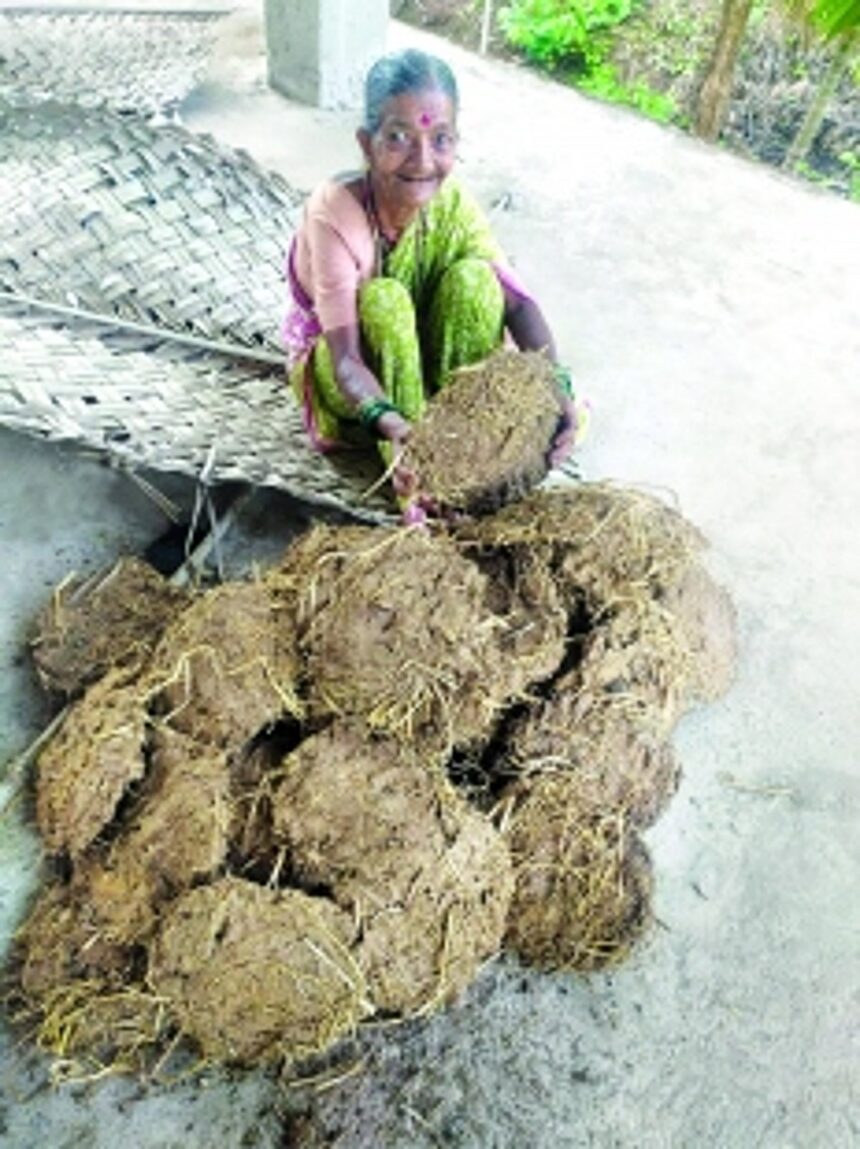
IBRAMPUR: During the auspicious Hindu month of Shravan preceding Ganesh Chaturthi, many families ‘go back in time’ and revive old traditions. Old houses are cleaned or even renovated in a modest manner to herald the family’s celebrations. Even as the modern ways of life take over younger Goans, the older generation is still keeping their old traditions alive, hoping they will stick. One such case is Jaanki Naik from Hankhane, Ibrampur.
Jaanki, 80, has grown-up grandchildren, but is still fit and wiry. “I have given my best in life and still continue to make good use of the time I have on hand,” she says with a smile. She recalls that it was in utter poverty that she spent her childhood, and considering that they lived in backward hinterland areas, it was an arduous task for them to earn a living, more so during liberation time.
“We had to somehow fend for ourselves. Our condition was very bad. Life was really challenging as people were married off young. It was in such a situation that I learned to make cow dung cakes. I must have been around 15 to 20 years when I achieved mastery over it. It’s been over 60 years now, and it’s an occupation I enjoy,” says Jaanki. “Today we have gas cylinders and various sophisticated equipment to be used to cook, but during those times, it was firewood, dried leaves, and cow dung cakes that were used in the kitchen,” she recalls.
“Initially, we used to make cow dung cakes and sell them. I would make about 50 cakes a day based on the orders received, as they were widely used for different purposes,” she says (see box). “Since we had cows, dung was available in plenty. We used to stack these cakes in bags before the monsoons to tide us over all the rainy months, as fuel to cook our food,” she recalls.
Regretting that the tradition of making cow dung cakes is slowly dying out as the younger generation does not want anything to do with them, Jaanki feels that such valuable traditions should be maintained. “Cow dung is available to people who rear cattle. However, you require patience and the love for this work, it is not something dirty, it is our tradition. Today you may not see many cow dung cakes, but people are going back to their roots in different ways. Planters made of cow dung are now promoted,” she points out, explaining that saplings can be planted in these dung pots, which are then put into the ground. “The cow dung pot breaks down in the ground, feeding the plant,” she says, animatedly.
The making of cow dung cakes is an art, and involves mixing hay with cow dung, and when it is used as fuel, it catches fire in a controlled manner, and burns slowly. According to Jaanki, despite all advances in the world, there is still no replacement for cow dung cakes, which are eco-friendly and leave no residue and cause no pollution. “We have been using these cakes since my childhood and never came across any harmful effects. Earlier, the cakes were dried everywhere, on the roads and pathways, but since vehicles have now increased, they’re now dried in one’s own house,” she says.
Reminiscing her youth spent in the cool comforts of a cow-dung house, she says the house was a natural mosquito repellent. “Today, we see cemented floors, tiled floors, marble floors, but the irony is that lots of tourists pay good money to stay in mud houses with cow dung floors. So in a way, despite all advances, our traditions still hold value today,” she quips.