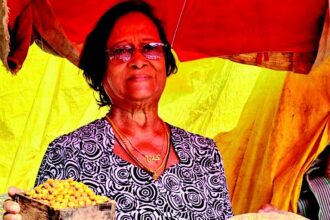
SIOLIM: As the cockerel crows in the waking hours of the morning, Julie Fernandes opens her eyes to his song. The octogenarian’s frail eyes are unable to make out the numbers on a clock anymore, but this natural alarm is the only one she needs.
She gathers her goods and heads off to Mapusa market, oftentimes one of the first people to arrive and last to leave. Her trade: Selling country chickens; something she has been doing almost all her life.
During the era when the Portuguese still ruled Goa, Julie’s tale began; a tale fraught with responsibility, love, grief and what it meant to endure despite the circumstances. At the tender age of 11, most children enter puberty, where fun and games and fun take precedence above everything else. However, this was not the case for Julie, who as the oldest of six children, was thrust into taking responsibility for her younger siblings when her mother had taken ill for a prolonged period of time.
Julie remembers the bumpy bullock-cart ride to Sal, Assonora as her grandmother’s aide in selling homegrown seasonal vegetables. Once there, they would procure local bananas, which they would ripen, and then resell in Mapusa market for 5 paise per dozen. A price like that is unthinkable now, but back then, prices could further drop to even half a paisa per dozen. With what little they would make from that, Julie learned how to run the household.
As time passed, her grandmother passed away, but her mother had finally got the treatment she desperately needed, much to Julie’s delight. Again, Julie ventured to Mapusa market as a young girl, this time by her mother’s side, and with a new product, country chickens.
A hen or a fowl sold for 25 paise, while a rooster sold for 75 Paise. For the sake of comparison, chicken is presently sold for Rs 500-700 while local roosters cost nothing less than Rs 1,200-1,500. She remembers the time when she traded in escudo.
Country fowl were fast-selling in those days because trade was limited to locals, and there weren’t any broilers available. This was the way things went for Julie every day except for Mondays when they would take the bus to Sawantwadi and Belagavi, buy the chickens, and then walk to the market to sell them.
The Portuguese were the biggest clients. They had a particular affinity for buying roosters, and this was good for Julie and her family. Luck seemed to have smiled on them because life was better now that her family was doing well with the excellent business coming in. It was hard work, day in and day-out, come rain or shine, to sell the birds and make a living. But Julie never shied from it. She did what was necessary to help her mother and her family.
At the age of 19, Julie fell in love and got marriedIt was an inter-religious marriage. All that mattered was love and not religion.
Even after marriage, Julie maintained her business of selling chickens, only now to make a living for her and husband as they built a life together. She enjoyed 11 years of married life and had four children.
Unfortunately, Julie’s life took a turn for the worse when her husband was found murdered, his body stuffed into a trunk. To date, the case has not been solved.
Heartbroken, alone, and with no closure, Julie went into a dark place. Losing the love of her life so gruesomely sapped her moral and physical strength to go to the market or do anything else. She and her kids reached a point where they had no place to live, except for a small hut. With no income or support from anyone, Julie and her four kids were starving.
Then one day, salvation came in the form of a friend named Champa, who seeing the hardship sh
e was under, bought Julie and her family some groceries. Champa told her that despite all that she had endured, she needed to get back onto her feet. Finally, Julie managed to gather the courage to get out of the hut the next day, but when she walked to the market, she had not a penny to her name.
This time, help came from a place she’d never thought of; pygmy collectors. Back in those days, pygmy collectors were people who would collect all the cash earned by shops and sellers and deposit it into the bank for a price. These collectors generously provided her with the saving grace to make a life again. They would lend her Rs 100, which she then used to start her chicken selling business again.
Julie would travel to places like Assonora, Belagavi, Siolim, Calangute, Mapusa, Pernem, and Sawantwadi to conduct her business. After selling the chickens and making a profit, she would return the principal amount to the pygmy collectors, who refused to charge her an interest.
Bit by bit, Julie scrimped, saved and once again built a life for herself and her children. After years of hard work, she saved enough to accomplish her dreams of building a house and marrying off all her four children.
As time has passed, the world has grown and so has lawlessness, she laments. She remembers there was a rule of law once, during the time of the Portuguese, where people were afraid to even raise their voice against another, let alone get into fights. Nowadays, she says, lawlessness rules in the marketplace, and fights, cheating and thievery are common. Despite police patrolling the market, there is no fear of them as thievery happens in broad daylight.
She herself was robbed of cash on multiple occasions, and once of her gold, but that hasn’t deterred her.
Touching 80 years of age, her once nimble feet now drag as she walks to the market, undeterred by the hardships of life that she has become accustomed to. She is now wiser to the ways of the world, and has survived some of the harshest things imaginable, but she vows to keep going as long as she is able.
Julie’s advice to the world and specially to the youth is to be positive despite the hardships. She encourages people not to shy away from blue-collared jobs, because what matters is the effort one puts in. Risks are a given in any business – there were days she lost entire flocks to bird flu, she says – but that did not stop her. Better days awaited her just around the corner.