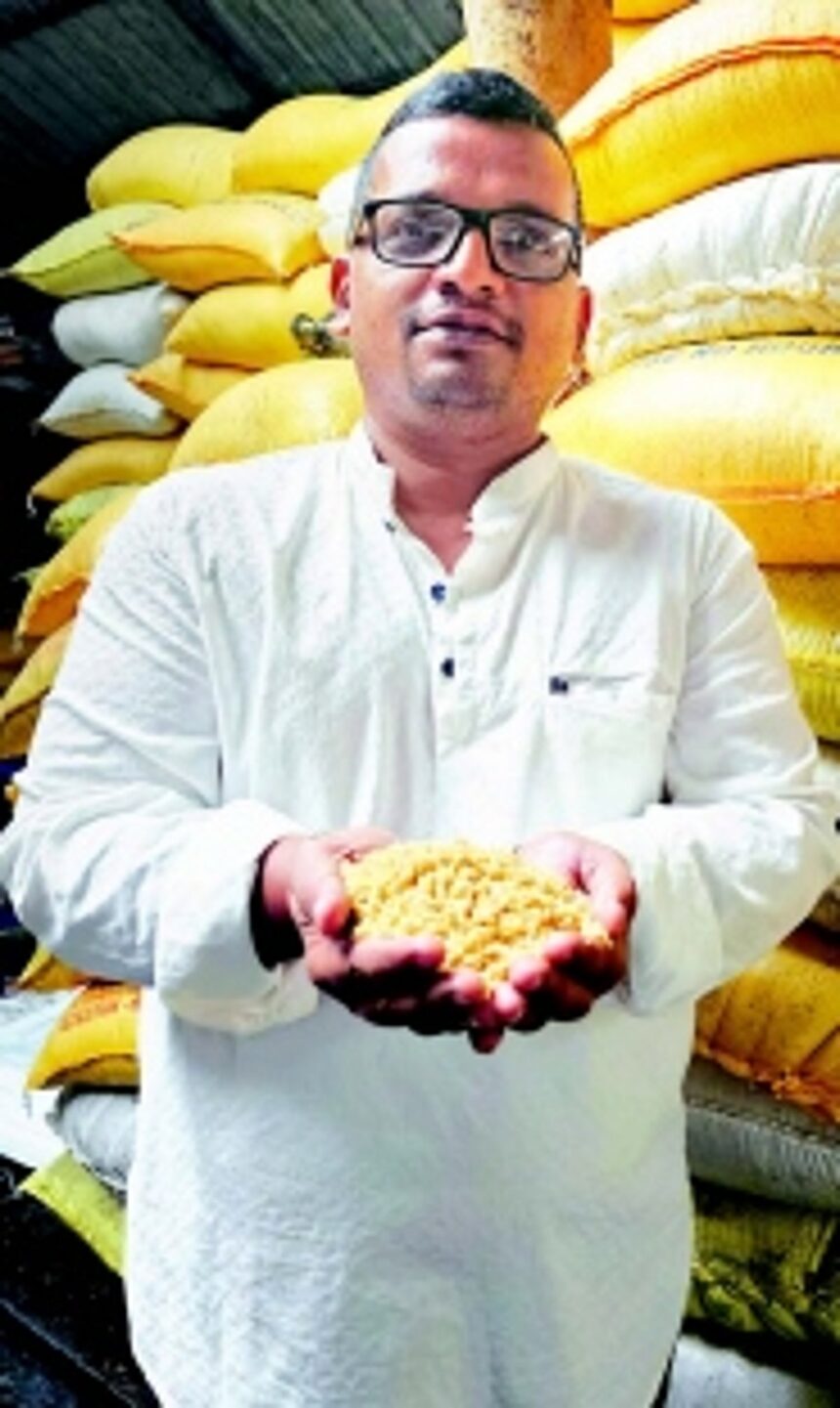
MARGAO: Although 63 years have passed since Siddesh’s grandfather, Ramnath, initiated this wholesale business, most of the traders who used to sell local salt on a wholesale basis have now shifted to other ventures. This shift is due to Goan salt being one of the cheapest commodities in the market, with minimal profit margins.
Furthermore, storing Goan salt presents logistical challenges, as it tends to retain moisture and keep dripping, requiring storage on the ground without tiles, concrete, or any other flooring type. These issues have led most customers to prefer packaged salts. Additionally, a past policy decision by the Central government to promote the consumption of iodised salt has further reduced the demand for traditional salt.
However, quitting this trade was never an option for Siddesh, as it is not just a business but a means of preserving the legacy of Goechem ‘mitth’ (Goan salt). “First and foremost, as a Goan, I empathise with my fellow Goans who struggle to sustain their livelihoods despite hard work. This motivates me to continue this business and promote salt and its associated way of life,” Siddesh added.
With an engineering background, Siddesh had other career options, but he felt that leaving the salt business would deprive both buyers and sellers of a significant trading point. Siddesh’s customers come from various parts of South Goa and even from the North, such as Mapusa.
“I do this out of love for my land. Given the current trajectory, Goan salt may vanish entirely. This is a part of our heritage and identity, and Goa is blessed to have this natural resource. In the past, there were numerous salt pans in Goa, but their numbers have dwindled, with only 8-10 salt pans remaining,” Siddesh lamented.
He asserted that the primary focus should be on supporting salt pan owners in maintaining their salt pans. Labour is also scarce, as workers endure scorching heat during the salt production season, which typically runs from March to May.
Siddesh cited examples of salt pans in Navelim, Ambelim, Candolim, Morjem, Mandrem, and others that have dwindled, leaving only a few, like Nerul and Curca, among others. The loss of salinity in water bodies, such as Dialgon in Navelim, contributed to salt pan closures. Many salt pan owners have opted to sell their land for commercial purposes, as operating salt pans is challenging, and they generate more revenue this way. In this context, Siddesh holds great respect for senior citizens who are still maintaining their salt pans.
Siddesh, now 45 years old, gained a unique perspective on how the ecosystem functions when he joined his father’s business in 1997, at the age of 18. His late father, Laxmikant, established the shop, Om Sai Depot, located near Malbhat on the Old Station Road in Margao in 1975.
“Tradition still plays a significant role in how this business operates. Initially, there was a gap in terms of where customers could purchase salt. They could either go directly to the salt pans or buy it from vendors who went from house to house. My grandfather’s place served as a junction in Margao where customers could buy salt brought from the salt pans and stored in an open ground outside his place in Malbhat,” Siddesh explained.
When ice plants were established across the State, the demand for traditional salt increased, prompting his father to open the shop. However,
later on, the ice plants shifted to white salt due to ease of procurement and storage. Siddesh’s family, though, did not abandon the business entirely, as many
locals with traditional occupations continued to purchase salt from them, albeit in smaller quantities.
Siddesh’s customers include vendors selling Goan sausages (chourico) in the markets, as well as those who buy salt for pickling and preparing ‘xit koddi’ or fish or vegetable delicacies at home, and some elders even use it for customs like ‘disht’ (removing evil eye). There is a surge in demand during the ‘Purument’ season when vendors buy salt for fish drying. Some purchase compressed salt for its perceived medicinal value in relieving aching bones and frozen joints.
Siddesh concluded, “This ‘made in Goa, sold in Goa, and consumed in Goa’ product offers a wealth of insights about Goa. Outside Goa, it is known only in Karwar or Gokarna. I hope our red salt receives a Geographical Indication (GI) tag to help preserve this commodity for future generations.”