MARGAO: In the heart of South Goa, amidst the lush landscapes and tranquil villages, lies a unique tale of innovation and tradition intertwined. Nestled in Gorvotti-Nuvem, Jose D’Costa, a former second engineer on a ship, returned to his roots with a vision to revolutionise a common farming practice.
Observing the challenges faced by local farmers and inspired by his expertise in handling boilers during his tenure at sea, Jose embarked on a journey to streamline the production of a local favourite: Ukdo rice, also known as Goan parboiled rice. The local name is derived from the word “ukadd,” meaning ‘to boil’. One may find Ukdo rice in the fish thali preparations at local restaurants or being served at lunch in the homes of many Goans.
For perspective, parboiling involves soaking, steaming, and drying rice paddy before milling or hulling. This process helps retain vitamins and minerals, improves texture and shelf life, and also increases the fiber content of rice.
However, the traditional method often proves labour-intensive and time-consuming for farmers. Determined to offer a solution, Jose in 2017 began crafting custom boilers from stainless steel, which were tailored to the specific needs of rice parboiling. In response to the query, he mentioned that he didn’t receive or seek assistance from the government. Instead, he took the initiative on his own, with encouragement from the farming community, to create this new system.
Finally, in the year 2019, these modified boilers were put to mass use, marking a significant departure from the conventional practice of parboiling.
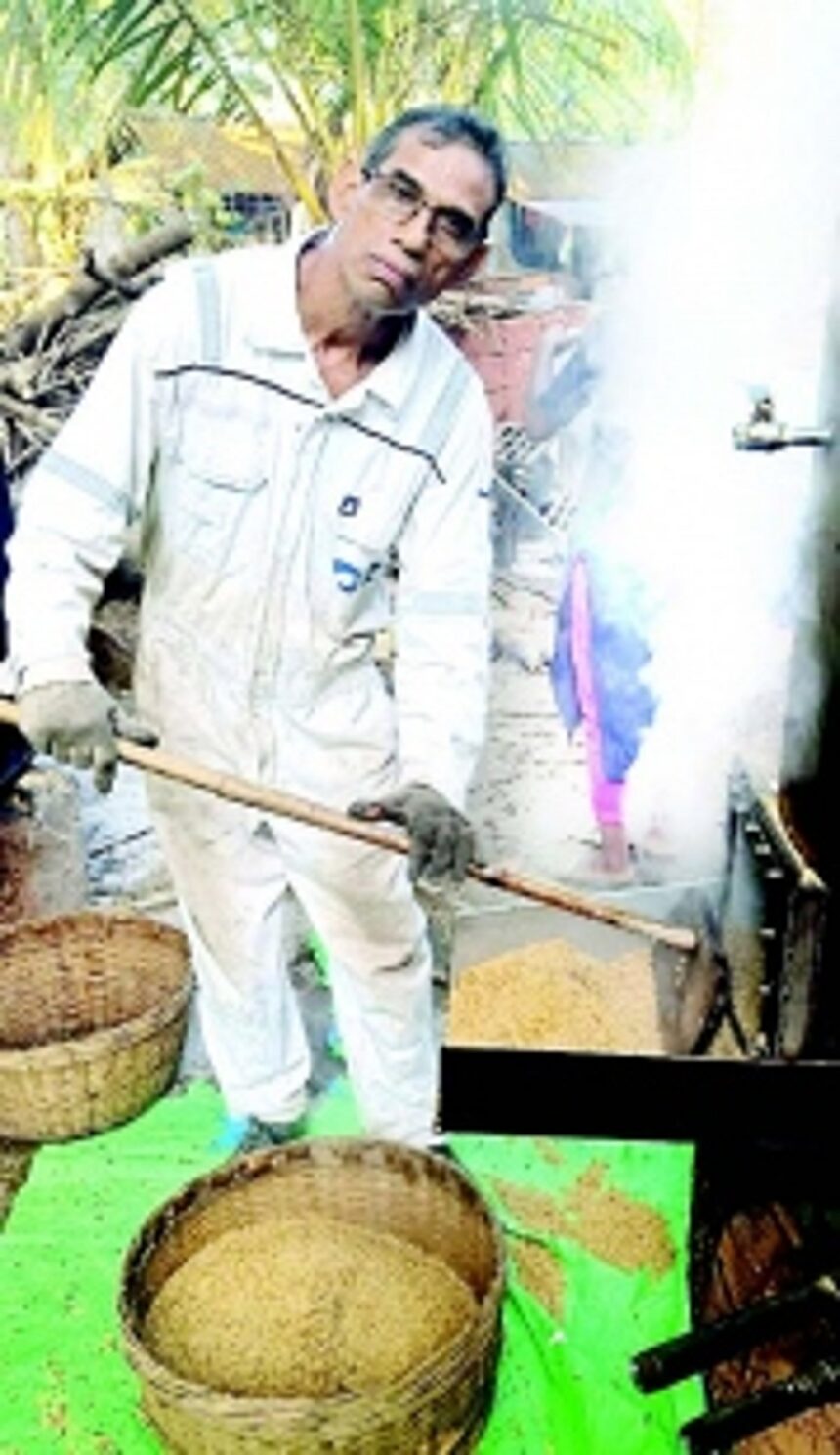
The innovative approach introduced by Jose significantly reduced both the time and costs associated with parboiling rice. By leveraging his intricate understanding of boiler mechanics, Jose devised a streamlined process that involved soaking the rice overnight before subjecting it to controlled steaming. Water is carefully poured into the boilers at around 5 in the evening, with the rice following suit, poured with husk. Unwanted elements float to the surface, which are removed.
Overnight soaking also allows the grains to absorb moisture, priming them for the steaming process.
At the break of dawn, the fires beneath the boilers are kindled, initiating the steaming phase. After three hours of meticulous monitoring, the rice emerges, tender and infused with nutrients, ready for drying. He added that the time required varies for the different types of rice varieties, and that it is not limited to any single particular rice type.
While the traditional methods require days for completion, Jose’s technique yields results in a far quicker time frame, thereby minimising labour costs and maximising efficiency.
Furthermore, it preserves the nutritional integrity of the rice through high-temperature steaming.
Moreover, the reduced moisture content achieved through this process ensures that the rice dries quickly, eliminating the risk of spoilage.
Besides being good for eating, Jose emphasised that another benefit is the significantly reduced rate of rice breakage during the milling process.
He also pointed out that each boiler has a capacity to accommodate 15 bags.
Farmers, who are his customers, acknowledge that this is a more robust, efficient, and economical solution for large-scale parboiling operations. D’Costa also offers low-cost services for either just the steaming or both the steaming and dying process, with women labour helping with the drying part.
The trust built between D’Costa and the famers, the easy access, and no compromise on quality have been the reasons why farmers from various parts of Salcete taluka including the coastal belt, have been making a beeline to his place.