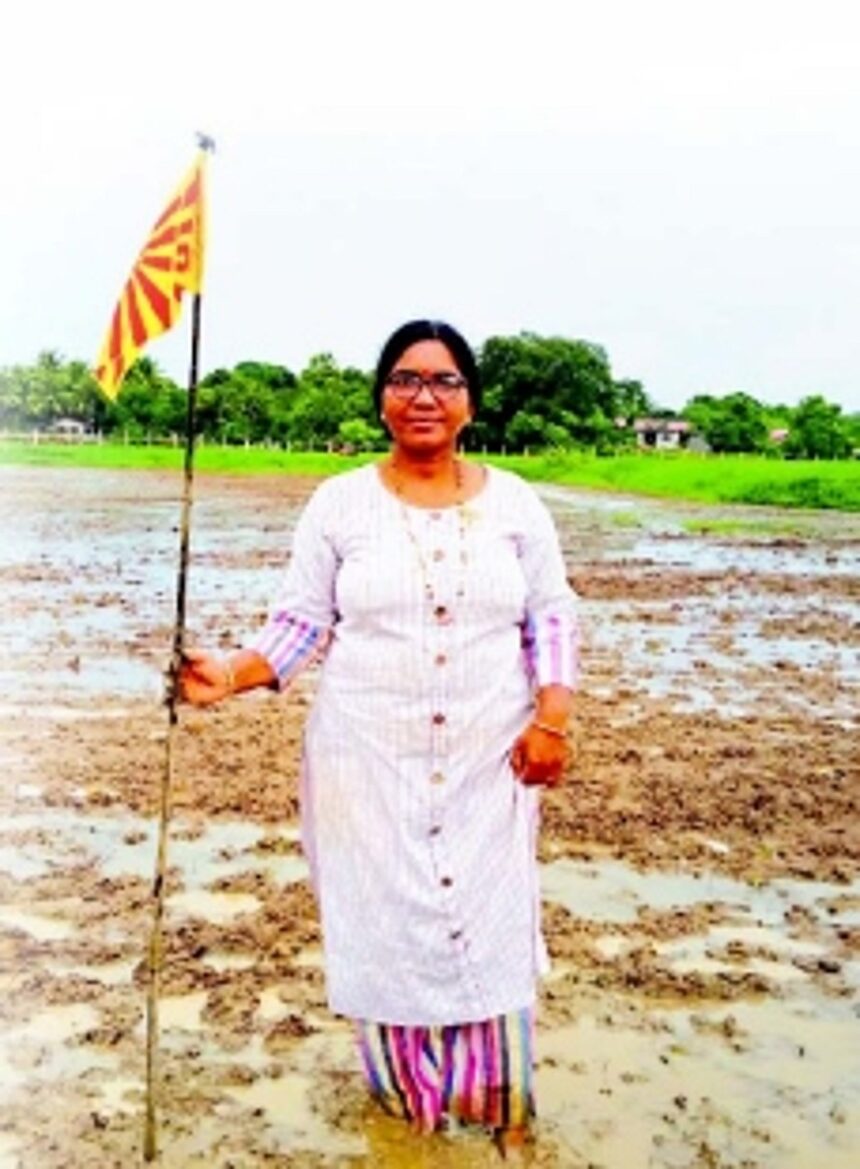
ASSAGAO: Ashwini Sabaji Pokre, originally from Shiroda-Ponda, grew up in a well-to-do family. Reflecting on her upbringing, she admits, “Our family was well-off, and so I hardly ever realised the real meaning of life because everything seemed to work out conveniently for me.” Ashwini acknowledges that she used to be quick-tempered, although very organised in her life. Her major flaw was that she would often lose her temper with her family or close acquaintances. However, it was around the time of her marriage that destiny took her on a different path, and she discovered that the true meaning of life is to live for others. Now, Ashwini practices sustainable yogic farming, a unique form of agriculture that combines thought-based meditative practices with methods of organic farming, a brainchild of the Brahma kumaris spiritual movement.
Recounting how she chanced upon her new way of life, Ashwini says, “One day, my well-wishers, friends, and even my sisters suggested I join the Brahma Kumaris movement just for a few days to see if it made any difference in my life. I decided to give it a try, thinking I had nothing to lose but could possibly benefit from it. Things really changed for me, and I felt that I am here on a mission that I must accomplish at any cost, or else my life would be useless.”
Life wasn’t easy when Ashwini first got married and moved to Assagao. Her husband, Sabaji Pokre, was initially skeptical about the Brahma Kumaris movement and even cautioned her about attending their classes and meditation sessions. “Since it was new to him, he felt I should study their functioning and their work before joining. He did not discourage me but cautioned me to think and act wisely,” Ashwini recalls.
Adjusting to a new household and living with in-laws posed another challenge for Ashwini, but she was determined to create a positive atmosphere in her home. “I would travel by bus to Porvorim to learn more about this movement and to get enlightened. Sometimes it felt like I was traveling a great distance, as negative thoughts kept weighing me down like a heavy burden. There was even a time when I took my young son with me on the bus, my mind blank, not knowing how to manage all the family struggles.”
But the struggle did not last long. Ashwini emerged as a new person, ready to reach out to others and help them overcome their struggles. She began conducting meditation classes in her home twice a week and also ventured into social service and farming. She introduced the concept of yogic farming in Assagao, where positive energy is channelled into the crops, resulting in a good harvest without the need for manure. She encourages people to be instruments of positivity in their lives, in society, and among plants.
“Sustainable yogic agriculture has resulted in lower costs to farmers and reduced the pressure on the environment. We also see improvements in farmers’ emotional well-being,” says Ashwini, who cultivates paddy with the help of her students and farmhands. The entire process is organic, requiring minimal fertiliser and pesticides. She plans to soon begin growing vegetables as well, after the rains.
“For me, the whole universe is a fine artwork of the Creator, and as part of this creation, we need to respect it, value it, and promote it. There is positivity hidden within us and in our surroundings. Since I joined this movement about 10 to 15 years ago, I have managed to bring about many changes in families, instigate a revolution by spreading positive energy among crops and plants, and ensure they get a personal touch,” she says.
Ashwini emphasises that the values and concepts of the Brahma Kumaris are often misunderstood. People mistakenly believe that it
requires sacrificing everything and adopting a life of renunciation, but she clarifies that this is not the case. “It’s all about spreading positivity and respecting life and this creation.
Ashwini’s ultimate goal is to expand the concept of yogic farming and bring more fields under cultivation in Assagao, reaping a big harvest through this unique approach.