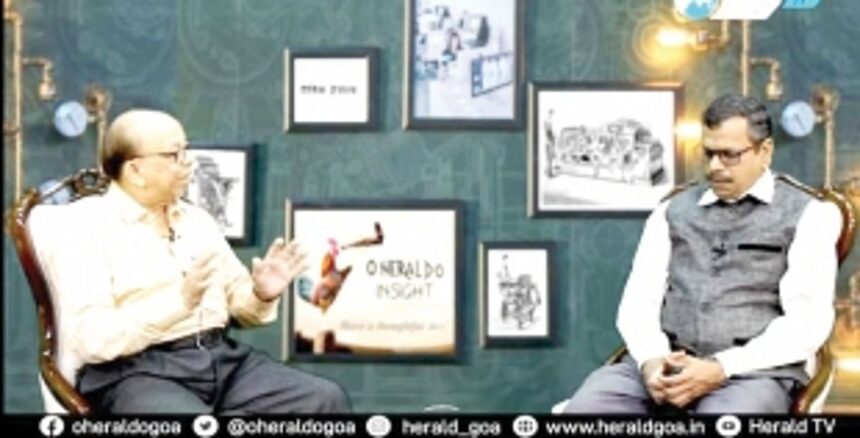
Avit Bagle: Prasanna, your name has a history. Apparently Sane Guruji suggested the name during your naming ceremony?
Prasanna Utagi: Yes, that is true. Sane Guruji was my mother’s putative brother who had greatly contributed to India’s freedom movement. I was born on August 5, 1947 and everyone was almost sure that the Britain’s Union Jack would be taken down on August 15 in order to hoist India’s tricolour. Guruji suggested that since I was born during the time of independence, I should be named Prasanna which means cheerful.
AB: Solapur and Goa shares a unique connection. Solapur’s Dr Dwarkanath Kotnis who originally hailed from Pernem assisted aid to Chinese soldiers. How was the Solapur that you witnessed as a child?
PU: I was born in 1947 and spent around 5-6 years in Solapur. We were staying in the outhouse of Bakshi Bungalow which was facing a huge fort and there was Subhash Chowk on the left while a library to its right. The public meetings held in Subhash Chowk attracted tremendous crowds. My father was a reporter in Solapur Samachar newspaper and I remember attending those Chowk meetings as a mere 2-4 year old.
AB: So it’s safe to assume that you picked up enthusiasm for social service from your father then. Do you remember any of the meetings?
PU: I don’t really remember the content of the speeches but the energy and style of the speakers had a huge impact on me. Sane Guruji has written a book on my mother and two of the main characters in it are my father and his friend Bhau Phatak who was a teacher. The book speaks about common men’s contribution to the freedom struggle and how they were supported by people like my mother.
AB: After Solapur you shifted to Bijapur, then to Mumbai and then Belgaum. Any childhood memories that you remember though scattered all around these places?
PU: I was admitted in government school near the library in Solapur. That was my beginning in Marathi medium. My father left Solapur Samachar and joined Gavkari which was based in Nasik. Later he shifted to Lokmanya in Mumbai and finally joined the editorial team of Acharya Atre’s Dainik Maratha. Since there wasn’t any option my mother took me, my two elder sisters and a younger brother to her mother’s place in Hirsi village of Indi taluka in Bijapur.
AB: Bijapur is a Kannada-majority area. Do you understand the language?
PU: I don’t know to converse in it much but I understand most of it. I was admitted in a Kannada medium primary school there. I remember carrying a jute bag on my back and a slate. The classes were held in a temple on the border of the village. Soon after a year we were shifted to my aunt’s house in Gundgao where I studied for a year and a half. Later father took us to Mumbai in 1956. So I have witnessed the hard life of farmers, cowherds up and close.
AB: What difference do you notice between the life then and now?
PU: A woman who used to work in my aunt’s field would take us to her home for meals. The warmth that local meal carried cannot be fulfilled by today’s sandwiches and burgers. The people who were financially poor were rich as human beings. Sane Guruji’s biggest teaching to us was that a human being should treat a fellow human with humanity.
AB: Could you describe your journey from childhood to youth?
PU: Father had managed to find us a 10×10 room near Musafir Khana in Mumbai’s Crawford market area as we couldn’t afford a house there. The arrangement was done by father’s good friend and a leading figure in the movement for labourers in Maharashtra, S S Mirajkar. We resided there for four years and I can say that’s where I came in contact with movements for workers. I was in second standard in Janabai and Madhavrao Rokde Marathi School.
AB: When did you come to Goa?
PU: I came to Goa in 1969. I worked in Bank of India’s Margao branch. Before that my father left Dainik Maratha and joined Vishal Maharashtra newspaper based in Belgaum. H V Dessai from Pernem was its chief editor. I studied in B K Model and Gokhale College, Belgaum where I was selected as the best NCC cadet. Through that I went to Mount Abu for army course. Kashinath Tendulkar’s younger sister Prema Tendulkar who was working for Goa’s freedom movement was taken to Khanapur and then to Mumbai after she endured a bullet in her knee. She was my father’s putative sister and I was given the responsibility to accompany her when she was staying near V T Station. Datta Deshmukh, comrade Krishna Melse would visit us. Dada Narendra was working in Bank of India and there I got the opportunity to work in the bank.
AB: Despite being a bank employee you chose to work for stall owners in Margao. What exactly was the issue about?
PU: Narayan Palekar, Kakodkar, Prabhakar Ghodge, Narvekar etc would gather around to talk after the shift. News about removing the stalls from the garden area and station road in order to beautify Margao had been published. We prepared a report mentioning the stall owner’s names, their addresses as well as how the entire families were dependent solely on these shops. We raised the question whether the municipality has made any alternate arrangement to help these families survive. We brought it to the attention of MGP leader and the then chairperson Gavandalkar that majority of these shop owners belonged to Bahujan community. He understood the issue and the respective resolution was taken back. My contribution was too little in this. The workers of Bhartiya Yuva Mahasangh helped a lot since I was a local president. I was official of Bank of India Employees’ Union in 1970. I was aware of the problems of working classes since I was involved in union for handloom craftsmen in Belgaum. As Anna Bhau Saathe once said that the world stands on the hands of labourers and not on the hood of Lord Vishnu’s snake, I handled the question as a supporter of his ideology.
AB: There was a threat to your job because of your rebellious nature. The employees in cooperative banks today earn well due to the contracts that you brought into practice.
PU: My first attempt to draw a contract was for Goa State Cooperative Bank in 1971. Then in April 1974 I did it with Goa Urban. The workers from various shops who would come to the bank would say that I resolve the issues pertaining only to my field. That time there were unions for mine and port workers but there wasn’t any for the labourers who were not part of any organisation. Hence, I established Goa Shops and Industrial Workers Union. MGP government implemented The Goa, Daman and Diu Shops and Establishments Act which has lot of provisions for workers not associated with any unions. Canacona based lawyer called Gaonkar had his office in Margao from where I would work for these workers at night from 8 to 10 pm. I sent letters to shop owners in Margao stating that they should do certain things for their workers based on the provisions mentioned in the law. I also sent a copy of this to labour commissioner which attracted huge attention. That was the time when nationwide emergency was implemented which brought limitations on our civil rights. But I kept my work going. One of the traders who was our bank’s customer handed over his worker to the police, accusing him of theft. His fellow labourers came to me and so I rushed to the station and helped him get the bail. The trader obviously did not take it well and wrote a letter against me to my bank’s chairman and naturally the chairman wrote about the issue to branch manager. While presenting my side I made it clear that I didn’t lack in fulfilling my job duties towards the bank and according to Indian Constitution, I have the right to form a union. Besides, I was official of the union which was legally registered and so I told them to take the decision as per their will. The case went on for nine months. In the meantime, I took a visit with the respective trader and told him that his worker was forced to steal only because of the situation created by him. The solution on that was to pay him his rightful amount of wage. Later I even managed to get that worker a rickshaw through a bank loan.
AB: Currently you’re writing a book for people to understand the economics of capitalism. Could you tell us more about it?
PU: The Earth functions because working class functions. First there was slavery then came feudalism and now it’s the era of capitalism. In capitalism, the profits are snatched by the owners of the equipments used for the production and there is no equal distribution of it. Karl Marx has written about this in his foundational text called Das Kapital and it took him 15 years to finish the book. Two more volumes of this text were published later on. If these rules are explained in simple language then intellectuals who are willing to contribute to the betterment of society can be produced. Tarkateertha Lakshman Shastri Joshi would say that give a man such a thought that he would help you to change the society. Govind Pansare was of the idea that a worker involved in any movement should be a thinker. To become such a studious and scholarly leader, one must also possess skills to write his thoughts in articulate manner. I will not only write but will also explain. The workers will not realise the importance of their historical work if they’re not made to realise the dynamics. In all likelihood the book could be published in next 4-5 months.
AB: You have completed 75 years of life. What do you think when you look back and introspect?
PU: Along with the changing economy the lifestyle of the workers has changed as well. Those who wrote the Indian Constitution aimed at reducing the inequality as the society progressed. The centralisation of property should have stopped but there is no definite implementation of this. Instead of free trade, the economy is becoming more and more monopoly oriented which is why there is centralisation of power at the government level. Only a handful of businessmen are controlling an entire nation’s economy and the government is agreeing to their decisions. The government is collecting common men’s money through GST while only selected conglomerates are given the benefits in property as well as corporate taxes.
AB: Do you think that the collective sensibility of the community is on decline?
PU: There are 15% of people who lead luxurious life whereas 80% of community is deprived of even basic facilities. It’s a fact that everyone agrees upon, but no one volunteers to bring in the resolutions that are mentioned in the Constitution. We are living in an unannounced, unofficial emergency to be honest. The irony is that the tribal and indigenous people fighting to safeguard forests, land and water are imprisoned under UAPA while the corporates who have set out to loot the tribals off their lands are given full freedom. That’s the harsh reality.