Nestled in the bylanes behind Holy Spirit Church, is the ancestral house of Joaquim Felipe Roque Correia and the home of a 113 year old legacy – a legacy that has been kept alive by four generations of the Correia family – the oldest religious wall calendar published in the Portuguese language, a feat unrivalled in the whole of Asia – ‘Almanac de Parede’.
The calendar was first published in 1903 at ‘Tipografia Progressa’, the printing press owned by the late Joaquim Correia who was also known as a ‘Calendarist’ who knew everything regarding calendars, including religious calendars .
Much later, when his grandson, advocate Eric Correia was a student at St Xavier’s Ahmedabad, he would be enthralled with the workings of the printing press that was being managed by his uncle Domingos Xavier Carlos Correia, Joaquim’s eldest son who was also an award winning Pharmacist.
After Joaquim passed away in 1969, his son Domingos, an award winning pharmacist spent a lot of time and energy on the calendar and the printing that required a lot of physical work at that time where every alphabet had to be made. Domingos passed away in 1994 after contracting jaundice and his sister Elsa Ena Correia, a government primary teacher and recipient of the state award in that field, took over and ensured that the calendar was published even in her mid eighties. After her death in 2012, advocate Eric, the son of Joaquim’s seventh child Olav Sebastiao Correia- an employee of All India Radio and Doodarshan- along with his wife Sheila have been running the show and for them there was never a question or doubt about shutting shop.
“There has never been any doubt it. For us this has always been about total continuity,” said Sheila who is helped by her son Jonathan and daughter Ana Paula in compiling the calendar which is done at their home, the ancestral house.
Sheila who hails from the De Souza family based in Candolim reminisces about her aunt Elsa who used to often have long conversations with her about how she would look after the calendar, the people her aunt would work with to bring out the publication. For instance, there was Augusto Vas from Nagoa who was grew up under the tutelage of the late Elsa and worked at the Tipografia Progressa ’and another man who had a big role in bringing out the calendar is Laurence Coutinho of David and Company, that still prints the calendar and has even suggested modern changes that were incorporated. The calendar no longer has details about telegrams and its rates but instead has website links to key government portals.
A conversation with Eric and Sheila about how their late aunt, uncle and grandfather nurtured the publication from scratch to what it is today speaks highly about the passion that still motivates this the family, for whom the publication has not only been about printing it; but a way of life for them.
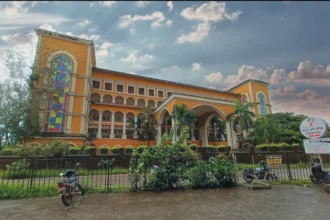
As you walk around their house that has the typical Portuguese architecture that dots the Borda roads you will see the original board of Tipografia Progressa and they walk you through where the printing press was located and they even the recall the sounds it would make, the hand action required and you can see Eric and Sheila swell with pride and emotion as they walk down memory lane. Adoring their walls are various portraits of the family of the late Joaquim and his eight children, their families and the walls, the floors the old furniture have all played their part in this timeless labour of love and zeal for providing the thousands of their readers unknown to them, the cherished annual calendar.
Every year they print 1,000 calendars which are distributed at select book vendor stores like T G Borcar, M P Raikar, Emmanuel Printers, Zito Almeida, Tip Nacional, Epifanio Silva, Infant Jesus as well as Fundacao Oriente.
“We also post 125 almanacs to Daman every year,” said advocate Eric who expressed how amazed he is with the kind of reception and feedback their calendar receives from Goa, India and Europe.
Writer Frederick Noronha who has profiled the calendar issues speaks about the response it has received abroad and gives the example of Patrice Reimens, an Amsterdam-based ‘who long back was keen to lay his hands on a couple of copies, one for a friend in Romania’.
“But, in the past, the almanac wasn’t just a quaint collector’s item. At its peak it sold some 5000 copies,” said Frederick who was given the statistics and information by Elsa herself about the Goa’s only annual publication in Portuguese language. Frederic explained how these varied calendars that come out before the year end have been a long tradition in Goa in the past were called Almanacs – a kind of detailed calendar, that goes beyond just giving you the basic information about what date falls on which day of the week.
“I think these calendars play a useful role in informing us about what’s happening where in this small region. Otherwise, even newspapers don’t adequately cover the fairs and festivities — that are, really, such an important part of society’s life here,” said Frederick. He adds that the Almanac de Parede is a double A3 piece of paper, printed black and white, very traditional.
Incidentally, the calendar even had information has dates of government holidays for which the Correia family has to wait for the government gazette to release the information before publishing the fresh set of dates each year.
“So what is the Almanac all about? It is a tiny religious calendar which contains vast amounts of information that gives the days and names of the corresponding saints, the annual religious feasts,
public holidays, hindu festivals, the phases of the moon, the Holy week, the cost of postage and rules of etiquette in sending telegrams. The calendar is also used to give names to new born for example the 13th of June is the feast of St. Anthony, the son would be called Antonio or daughter Antonia,” said P Mesquita in the O Clarim, published in 2003.
Besides the calendar, the printing press would publish a lot of Portuguese literature including a recipe book called ‘Liuro De Cozinha Goesa that was edited by the late Joaquim and various educational text books that were even printed for various educational institutes of the Jesuits and Salesians.
In fact, according to the feedback the calendar receives, several schools used to check the calendar while fixing dates for the school as they could check for events of significance.
There are still some readers who receive the calendar since the 1960s and have written in various forums about how Almanac de Parede is an invaluable contribution to Goan culture.
Incidentally another aspect of the printing press was that they would print ‘rolls’ that were chits that carried information announcing deaths and details of the funeral and there were people who would engage in distributing these chits to the houses in the neighbourhood. There were even orders for printing names on the wreath in Portuguese. “The calendar was always prepared before December 3 as there was a man who would go every year and distribute the calendar at the St Francis Xavier feast and Novenas at Old Goa,” said Eric while talking about the readership of the calendar. He shows a diary that his aunt and uncle would keep where they would personally keep handwritten notes of all the records of the calendar such as the people who had ordered it, if it had got delivered and the expenditure and costs. In the past, it cost 25 paise while today the price is ten rupees for the single newspaper-sized sheet, printed on one side.